

Steve Yzerman spent seven weeks unable to trade Dylan Larkin, and it may have cost him his job. Now the man who could not move Detroit’s captain is gone, and the easy read is that the trade just got closer. Read it the other way. The likeliest outcome in Detroit is now the one nobody is planning for, and it is the same one Yzerman’s exit makes more plausible, not less: Larkin stays.
That is not wishful thinking about a happy ending. It is what happens when you separate the two things the trade has always depended on. One is the market, which was frozen and remains frozen. The other is the relationship, which was broken and just got a reset button. Yzerman leaving changes only the second one. That turns out to be the one that matters.
The Standoff Yzerman Left Behind
Start with what did not change. Larkin’s trade request, first reported by Elliotte Friedman on June 4, is still open. His approved list, Florida, Minnesota and Vegas, then Dallas added in early July per MLive’s Ansar Khan, is still four teams long. And not one of them has produced a deal.
Seven weeks later, the request is exactly where it started. What changed sits one level up the org chart. On July 15, Detroit moved Yzerman from general manager to senior advisor, with Governor and CEO Chris Ilitch running the search for the next head of hockey operations. The captain’s future is no longer Yzerman’s call. It is the first item in the new boss’s inbox, and it will be decided by someone who has never told Larkin no.
Read Friedman’s Own Words, Three Weeks Apart
Here is the evidence that the change is real and not cosmetic, and it comes from the insider closest to the story contradicting himself in the best possible way.
On June 22, three weeks before the front-office change, Friedman was blunt on the 32 Thoughts podcast: “I think they’re going to trade him. I think Yzerman looks at it like we have to move on.” That was not hedging. That was the league’s most plugged-in reporter saying the relationship between the GM and the captain had reached the point of no return.
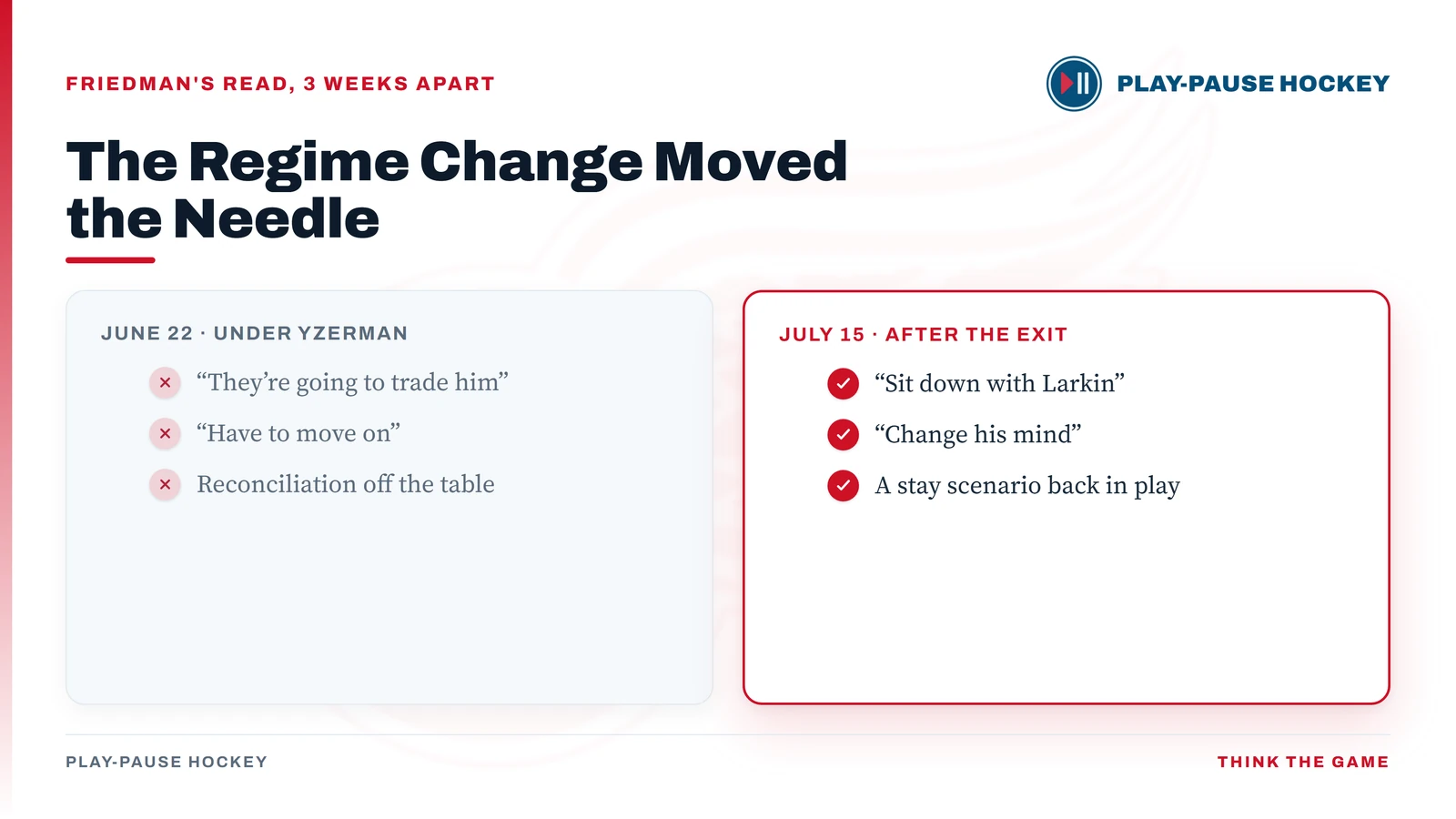
Then Yzerman was gone, and the same reporter’s read moved with him. On NHL Tonight the day the change was announced, Friedman floated a different picture entirely:
“I see a world where somebody comes in and takes this job and says, ‘I want to sit down with Dylan Larkin and see if I can change his mind. Sell him on a plan.’”
Friedman's June 22 comments were made on the 32 Thoughts podcast; the July 15 remark was delivered on NHL Tonight the same day Detroit announced the Yzerman move. He caveated the reconciliation scenario as "uncertain" in the same breath.
You do not have to take the second quote as a prediction to see what it establishes. The person who spent June telling you the trade was inevitable spent the middle of July telling you a reunion was suddenly imaginable, and the only variable between the two was who holds the pen. That is the definition of an inflection point. The relationship was the whole problem, and the relationship just got a do-over.
Why Nothing Moved: The Johnston and Boldy Asks
The counter is obvious. If the market was frozen under Yzerman, why would a new name at the top thaw it? It would not, and that is the point. The market froze for a specific reason, and the reason had nothing to do with Larkin’s resolve.
Detroit’s asking price was the wall. Yzerman asked Dallas for Wyatt Johnston, a 23-year-old coming off an 86-point season, and the Stars shot it down as a non-starter. He reportedly asked Minnesota for Matt Boldy and got the same answer. Those were not negotiations that broke down. They were prices set high enough that no one would pay them, which is what a team does when it is not actually trying to sell. We wrote at the time that Detroit’s asking price was a message, not an offer.
A new GM inherits that exact leverage. The captain still has not meaningfully expanded his list, and the return Detroit wants still is not on the table. Nothing about the change of title lowers the price or shortens the list. It simply hands the same strong hand to someone with a reason to consider playing it differently.
A No-Move Clause That Cuts Both Ways
This is where the sharpest fan objection lives, and it deserves a straight answer. He asked out. He has a full no-move clause. You cannot force a franchise player to re-sign onto the rebuild he already vetoed with his feet.
All true, and all of it helps the stay case rather than hurting it. Larkin’s contract carries full trade protection through 2027-28, on an eight-year, $69.6M deal signed in March 2023, with five seasons still to run. Full protection means Larkin, not Detroit, controls the exit. No GM can dump him for the best available offer, because he decides which offers are even allowed to exist. That is why the failed Johnston and Boldy asks cost Detroit nothing: there was never a clock forcing a sale.
Turn that around. A clause that lets him block every trade also lets him accept none of them, indefinitely, while he listens to a pitch. The no-move clause is not the reason he leaves. It is the mechanism that lets him stay if a new plan is convincing enough, on his terms, at no cost to a team that was never going to sell him cheap anyway.
What Detroit’s Next GM Actually Inherits
So picture the desk the new hire sits down at. Kris Draper is the internal name floated first, with external candidates in the mix, per the Detroit News. Whoever it is walks into a franchise-captain decision already in progress, half-shaped by a predecessor who no longer holds the title, and free to restart the whole thing at a new number or with a new sales pitch.
And the player at the center of it is worth selling to. Larkin turns 30 this week, and he is coming off the best offensive season of his career: 34 goals and 67 points in 74 games, his fifth straight 30-goal season.
He is the captain, and he is the only man on the current roster who has played a single playoff game for Detroit, back as a rookie in 2015-16. If a new GM wants a face to anchor a fresh vision and sell a fan base on one more turn of the rebuild, he already has one under contract for five more years.
None of this makes the reunion the favorite. The honest counter is heavy: the frosty history with the front office is real, the ten-year playoff drought that soured Larkin in the first place is still the longest active streak in the league, and a phone call does not erase four years of April disappointment. Friedman himself called the stay scenario “uncertain.” A pitch can fail.
But the field has spent this month asking where Larkin gets traded. That is the wrong question now. The right one is whether Yzerman’s Detroit exit changed the only variable that was ever really in play, and the reporter who knows this story best already answered it twice, three weeks apart. The likeliest outcome is no longer a trade. It is a conversation Detroit could not have had a month ago.