

Florida Bought Its Replacement the Day Before Bobrovsky Signed
Work through the dates and the story stops being a negotiation.
On November 1, 2025, the New Jersey Devils signed Jacob Markstrom to a two-year extension worth $12 million, a $6 million cap hit, at a time when Tom Fitzgerald was running that team and Sergei Bobrovsky was still a Florida Panther with a season left on his contract. On June 30, 2026, Florida traded Evan Rodrigues, Jesper Boqvist and Ben Steeves to New Jersey for Markstrom and Angus Crookshank. On July 1, Bobrovsky signed with Toronto for three years and $21 million.
Then, this week, the reporting caught up. Daria Tuboltseva of RG reported that Florida’s final offer to Bobrovsky was two years at $6 million a season, that he accepted the money, and that the talks collapsed when he asked for full trade protection and general manager Bill Zito countered with partial protection only.
One reporter, no confirmation from the Panthers. Hold onto that, because the price comparison that follows stands or falls on that $6 million figure. The transactions around it do not.
We wrote at the time that this was a repricing, that Florida’s goalie reset swapped an expensive declining goaltender for a cheaper one and that the cap math justified it. The report makes that read wrong. Florida did not get cheaper in goal. It arrived at the same annual number, and it spent three roster forwards to put a different man behind it.
The Cap Sheet Shows One of These Costs and Not the Other
This is the part the accounting hides. A cap hit measures what a player costs you per season. It does not measure what he cost you to acquire, because assets surrendered in a trade never appear on a cap sheet at all. Two goaltenders can carry an identical $6 million and represent wildly different bills.
Re-signing Bobrovsky at the reported figure would have cost Florida $6 million a year and nothing else. He was a free agent. There was no trade to make, no draft capital to move, no roster player to send out. Acquiring Markstrom at $6 million a year cost Florida the same money plus Rodrigues, Boqvist and Steeves, and it happened in the same week the Panthers separately traded for Akira Schmid out of Vegas. The Panthers’ new goalie tandem was assembled inside 48 hours, and neither half of it was the man they had spent the spring negotiating with.
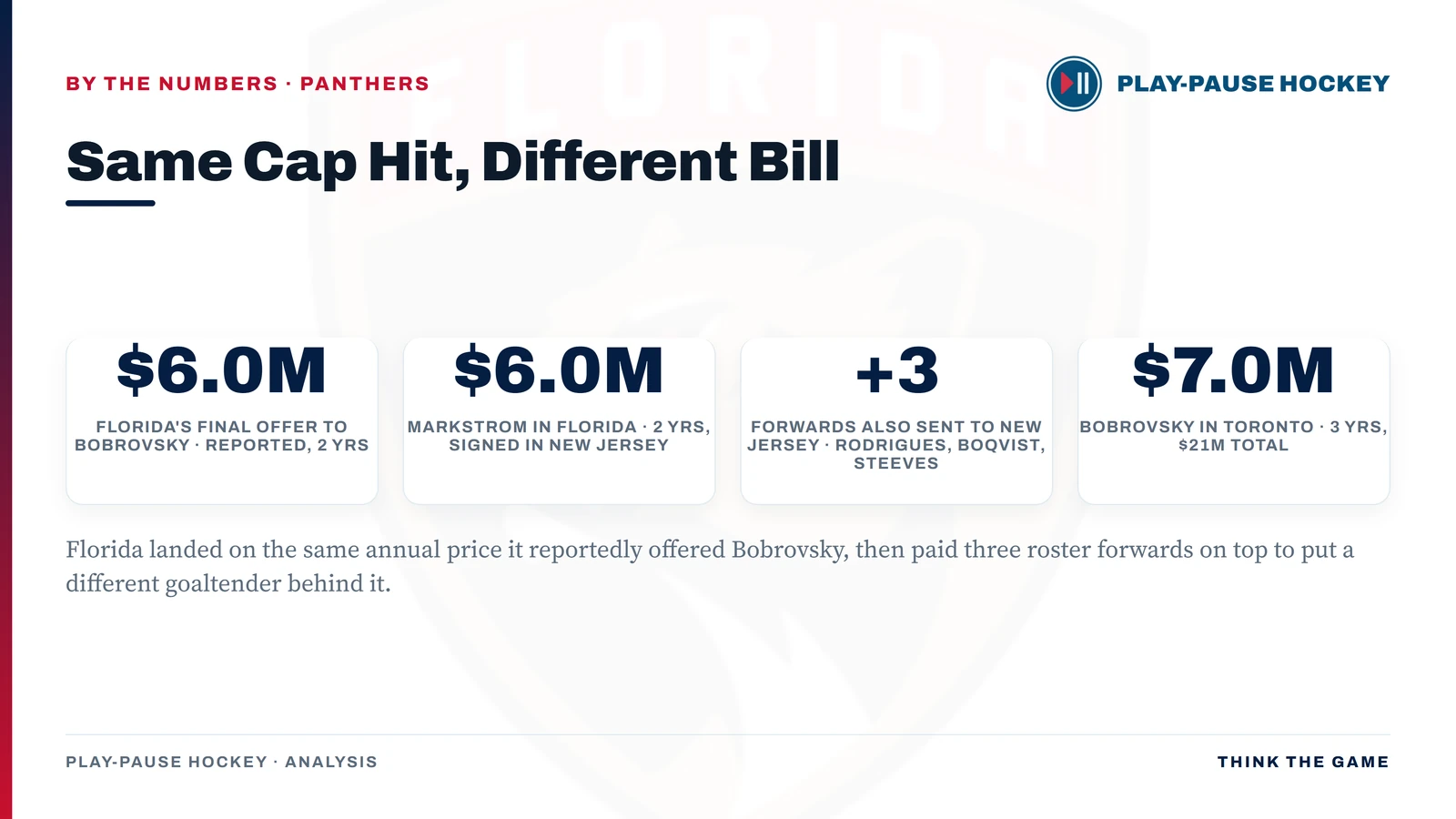
There is a second number worth sitting with. Toronto pays Bobrovsky $7 million a season. Florida reportedly had him at $6 million. The team that let him walk had him a million a year cheaper than the team that signed him, and chose not to close it.
A .0064 Gap Is What the Forwards Bought
If Florida changed goaltenders to get better goaltending, the season just played is the place to look for it.
Bobrovsky went 27-23-1 in 52 games in 2025-26 with a 3.07 goals-against average and a .8768 save percentage, the worst full season of his career, as the Panthers finished 40-38-4 and missed the playoffs for the first time since 2019. Markstrom, in 44 games for New Jersey, went 23-19-1 with a 3.066 goals-against average and a .8832 save percentage.
That is a difference of .0064. Both men were bad by the standard either had set before. Markstrom is 36 and Bobrovsky turns 38 in September, so this is not a youth movement either. Whatever Florida bought with those three forwards, last season’s evidence does not show it in the crease.
Friedman posted that on July 1, hours before the signing. Read it against the June 30 trade and the sequencing is clear enough: by the time anybody was reporting where Bobrovsky would land, Florida had already committed three players to a different goaltender.
The Clause Was Not Free, and That Is the Real Argument for Zito
A cap-literate fan will make this objection before finishing the paragraph above, and it lands: full trade protection on a 38-year-old goaltender is not a rounding error, it is a genuine liability, and pricing it at zero is exactly the mistake this article could be accused of making.
That objection is correct on its own terms. A no-trade clause on a goaltender coming off a .877 season removes Florida’s only exit if the decline continues, and the Panthers have watched what a stranded veteran contract does to a contender. Zito refusing to write it in is defensible management. Bobrovsky asking for it, at 37, off the worst year of his career, was asking Florida to absorb a risk he would not absorb himself.
But notice what the concession actually costs. If the clause was the sticking point, then the clause is what Florida paid three forwards to avoid, and that puts a price on it: Rodrigues, Boqvist and Steeves. That is a coherent decision. It is not the decision we described in June, and it is not the decision the cap sheet describes now.
Florida did not choose the cheaper goaltender. It chose the other one, and paid extra for the privilege.
One caution on the reporting itself. The Tuboltseva story is single-sourced and Zito has not confirmed or denied it publicly. The outlets carrying it describe Bobrovsky’s request as a full no-trade clause against a partial one, though that wording reaches us through the outlets quoting her rather than from RG’s own page, which would not load for us on August 13. Markstrom’s contract and every transaction date in this piece are public and independently checkable. Florida’s $6 million offer to Bobrovsky is not. It exists in that one report, and it is the number the whole comparison turns on.
Florida Chose a Goaltender, Not a Discount
The honest verdict is narrower than either “Florida got fleeced” or “Florida got cheaper.”
Florida made a preference call and paid a premium to act on it. The cap number landed where the Bobrovsky talks had already landed. Three forwards went on top.
Whether that was worth it turns on things save percentages cannot show yet. What Florida’s goaltending staff sees in Markstrom’s mechanics. What it stopped seeing in Bobrovsky’s. How many roster players a front office should trade to avoid writing one clause into one contract.
The framing, though, is settled. Toronto’s Bobrovsky bet is a bet on a 38-year-old’s workload, the priciest commitment of Chayka’s first Leafs offseason, and it will be judged on saves. Florida’s side was never the thrifty half of that transaction. The Panthers paid the same dollars, gave up three players, changed one name on the depth chart, and had it all done while they still held the exclusive right to re-sign the goaltender they were replacing.