
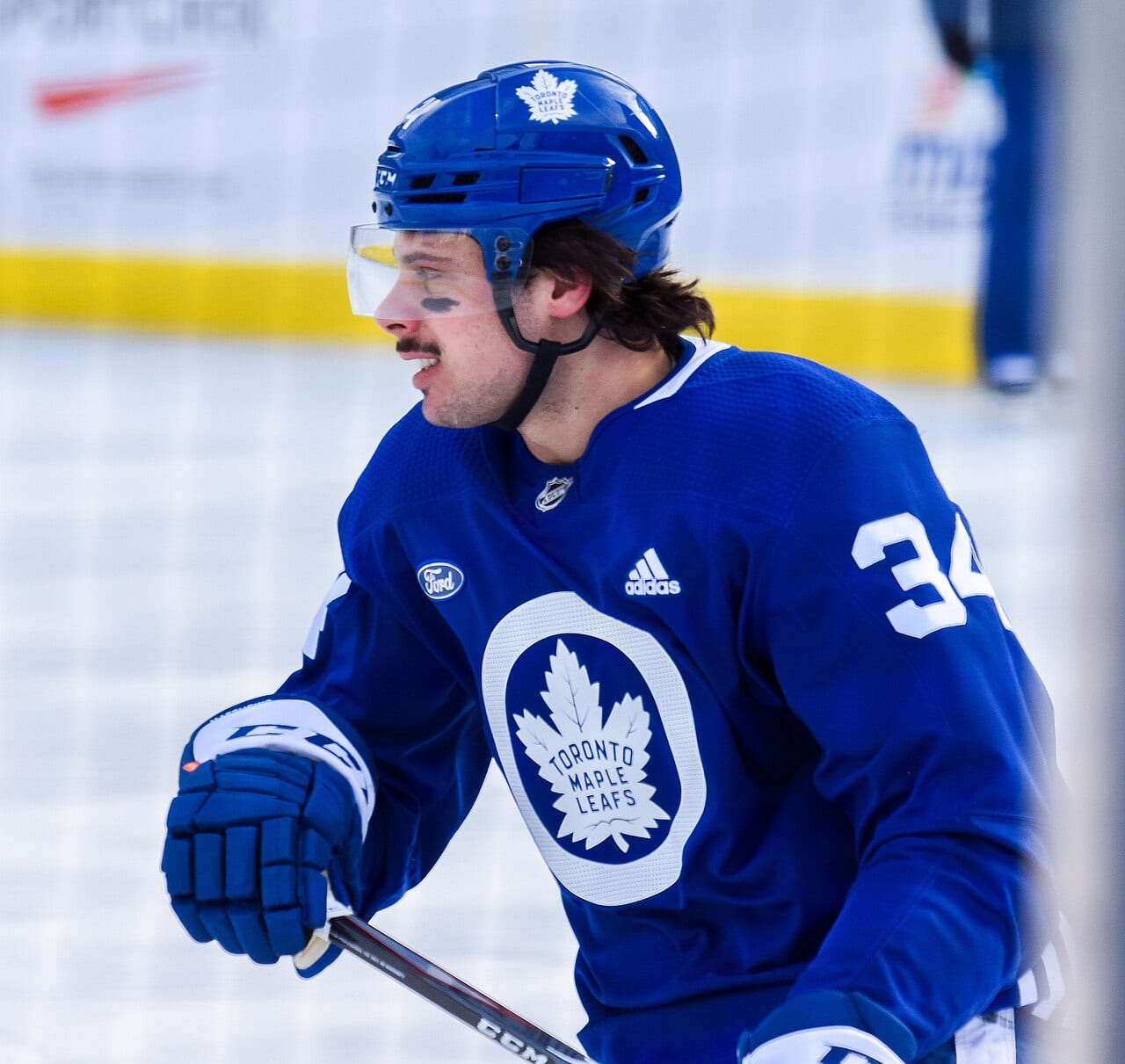
Auston Matthews missed time in each of the last two seasons. The Toronto Maple Leafs described those absences, in total, as an upper-body injury and a lower-body injury. On Thursday a chiropractor in Scottsdale, Arizona spent a radio segment discussing Matthews’ rehabilitation and mentioned his lower back. That sentence is now the most detailed thing anyone has said publicly about the captain’s body in two years, and the man who said it does not work for the Maple Leafs.
The reflex is to file this under leak. It is worth being accurate about the sequence first, because the accurate version is more interesting than the dramatic one.
One Sentence From Scottsdale Beat Two Seasons of Team Statements
Shawn Robek is a chiropractor who works with NHL players out of Scottsdale. He posted a photograph of himself with Matthews, ordinary offseason content of the kind trainers post about star clients, and it circulated among Leafs fans. That photograph is what got him booked onto TSN 1050’s First Up on August 13, his first Toronto radio appearance. He went on to talk about a knee.
Per David Alter, The Hockey News, who transcribed the audio, Robek said the "low back was not the concern this year. Obviously, we're taking care of his knee." TSN has not published a transcript of the segment.
Read that sentence twice. The knee is public. The knee has been public since March, because it happened in front of cameras. The clause doing the work is the first one, and what it implies is that in some other year, the low back was the concern. Toronto has never said that. Toronto has never said anything close to that.
Nobody leaked anything. A practitioner talking about his own client, on a booking arranged around a photo he posted himself, said a thing that was true and unremarkable inside his own practice. It only became news because of how little exists around it. In a normal information environment that sentence is filler. In this one it is the whole story.
Article 34 Says a Club May Name the Injury, the Prognosis and the Surgery
Here is where the received wisdom breaks. The upper-body and lower-body convention gets defended, by fans and by the people who run teams, as a privacy protection that the collective bargaining agreement forces on everyone. Go and read the agreement.
Article 34.3(c) governs disclosure of a player’s medical information, and subsection (iii) is not ambiguous:
For public relations purposes a Club, the League, and/or the NHLPA may disclose the following information: (A) for injuries sustained during the course of a Player’s employment as a hockey Player with the Club […] (I) the nature of a Player’s injury, (II) the prognosis and the anticipated length of recovery from the injury, and (III) the treatment and surgical procedures undertaken or anticipated in regard to the injury.
Quoted from the 2013 NHL/NHLPA collective bargaining agreement, Article 34, page 178. Extended by the 2020 memorandum, it is the agreement in force until September 15, 2026. The bracketed ellipsis removes a clause listing what counts as employment, such as team travel.
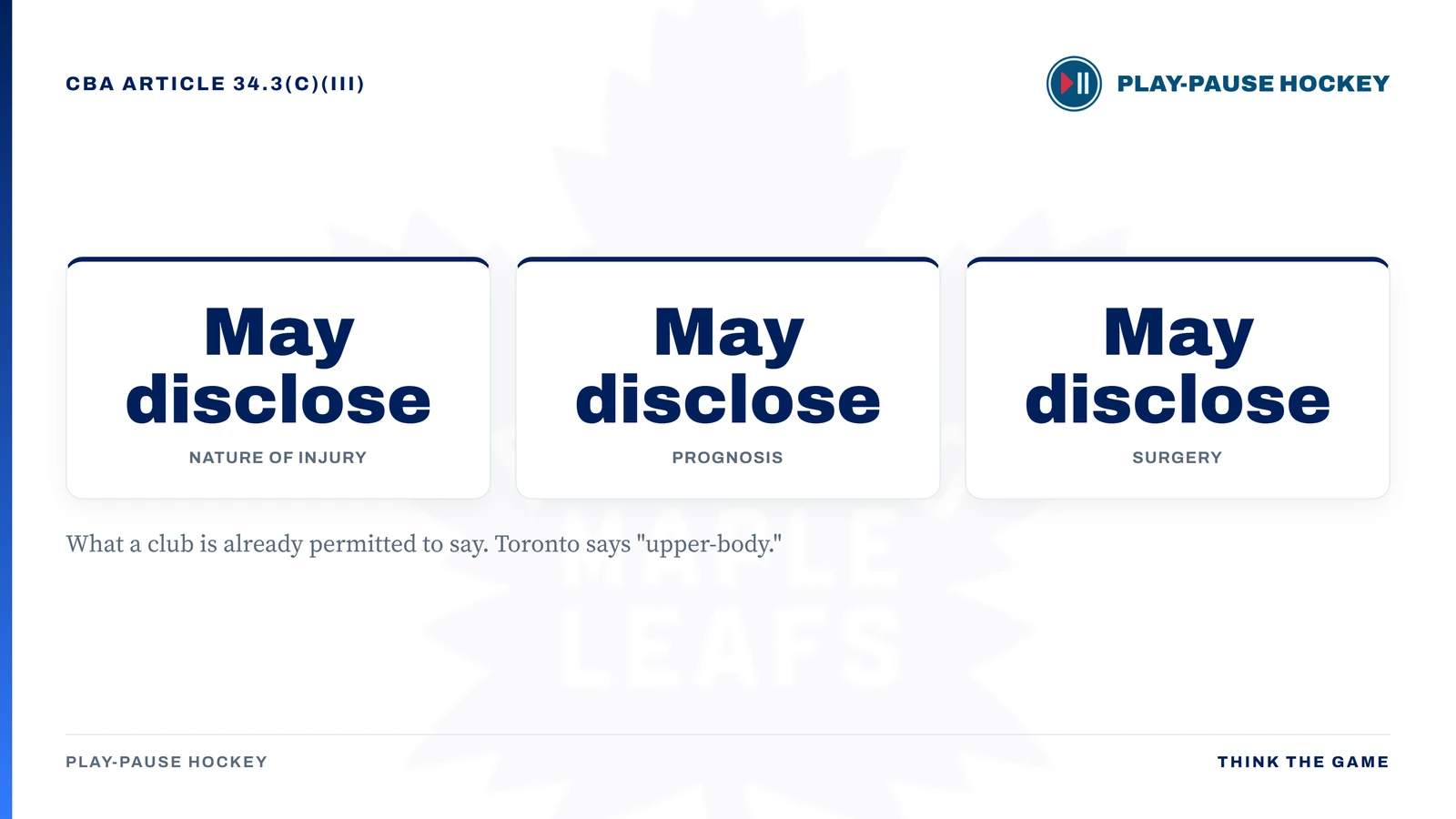
The nature of the injury. The prognosis. The surgery. That is an express permission, sitting inside the section that otherwise restricts what a club can say, and it requires no separate consent from the player because it is a use the agreement itself already authorizes. It has been in the document since 2013.
There is a real limit on it, and it deserves stating plainly rather than being buried. The permission covers injuries sustained during employment as a hockey player. A general medical condition falls under a narrower rule, subsection (B), where a club may confirm only that something is keeping the player from playing and roughly how long he will be gone. So a club genuinely cannot broadcast every health matter a player has.
That distinction does not rescue the convention. Matthews got hurt playing hockey. Every absence in question sits squarely inside subsection (A), which is the permissive one. Toronto could have named any of them and did not.
What Toronto Actually Said, One Injury at a Time
Lay the record out and the pattern is not subtle.
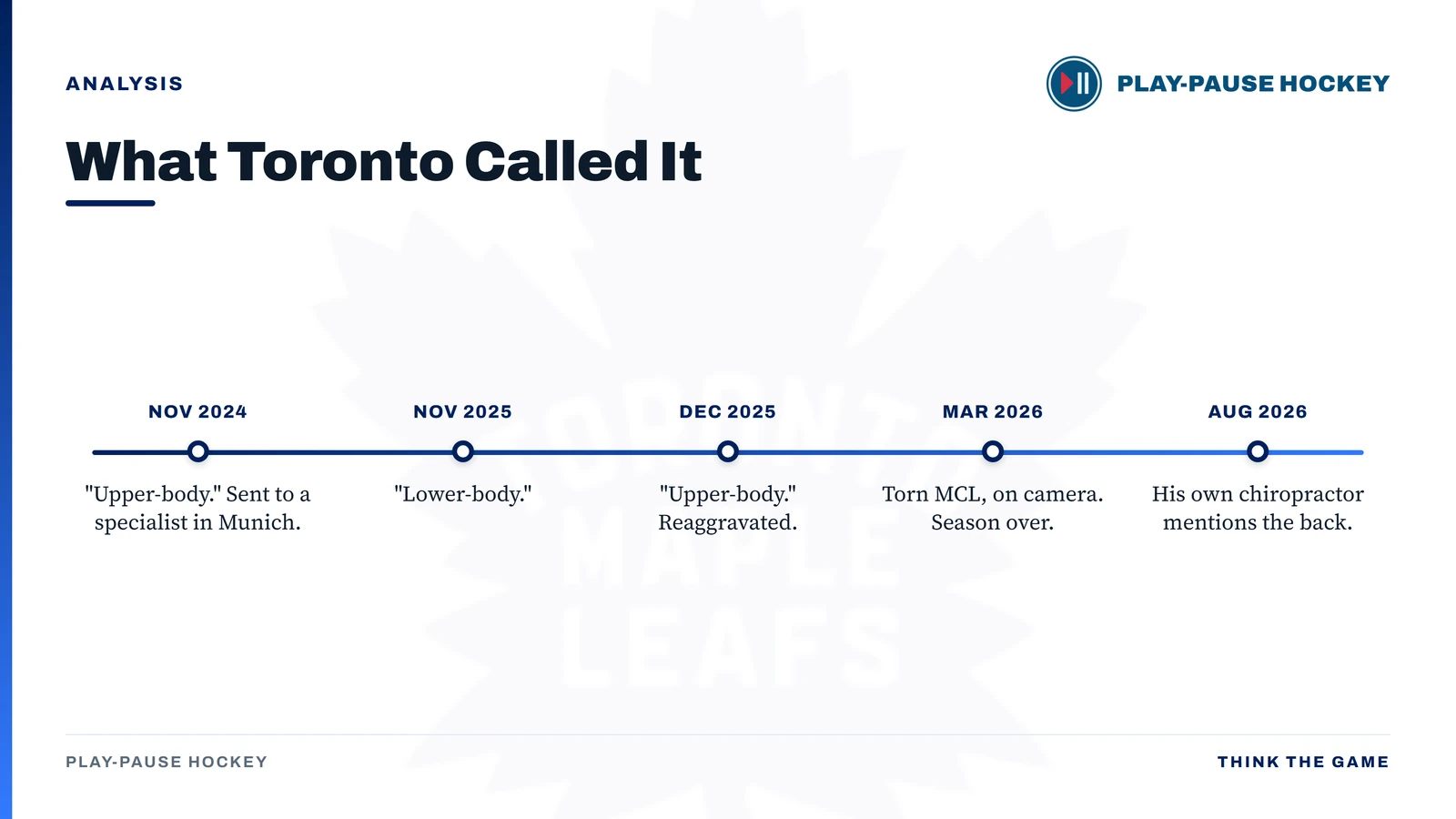
In November 2024 Matthews went to Germany to see a specialist he had used before. General manager Brad Treliving confirmed the trip and called it more of a general checkup. The official label throughout was upper-body, which is the part worth sitting with: the club acknowledged the player was flying overseas to a doctor and still described the reason by naming half of a torso.
Then a lower-body injury in November 2025. Then an upper-body injury in December, reaggravated later that month.
That exception is the tell. When the injury was invisible, the description was a body region. When it happened on television and ended his season, the club managed a diagnosis, a surgery and a timeline. The agreement did not change between those two situations. What changed was whether vagueness was still available.
The Confidentiality Wall Stops at the Club’s Payroll
The last piece of the mechanism is the part almost nobody covering this story has looked at, and it is faintly absurd once you see it.
Article 34.1(b) sets out whose duty runs to the player rather than the team, and it lists the professions by name:
The primary professional duty of all individual health care professionals, such as team physicians, certified athletic trainers/therapists, physical therapists, chiropractors, dentists and neuropsychologists, shall be to the Player-patient regardless of the fact that he/she or his/her hospital, clinic, or medical group is retained by such Club to diagnose and treat Players.
Chiropractors are in the agreement. They are named, in writing, between physical therapists and dentists, which means that when the NHL and its players sat down to decide who owes a duty to whom, somebody in that room thought specifically about chiropractors.
Same document, Article 34, page 176.
Then look at the qualifier: retained by such Club. The architecture governs the people the team is paying. Robek is Matthews’ own practitioner, in Arizona, hired by the player and answerable to him. The rules built to control what gets said about an NHL player’s body were drafted around the club’s staff, and the most specific public sentence of the last two years came from a man standing entirely outside them.
Which raises the fair objection, and it is the one an informed fan should push: is this not just injury-hunting dressed up in clause numbers? A guy said an ambiguous thing and a desk built a thesis on it.
The answer is that the argument here does not depend on Matthews having a back problem. He may not. Robek’s sentence is perfectly compatible with a routine assessment that found nothing, and a reader who wants to dismiss the implication entirely can, without touching anything else on this page. The claim that survives either reading is about the vacuum, not the diagnosis. A league permits its clubs to describe injuries and the clubs decline, so the only specific description available in two years arrives from a private practitioner in another country who had no reason not to talk. That is a structural fact about who is allowed to speak, and it holds whether or not the back ever mattered.
They Reopened the Medical Article in 2020 and Went Around 34.3
Thirty-three days from now, on September 16, the collective bargaining agreement that contains all of the above expires and a new one takes effect through 2030.
It is not a light rewrite. The season goes to 84 games. Contract lengths drop to seven years for re-signings and six on the open market, the rule behind the September 15 term deadline that teams have been racing all summer. Long-term injury relief gets rebuilt, with replacement salary generally capped at the prior season’s league average, and the playoffs get a salary cap for the first time. Deferred salary is gone. Teams can put a 19-year-old in the AHL. The dress code loosens.
Injuries are all over that list. Every one of those provisions is about what an injured player costs. None of the published summaries of the new deal describes a change to what a club has to say about him.
The changes above come from the June 27, 2025 memorandum of understanding ratified by the players on July 6, 2025, running from September 16, 2026 through September 15, 2030. Aird & Berlis covers the long-term injury relief rebuild specifically. We have not seen the full text of the new agreement, so treat the disclosure point as what the public record shows rather than as a reading of the document.
The precedent is firmer, and it is worth more than a summary. The last time the parties genuinely opened the medical article was the 2020 memorandum that produced the agreement now expiring, and they went at it hard. They replaced the second medical opinion list. They added a player’s right to a second opinion from his own doctor. They barred clubs from signing sponsorship deals that constrain who staffs their medical department. They rewrote off-season rehabilitation. They created a complaints procedure for standard-of-care violations. They added a section guaranteeing an injured player a business-class seat home.
That is six subsections of Article 34 rewritten or newly inserted: 34.1(c), 34.2(c), 34.4(a), 34.4(g), 34.6 and 34.14. Subsection 34.3, the one governing disclosure, is not among them. The number 34.3 does not appear in that memorandum at all, and neither does the phrase “disclosure of medical information.”
So the parties spent an entire negotiation on how an injured player is treated, down to his seat on the flight home, and left alone the clause that decides what the public is told about him. Everything announced about the agreement replacing it points the same way. The NFL and the NBA both require their teams to file injury reports. The NHL has asked for nothing of the kind, in an era when the league does business with sportsbooks that price its games.
This is not a scandal, and Toronto is not unusual. Every club does it, the incentive is obvious, and no general manager volunteers information an opponent can use. The point is smaller and more durable than outrage. For two seasons the most informative sentence about Auston Matthews’ body belonged to a chiropractor in Scottsdale, and the reason it belonged to him is that the agreement handed his profession a duty and never handed it a leash. Nothing announced about the deal taking over on September 16 changes that. Toronto’s roster with no expiring contracts is the same club meeting the same problem from the other side, where the clause nobody reads is the one that ends up deciding things.