

Kevin Lowe had a division lead to protect and a fourth-liner sitting two goals into the best night of his life. When Los Angeles pulled Stephane Fiset with Edmonton up 4-3 late in the third period on February 21, 2000, the obvious thing was to put Georges Laraque over the boards and let him shoot at an unguarded net from anywhere on the ice.
Lowe left him on the bench.
Per Dave Stubbs, NHL.com, Lowe told him: "I'm sorry, Georges, I can't put you in because we need to be first in the division."
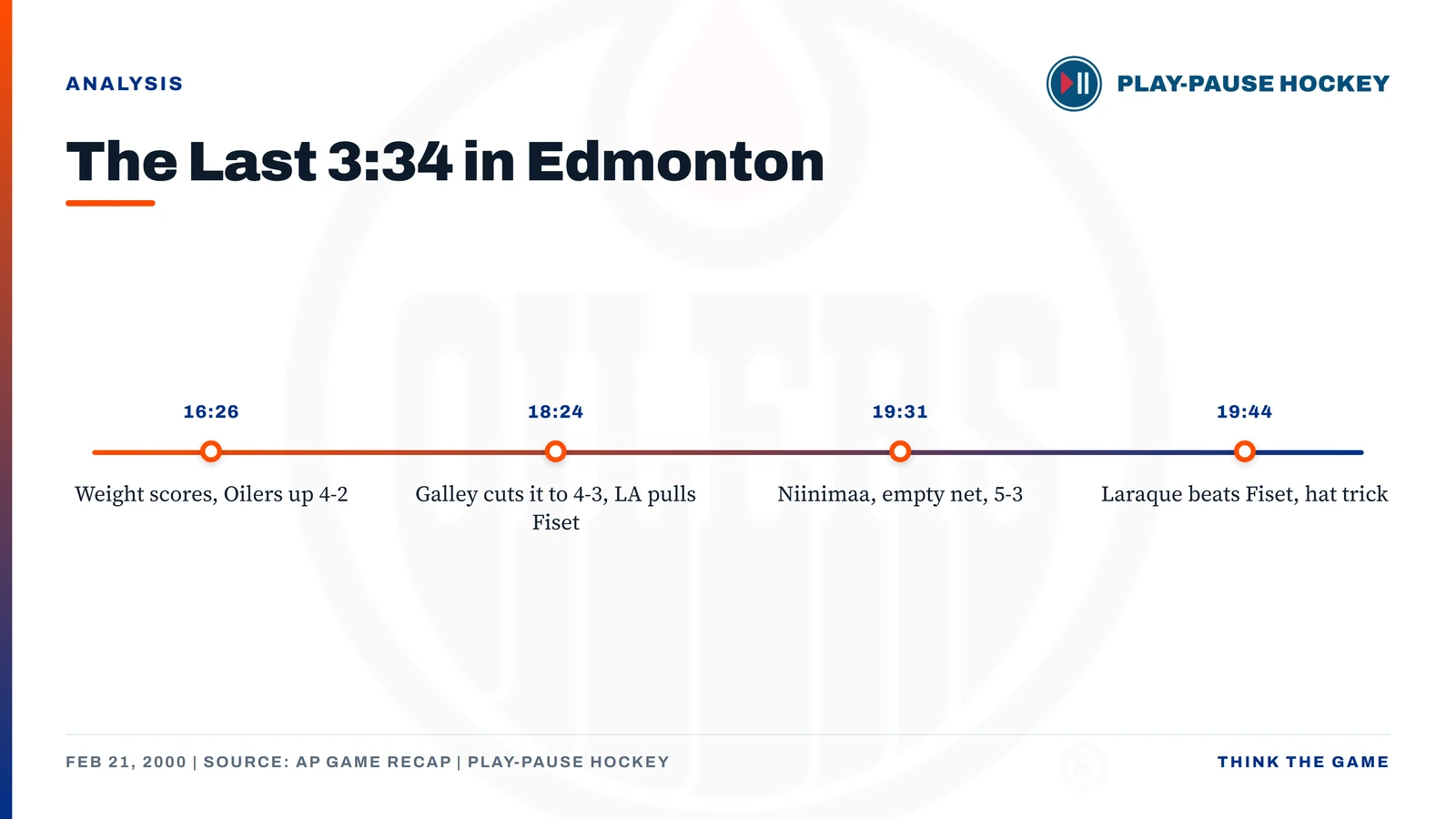
Edmonton got the empty-net goal anyway. Janne Niinimaa scored it at 19:31. Thirteen seconds later, Laraque completed the only hat trick of his 695-game NHL career with a spin move through a check, on a goalie.
The Free One Went to Janne Niinimaa
This is the part of the story that has quietly inverted over twenty-six years. Search the anniversary posts and the aggregator rewrites and you will find a fairly consistent version in which the enforcer’s third goal was the empty-netter, a charity puck rolled into a vacant crease at the end of a decided game. It is a tidy story. A big man who fought for a living gets handed one.
The game sheet does not support it. Niinimaa’s goal at 19:31 of the third carries the EN notation. Laraque’s, at 19:44, does not. Los Angeles pulled Fiset after Garry Galley cut it to 4-3 at 18:24. Niinimaa hit the vacant net at 19:31. Fiset went back in, and thirteen seconds later Laraque scored on him.
Sources: the official game sheet for the sequence and the notations, and the Associated Press game story, filed from Edmonton that night, for every quote from the room below.
Thirteen seconds is the whole argument. The free one existed. It was scored. It went to a defenseman, and by the time Lowe finally opened the gate for Laraque there was a goaltender back in the Los Angeles net.
What 8:20 a Night Actually Bought Edmonton
Laraque was twenty-three that season and playing the role the league still had a job description for. He finished 1999-2000 with 8 goals, 8 assists and 123 penalty minutes in 76 games, per Hockey-Reference. Across twelve NHL seasons he averaged 8 minutes and 20 seconds of ice time per game, which is the statistical signature of a man whose employment did not depend on scoring.
He scored anyway, at a rate that is easy to underrate. Fifty-three goals in 695 games works out to one every thirteen games. Getting three of them in a single night is, at his own career rate, the output of thirty-nine average Georges Laraque games compressed into one evening.
He did it on three shots. The game sheet credits him with three attempts, three goals and a shooting percentage of 100, in 10:10 of ice time across fourteen shifts. Doug Weight, the captain, played 21:18 and took the same three shots for one goal.
He had come into the game with three goals on the season. He left it with six, first place in the Northwest Division for his team, one point clear of Colorado, and a shower of hats on the ice at Skyreach Centre.
The 1999-2000 Kings, for the record, were not a soft touch. Andy Murray’s team finished 39-27-12-4 and second in the Pacific.
A Defenseman on His Back and Sixteen Seconds Left
The goal itself is better than the legend. Laraque took the pass along the wall, turned back into traffic with Los Angeles defenseman Aki Berg on him, and went to the net through the check, which is not how anyone scores on an unguarded one.
“Boyd was on the boards. A defenseman was on my back. I did a little Denis Savard spin-o-rama.”
That is Laraque in the room that night, in the AP’s game story. The two assists on the goal went to Devereaux and Dowd, which is why the retellings split on who fed him: the wire named Devereaux, Laraque told NHL.com in 2016 that Dowd gave it to him in the corner, and the game sheet says both.
Steve McKenna Went After Him Between Goals
There is a detail from earlier in the night that makes the third goal better. At 17:31 of the second period, two and a half minutes after Laraque’s second goal, Kings enforcer Steve McKenna picked a fight with him and was assessed the instigator, a fighting major and a ten-minute misconduct. Laraque took five minutes for the fight and then went out in the third and scored again.
Garry Galley, who had cut the Kings’ deficit to a single goal at 18:24 and then watched the whole thing from the other side, was blunt about it in the same AP story: “He held off guys and drove to the net. You have to give him credit for that.”
Doug Weight, the Oilers captain, went the other direction and enjoyed himself. “We got the big guy putting the puck in the net. That line played unbelievable. Georges is a kid at heart. We created a little monster now.”
Wayne Gretzky, ten months into retirement, phoned to tell him he needed forty-nine more to catch him. Gretzky finished with fifty career hat tricks, ten clear of anybody else, so the arithmetic was doing exactly what a good chirp is supposed to do.
The Version That Survived Says He Scored on an Empty Net
The objection worth taking seriously is a good one, and it is the reason this piece went to the game sheet rather than settling for the wire copy: teams do not usually put a goaltender back in for the last twenty-nine seconds of a game they trail by two. If you assume Fiset stayed on the bench once he was pulled, the popular version follows, and every retelling that reaches that conclusion reaches it honestly.
The scoresheet closes it in three places at once. The EN notation sits on Niinimaa’s goal and on no other. Fiset is charged with five goals against on thirty-four shots, and 29 saves plus 5 goals is 34, so the count has no room for a goal he was not on the ice for. The empty net is credited separately in the goaltending table with exactly one shot faced and one goal allowed. Three fields, three agreements, one conclusion: Los Angeles put its goalie back in, and Laraque beat him.
The second thing that retelling did is stranger and easier to prove. The same AP story that got the sequence right called Laraque a “6-3, 240-pound defenseman” in its second paragraph.
The error has now outlived the copy desk that made it.
Note what he does not say there. He does not claim the goal was hard, and he does not correct the record about the empty net. Eighteen years on, the thing he wanted people to know was that it happened at home.
He Scored Thirteen the Next Season
The honest limit on all of this is that the game did not decide anything. Edmonton’s hold on first in the Northwest did not survive the spring, and the Oilers went out in the first round. Nobody should pretend a February win in 2000 was a hinge.
What it was is a decent test of a lazy assumption. Hockey keeps two records of every career, the one on paper and the one that happened, and they do not always describe the same player. Kopitar’s trophy case is the polished version of that problem, twenty years of awards naming everything except the thing he was best at. Laraque’s is the crude version. The paperwork says fighter, so the goals had to be an accident. The reason this story kept getting told as a freebie is that a hat trick by a fighter reads like a gift, so the gift got written in even after the box score said a coach had specifically refused to give him one. Laraque then went out the following season and scored thirteen goals in eighty-two games, still under nine and a half minutes a night, which remains his career high and which nobody has ever suggested was charity either.
Fifty-three goals in 695 games is not a scorer. Three in one night, with the easy one already spent on somebody else, is not luck.