

Asked last week how he had taken being traded, Mavrik Bourque went quiet for a few seconds before he answered. What came out was two separate claims, and Nashville only controls one of them.
Speaking in French to TVA Sports at a charity pro-am in Quebec City, he said he did not think he had needed a change of scenery, but that in the end he would get a better opportunity in Nashville to show what he can do, and that he might get more chances on the power play.
Per Stéphane Cadorette, TVA Sports, August 18, 2026. Bourque was speaking French; the quotations here are translated.
“Je ne pense pas que j’avais besoin de changer d’air, mais en bout de ligne, je vais avoir une meilleure opportunité à Nashville de montrer ce que je peux faire.”
The first half of that is settled, and Nashville said it out loud six weeks ago. The second half runs into a roster that returns 43 of the 55 power-play goals its skaters scored last season, in the bodies of players who are all still under contract. That is the number this trade turns on, and it is the one worth putting next to what Bourque said.
Dallas Played Him on the Wing and He Set a Career High Anyway
Bourque’s 2025-26 was the best season of his career and he spent it out of position. Eighty-two games, 20 goals, 21 assists, 41 points, 15:29 a night, per the NHL’s own numbers. He has played center his entire life except for that year, as he put it to The Hockey News in July, and TVA Sports reports he spent the season at right wing. Nashville’s team site was blunter still: MacFarland told it that playing Bourque in the middle of the ice was probably the biggest draw for the Predators.
The production came from even strength almost in full. One power-play goal. Five power-play points. In 82 games.
That matters because it tells you what Dallas was and was not giving him. By his own account, after the Olympic break he was getting quality top-six minutes next to Wyatt Johnston, Roope Hintz and Matt Duchene, night after night, which is why his answer starts with a denial rather than a complaint. He was not buried. He was just not on the power play, and he was not in the middle.
Two picks. That is the whole return, and Dallas GM Jim Nill did not dress it up: he called Bourque a casualty of the cap world and said the Stars would not have been able to fit his next contract. Bourque had played the season on a one-year, $950,000 deal. Nashville paid him $5.5 million a year three days later, close to six times the raise, which is the part of this story everybody covered in July.
Nashville Returns 78 Percent of Its Power-Play Goals
The power play has a record, and the record is specific. Nashville’s skaters scored 55 power-play goals in 2025-26. Steven Stamkos scored 14 of them and Filip Forsberg 11, so two players account for 45 percent of the team’s power-play offense on their own. Ryan O’Reilly added five, Roman Josi four, Jonathan Marchessault four, Matthew Wood four, Luke Evangelista one.
Every one of those players is still on the roster.
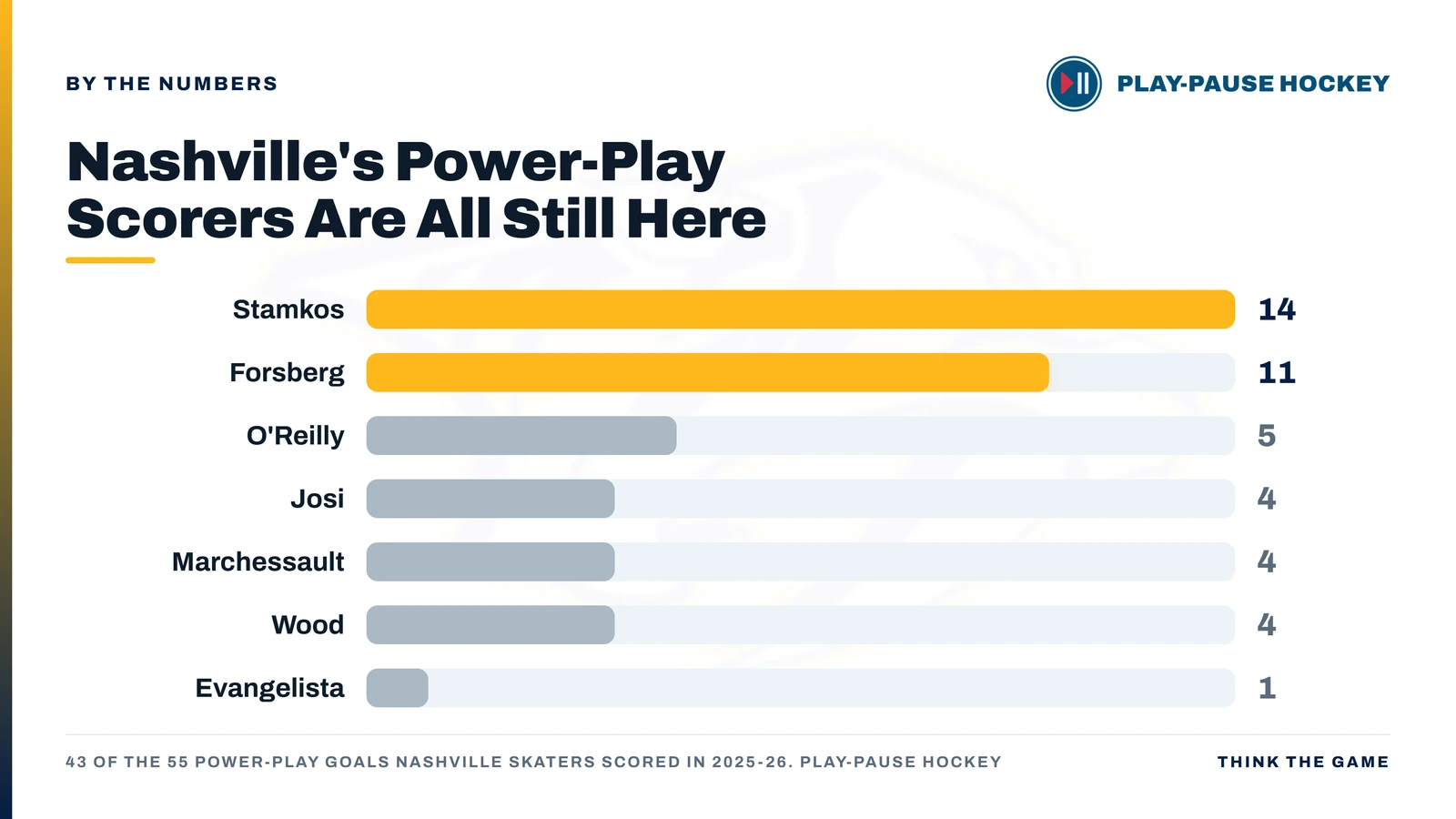
The 12 goals that left belong to three people: Michael Bunting scored five and is unsigned, Nick Blankenburg scored three and is unsigned, Erik Haula scored four and signed in Los Angeles. Subtract them and Nashville brings back 43 of 55, or 78 percent of its power-play production.
So the opening Bourque is describing is real in the sense that anything above one power-play goal is an improvement. It is not real in the sense of a vacancy. On a unit where the top two scorers combined for 25 goals and both came back, the honest ceiling for a new arrival is the second unit, which is a different job with a different number attached to it.
The middle is different, and not because it is empty. MacFarland said in July that the Predators intend to give him every shot at playing in the middle, which is a commitment the front office actually controls. The roster moves around that sentence are worth reading in order. On June 24, Nashville sent Fedor Svechkov, a 23-year-old center coming off a 70-game season, to Colorado, and got back Jack Drury, a 26-year-old center, in the same trade. A week after that it acquired Bourque.
Three centers moved through Nashville between June 24 and July 1. That is not a team clearing a lane for anyone. It is a team working the position hard enough to keep turning it over, which says more about what the Predators think they are missing than any quote about opportunity does. The difference from the power play is what kind of problem each one is. The middle is a competition, and a competition is something a player can win. The top power-play unit is not a competition this summer, because nobody vacated it.
The Power Play Is a Coaching Choice, Not a Depth Chart
The sharpest objection to all of this is that a power play is not a contract. Units get rebuilt every October, this one belonged to a team that finished 38-34-10 and missed the playoffs for a second straight year, and a coach who keeps running Stamkos and Forsberg out of habit is exactly the coach who gets replaced. Bourque could be on the top unit by American Thanksgiving and none of the arithmetic above would have predicted it.
A power play is a coaching decision. It is also a queue, and nobody ahead of Bourque in it left town.
That is fair, and it is the correct way to read the number. What it does not do is make the number irrelevant, because it cuts both ways. Nashville had every reason to change the personnel this summer and chose not to. Given the chance to bring in power-play help, the Predators brought back 78 percent of the group that produced a playoff miss.
The second risk is smaller and more specific, and it belongs to Bourque rather than the roster. The job he wants is decided on a skill his record is weakest at.
He lost more draws than he won last season. That is not disqualifying for a 24-year-old who spent the year on the wing, and it is the most fixable thing on this list. It is also the exact number a coach points at in March when a center starts getting the offensive-zone-only shifts.
What the Six Years Are Actually Buying
We argued in July that the cap hit was never the interesting question on Mavrik Bourque’s six-year deal, and that the term was. Six weeks later the deployment picture sharpens the same point rather than softening it. Nashville is not paying for a power-play specialist, and the roster says it never intended to. It is paying for a center, on a team whose veteran core sits directly on top of the one role that would raise his ceiling fastest.
That is a coherent bet and it is also a narrow one. If Bourque’s move back to center holds, the contract looks fine on production he can generate himself, which is how he got here in the first place. If it does not hold and he ends up back on the wing behind the same power play, Nashville has bought a $5.5 million winger through 2031-32, and the Bourque extension becomes another entry in Nashville’s rebuild-or-contend problem rather than a solution to it.
He was right about the first half of his answer. Dallas made that call for him, Nashville has already put the reply in writing, and the paperwork is not the hard part. The second half is still somebody else’s spot to lose.