

For the first time in a generation, the Buffalo Sabres are a team with something to lose. They turned a 50-23-9 season into 109 points and a first-place finish in the Atlantic, ended the longest playoff drought in the league, and won a round for the first time since 2007 before Montreal put them out in Game 7 overtime. A franchise that spent fourteen years selling patience finally has a window. So the question that should define this summer is simple: did Buffalo do the one thing that widens it?
It did almost everything but that. Here is what a reader won’t get from the transaction wire: the deal that would have changed Buffalo’s ceiling didn’t fall apart over money or term. It died over the gap between two draft picks, four slots wide, and the same general manager who chased it now says the position it would have fixed doesn’t need fixing.
Krebs, Kane, and a Summer That Looks Productive on Paper
Read the Sabres’ July as a checklist and it grades out well. On Monday they re-signed restricted free agent Peyton Krebs to a four-year, $18 million contract, a $4.5M cap hit, settling his arbitration case before the hearing could set the number for them. Krebs is a useful player coming off career highs (12 goals, 39 points in a full 82 games), and locking him in through 2029-30 at a middle-six price is sound business.
Around that, Buffalo has kicked the tires on hometown unrestricted free agent Patrick Kane, who is still productive at 37 and could slot into the top six and the second power-play unit. The depth is sorted. The defense pairings are set. If you graded this offseason on process, on not overpaying and not panicking, you would give it a good mark and move on.
That is exactly the trap. A productive summer and a summer that matters are not the same thing, and the difference this year is a goalie.
The One Trade That Would Have Changed the Ceiling
Before the draft, Buffalo and Winnipeg were close on Connor Hellebuyck. Not a rumor-mill floater, an actual framework, the kind both sides walk right up to the edge of. Hellebuyck, a three-time Vezina winner, was reportedly willing to waive his no-movement clause to come to Buffalo. The one hurdle that kills most goalie trades, the player’s consent, was already cleared.
What killed it was smaller than that. Per Elliotte Friedman, the sticking point was a single draft slot.
Per Elliotte Friedman (reporting echoed across the rumor mill): "Buffalo was like, 'No, if we're giving you the fourth overall pick, we have to get the eighth overall pick back.' I think Winnipeg wanted both of those picks, and that's why it didn't happen."
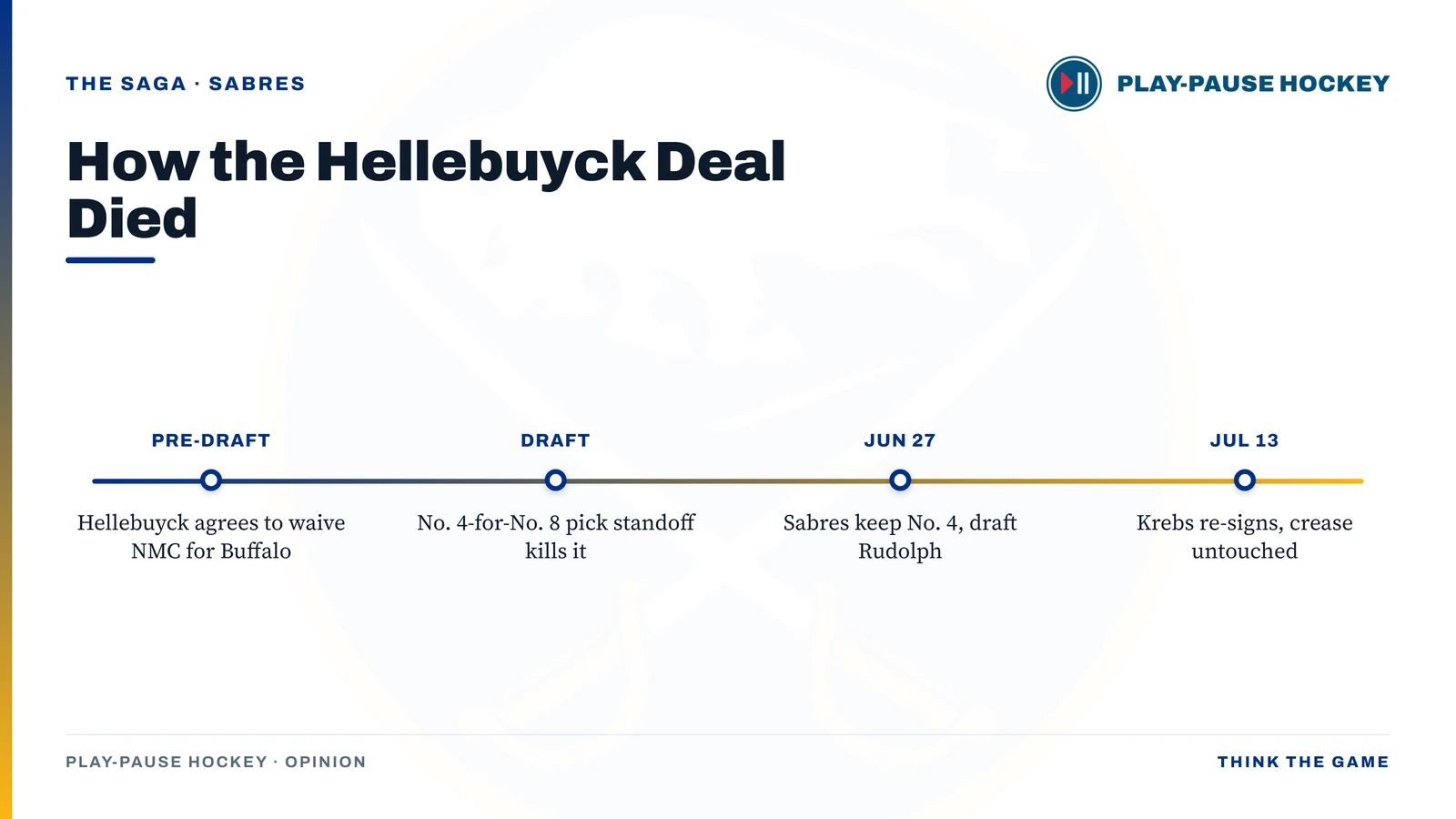
So Buffalo kept its pick, drafted defenseman Daxon Rudolph at No. 4, and walked out of the draft with the same crease it walked in with. The timeline below is the whole story: a deal that had the hard part solved, undone by the easy part.
You can argue draft-pick value all day. What you cannot argue is that Buffalo treated a franchise goalie as a must-solve problem. A team that believed it needed Hellebuyck finds a way to bridge four slots. Buffalo drew a line instead.
Kekalainen Says the Crease Is Fine. Here’s the Case, and Why It’s Thin.
To be fair to Jarmo Kekalainen, there is a real argument on his side, and pretending otherwise would be its own kind of hot take. Hellebuyck is signed through 2030-31 at an $8.5M cap hit and is coming off the worst season of his career. Trading multiple assets, including a top-five pick, for an aging, expensive goalie on a down year is the sort of move that ages badly. Kekalainen has said as much in public, pointing to his own goalies’ collective numbers from last season as evidence the position is not the emergency everyone outside the building thinks it is. Discipline, not desperation.
Kekalainen answered a contender’s question with a rebuilder’s confidence.
Here is why that reasoning is thinner than it sounds. The disciplined-walk-away math is the right math for a rebuilder with time to spend. Buffalo is not that team anymore. It is a 109-point club whose core is still on the good side of its contracts, with a two-or-three-year window that a soft crease can close in a single spring. True No. 1 goalies almost never come available, and when one does and tells you he’ll waive his clause to join you, the buy-low risk on a three-time Vezina winner is a different calculation for a contender than for a team picking in the lottery.
And the tell is in his own words. You do not chase Hellebuyck to the one-yard line if the group you already have is genuinely fine. The pursuit and the “we’re set” framing cannot both be honest. One of them is the front office talking itself into the roster it ended up with.
Windows Close in the Crease, Not on the Depth Chart
Strip away the checklist and the wager is clear. Buffalo is betting that a good team in front of an ordinary crease is good enough, the same bet Edmonton keeps making two provinces west, and the same bet that has never once ended with a parade. Krebs helps. Kane, if he signs, helps. Neither is the position that had the Sabres one goal from a conference final and could not get it.
Watch the arbitration deadline and the trade market into the fall. If Buffalo circles back on a starter by American Thanksgiving, Monday’s Krebs deal looks like the smart small move inside a summer that finally got serious. If the Sabres open the season with the crease exactly as it is, they will have answered the best chance they have had in fifteen years with a shrug, and called it a plan.