


Toronto didn’t sign a starting goaltender on Canada Day. It signed a playoff bet, then handed that bet a starter’s job. Sergei Bobrovsky was the best netminder left on the board, a two-time Vezina winner and back-to-back Cup champion whose spring résumé is genuinely elite. His deal is three years and $21 million, a $7 million cap hit, per ESPN. The pedigree isn’t the problem. The problem is the version of Bobrovsky the Leafs actually need is the one the calendar makes least likely: the guy who plays 45 games between October and April.
That’s the tension no glowing “biggest name available” headline captures. Toronto paid for what Bobrovsky does in May. It requires what he does in November.
Why the Leafs Reached for a 38-Year-Old
Start with why this signing exists at all. Toronto’s crease was thin. Anthony Stolarz has been genuinely good when he plays, but “when he plays” is the whole caveat: he has never been a full-workload starter, and counting on him for much more than 30 games is how the last few Leafs seasons wobbled, per Maple Leafs Hotstove. Behind him the depth was prospects and question marks.
So the front office did the logical thing and bought a proven name. That part tracks. What a contender chasing its first deep run in years wanted was a goalie who has been there, one who won’t shrink when the building tightens in April. On that criterion, Bobrovsky is the best answer free agency offered.
But read the job description again. The reason they signed him was volume, a goalie who “actually plays hockey games,” because Stolarz can’t carry the load. That’s a regular-season need. And it points straight at the one thing a 38-year-old is least equipped to promise.
The Spring Bobrovsky Is Real, and That’s What They Paid For
Give the signing its due, because the ceiling is legitimate. From 2023 through 2025, Bobrovsky was one of the best playoff goalies alive: a 44-21 postseason record, a .912 save percentage, a 2.41 goals-against average, six shutouts, and two Stanley Cups with a third Final appearance, per Maple Leafs Hotstove. That is not a compiler. That is a goalie who won series.
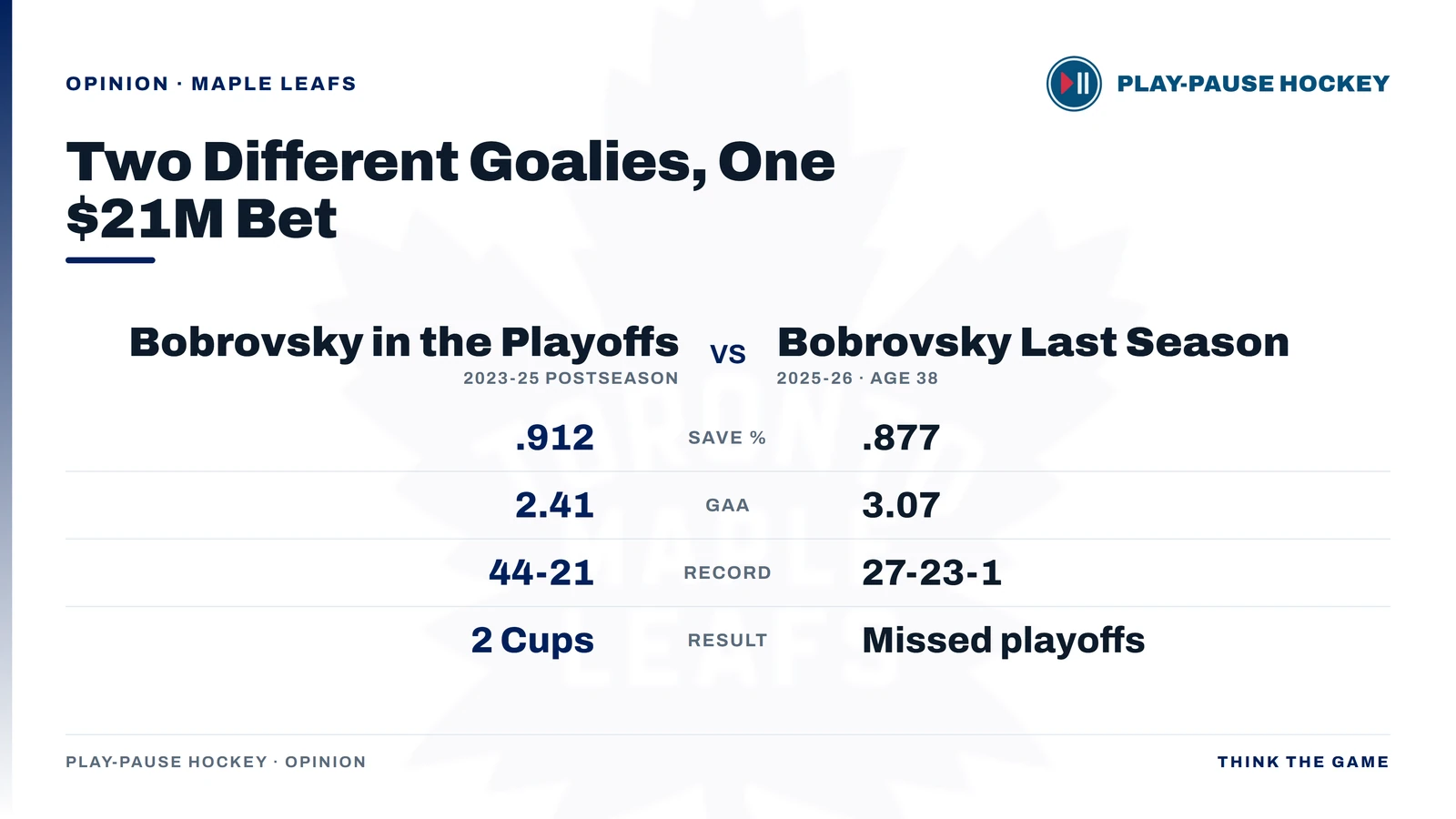
If the Leafs get that goalie in a series next spring, the $7 million looks like a bargain and this column looks foolish. Toronto has lost too many big games in the crease to dismiss the value of a netminder who has stolen them. The pedigree is the reason to make this bet. It is not the reason to feel safe about it.
But the Regular-Season One Just Turned 38
Here is the column Toronto would rather not stare at. In 2025-26, Bobrovsky went 27-23-1 with an .877 save percentage and a 3.07 goals-against average, the worst full season of his career, and Florida missed the playoffs for the first time as a two-time defending champion since the 1969-70 Canadiens, per Florida Hockey Now.
That’s the number that runs into the job. Toronto didn’t sign Bobrovsky to manage 25 curated games behind a healthy partner; it signed him because the partner can’t be trusted with volume. The playoff peak only becomes relevant if the Leafs are playing in the playoffs, and reaching them is an 82-game grind that leans on the exact regular-season goalie this contract is quietly hoping to avoid. You cannot get the May version without surviving the November-through-March one first.
The Term Is the Smart Part, and the Only Insurance
Now the honest counter, because it isn’t small. The Leafs did the one thing that keeps a deal like this from curdling: they kept it short. Three years, not the six or seven Bobrovsky reportedly wanted. This is the same goalie Florida’s goalie reset was built around avoiding on term, and Toronto solved that problem with a shorter pen stroke. In a league where the cap just leaped a record $8.5 million to $104 million, a $7 million goalie is a mid-tier line item, not a franchise anchor. If this goes sideways, it goes sideways cheaply and briefly.
There’s precedent for the optimism, too. Ed Belfour walked into Toronto at 37 and gave the Leafs two strong seasons, and mental toughness has never been Bobrovsky’s issue. Betting on a proud veteran’s pride is not the worst bet a contender can make.
But precedent cuts both ways, and the workload math doesn’t bend. A short term protects the balance sheet. It does nothing to protect the standings if a 38-year-old’s body says the .877 was the floor falling out, not a tired blip after three straight deep runs.
What Has to Break Right Before Spring Even Matters
The verdict isn’t that this is a bad signing. It’s that it’s a narrower one than the résumé suggests. Toronto bought a goalie for the postseason and needs him for the regular season, and the gap between those two jobs is exactly the gap between .912 and .877.
Watch three things. Whether Stolarz stays healthy enough to keep Bobrovsky’s starts in the low 40s instead of the high 50s, because workload is the whole ballgame at this age. Whether last season’s collapse was fatigue, curable with a lighter load, or decline, which a lighter load only delays. And whether the Leafs have a real plan in net if the answer is decline, because a three-year term is short, but one lost season is still a lost season for a team out of patience. Get the workload right and this is shrewd. Get it wrong and Toronto paid for April and never got out of March.