

Two-time Vezina winners who just backstopped consecutive Stanley Cups don’t usually get shown the door. Sergei Bobrovsky is about to be the exception. Florida let its franchise goaltender drift toward July 1 free agency and brought back Jacob Markstrom, 36, at a $6 million cap hit, per ESPN. On paper it reads like a contender getting worse at the one position that decides playoff series.
It isn’t. It’s the Panthers repricing the most expensive luxury on a cap-strapped roster, and given where this team actually stands, it’s the right call.
The full deal: Florida acquired Markstrom and center Angus Crookshank from New Jersey for forwards Evan Rodrigues, Jesper Boqvist and Ben Steeves, per NHL.com. Days earlier the Panthers added 26-year-old Akira Schmid from Vegas for a 2028 third-round pick. Two goalies in, one decorated era out.
Why a $5.8 Million Cap Crunch Made the Call for Them
Start with the number that runs Bill Zito’s summer. Florida sits roughly $5.8 million under the cap with both goalie jobs open and depth still to sign, per Florida Hockey Now. That is not the budget of a team that re-signs a $10 million goaltender.
Bobrovsky’s expiring deal carried a $10 million AAV. His reported ask is gentler, around six or seven years at $42 million total, per Daily Faceoff. Read the term, not just the dollars. That is a six-plus-year commitment to a goalie who turns 38 in September, coming off the worst save percentage of his career. Florida has watched enough aging-goalie contracts curdle around the league to know how that movie ends.
This is the same front office that just added Brady Tkachuk and still has to fit a returning Aleksander Barkov, a healthy Matthew Tkachuk and a long-term core back under the ceiling. Something at the margins had to give. The crease was the cheapest place to find it.
What Florida Gave Up Is Smaller Than the Résumés Suggest
Here is the part that makes the move defensible rather than desperate. Strip the trophies off the nameplates and look at last season.
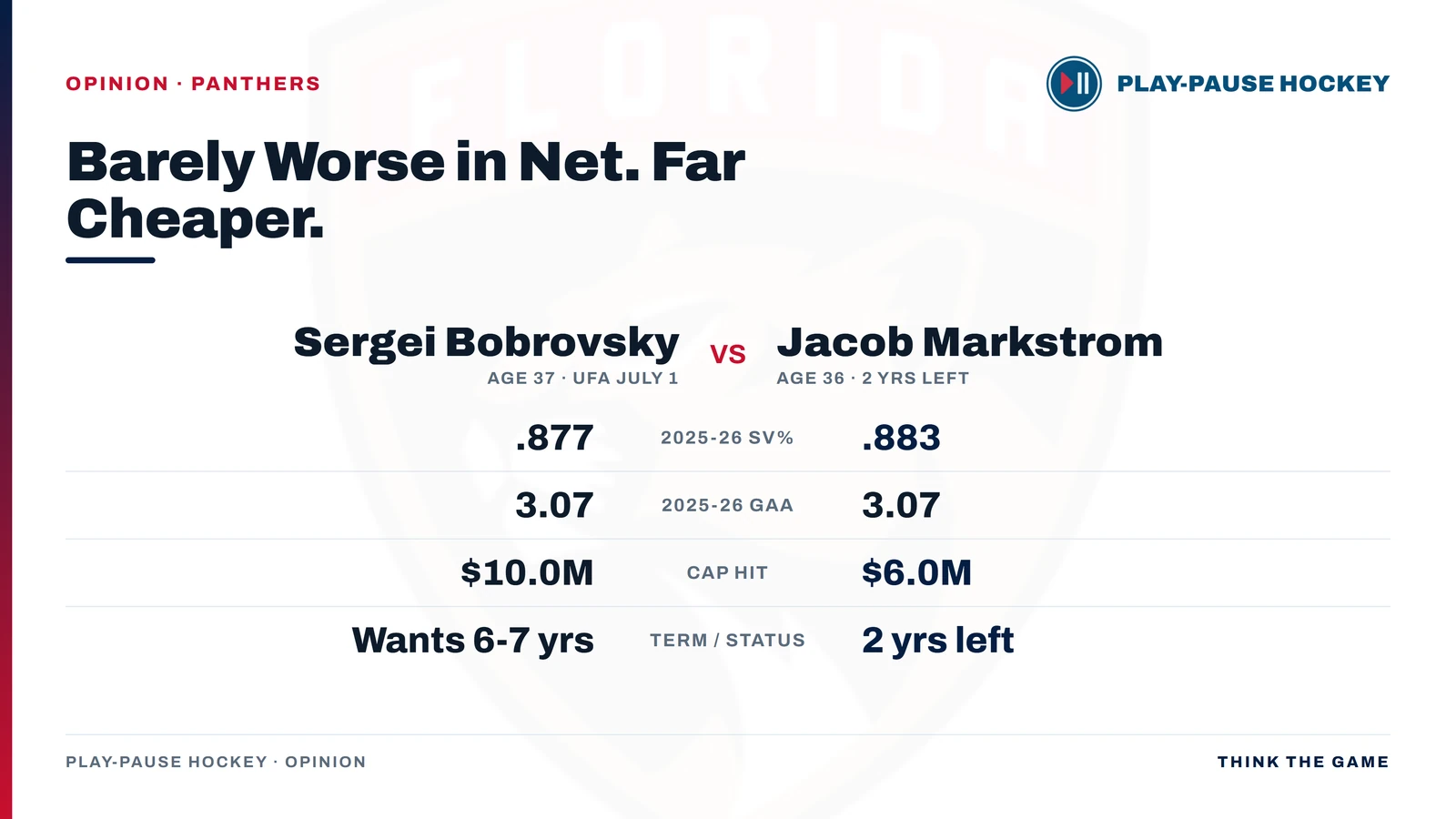
Bobrovsky went 27-23-1 with an .877 save percentage and a 3.07 goals-against average over 52 games. Markstrom posted .883 and an identical 3.07 across his year in New Jersey, and he carries a stronger career mark of .907 over more than 500 NHL games, per Daily Faceoff. The 2025-26 sample says these two were the same goalie last year. One of them costs $4 million more and wants five extra years to prove it.
A team chasing the Cup can’t take that downgrade in net. A team Florida’s age and shape, with the league’s best run-prevention structure in front of the goalie, can.
Akira Schmid Is the Quiet Half of the Bet
Markstrom is the floor. Schmid is the upside, and he might be the more interesting piece. The 26-year-old went .893 with a 2.59 GAA in 34 games for a Vegas team that reached the Cup Final, and he cost a single third-round pick. That is a starter’s audition at a backup’s price.
The design here is a real tandem, not a 60-start workhorse plan. Markstrom’s recent injury history makes a heavy ride unwise anyway. Pair a competent veteran floor with a young goalie who has shown flashes of more, behind a defensive team, and you have manufactured league-average goaltending for under $9 million combined. For the Panthers, league-average in net has always been enough.
Where This Blows Up in Sunrise
Now the honest counter, because it is not small. Bobrovsky in the playoffs has been a different animal than Bobrovsky in March, and he stole stretches of both Cup runs. You do not replace that postseason ceiling with a Markstrom-Schmid platoon, and if a series turns on goaltending next spring, Florida may miss the save it used to get for free.
The Panthers became the first two-time defending champion to miss the playoffs since the 1969-70 Canadiens, after a season wrecked by injuries including Barkov's, per Florida Hockey Now.
The deeper risk is that this whole plan leans on the skaters. If Barkov’s knee or Matthew Tkachuk’s body doesn’t fully bounce back, a .883 goalie won’t paper over it the way a peak Bobrovsky once did. Florida is betting the team in front of the net is elite again. Last season is a reminder that the bet can lose.
What to Watch When Barkov Comes Back
The verdict is straightforward. Florida looked at a declining, expensive goalie and a cap sheet with no room, and chose flexibility over nostalgia. That is what good front offices do with the position they can most afford to go cheap. The Cups Bobrovsky won are real. So is the math that says you don’t pay a premium for the past.
Watch three things. Whether Barkov returns to form, because the goalie plan only works if he does. Whether Markstrom’s health holds up over a full season. And whether Schmid plays well enough to turn a stopgap tandem into a genuine timeshare. Get those right, and the cheapest decision of Florida’s summer looks like its smartest.