

Shane Wright did the thing every unhappy young player is told never to do. He picked a team, out loud. The 22-year-old center asked out of Seattle, and word quickly followed that he does not just want out, he wants Vancouver specifically. It reads like a power move. It is the opposite. The moment his preference went public, the leverage in this trade stopped being his and became the Kraken’s, and Seattle has spent the last two weeks proving it knows exactly what it is holding.
Shane Wright Picked His Team. That’s His Whole Problem.
Here is the part the “player empowerment” framing skips: a trade only pays the player when more than one team is bidding. Wright named a single destination, so there is no auction. Seattle is not weighing Vancouver’s offer against three others and picking the best. It is negotiating with the one buyer everyone now knows the player wants to join. General manager Jason Botterill does not have to move Wright at all, and he certainly does not have to move him cheaply to the exact club that would benefit most from a discount. The ask and the acceptable price do not overlap, and that gap is the whole story.
The One-Team Request That Handed Seattle the Pen
The timeline matters. Around July 5, Wright’s camp made the request known, and his agent Kurt Overhardt’s version reached the reporting: Seattle would accommodate a move to a team in need of a young center, but on Seattle’s terms.
Per reporting relaying agent Kurt Overhardt (early July 2026): the Kraken have "agreed to move Shane this summer to a team in need of a top young centre," on Seattle's own timeline.
A week later, the destination leaked, and it was not vague. Postmedia’s Ben Kuzma reported that Vancouver is the one place Wright actually wants to be.
“Postmedia has learned Vancouver is Wright’s preferred destination because of what the club could become in a few years.”
Read those two reports next to each other and you can see the trap close. The selling team says it will not be rushed. The player, through no fault of his own, has already told the market he has one preferred home. That is not leverage. That is a tell. Botterill now knows the Canucks are motivated in a way no rival is, and he can price the return accordingly.
Seattle Is Asking a Cornerstone for a Checking-Line Season
So what is the price? According to Vancouver insider Rick Dhaliwal, the Kraken want one of the Canucks’ two prized young defensemen: Zeev Buium, 20, or Tom Willander, 21. Both are on cheap entry-level deals with years of control left. Both are the kind of blue-line piece a rebuilding team is supposed to protect, not spend.
Per Rick Dhaliwal (mid-July 2026): Vancouver approached Seattle, but "the ask was very high," centering on Buium or Willander.
Now weigh that against what Seattle is actually selling.
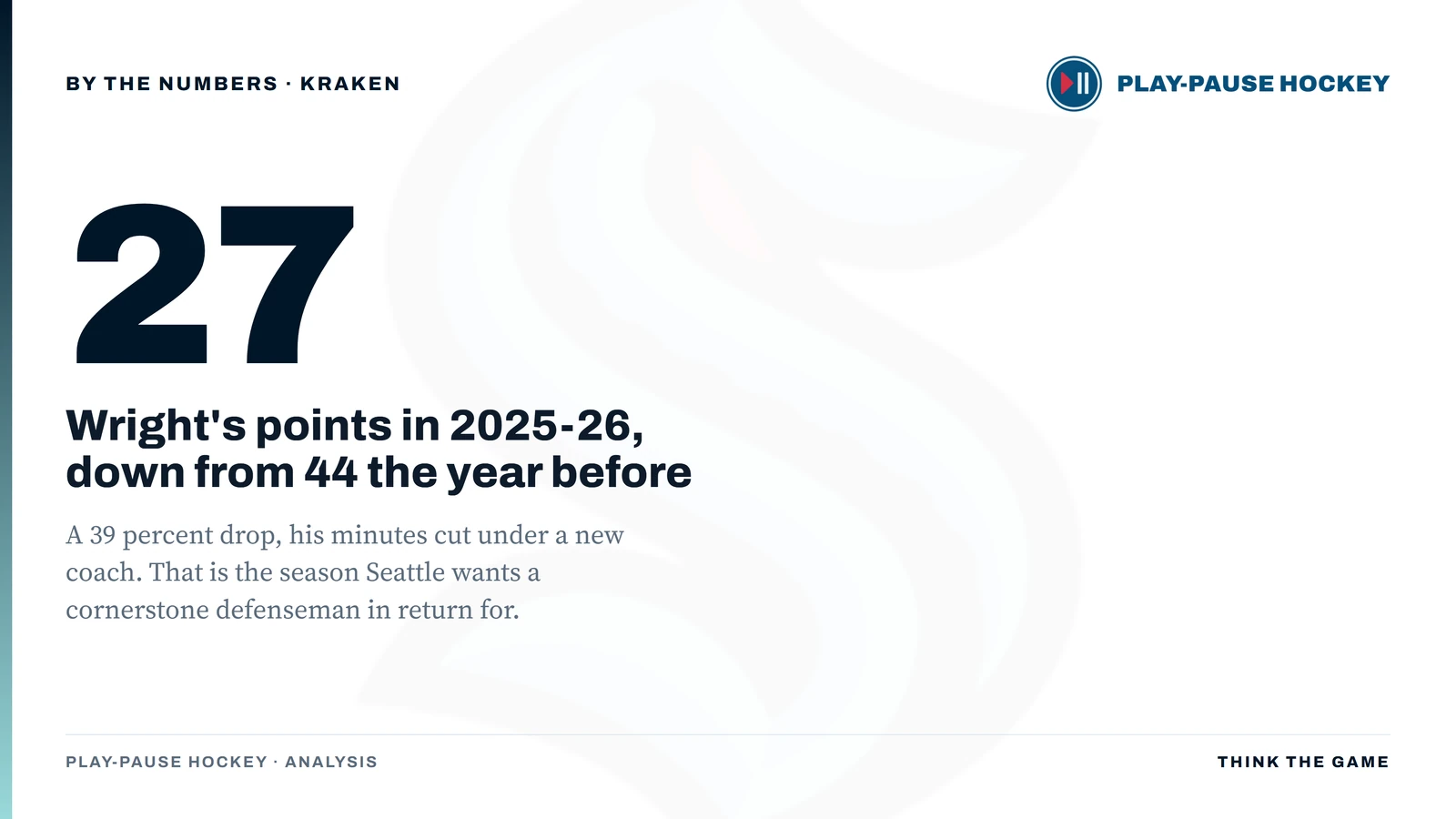
Wright is a year removed from a 44-point season, and last year he managed 27, his ice time falling under fourteen minutes a night in his first season under new coach Lane Lambert. This is not a knock on the talent that made him the fourth pick in 2022. It is a straightforward statement of what a defenseman-hungry team is being asked to buy: a center coming off a checking-line role, one whose value case rests almost entirely on age and pedigree rather than recent results.
That is a hard sell for a cornerstone in return, and Vancouver’s own side of the argument agrees.
The Reclamation Case, and Why It Cuts Both Ways
The honest counter is real, and it is the reason the Canucks keep circling. Wright is 22. He was a generational-hype prospect. Seattle’s depth chart buried him on a checking line, and a change of scenery with a bigger role is precisely how these reclamations are supposed to work. Vancouver, mid-rebuild and short on down-the-middle youth, is a logical fit on paper.
That is why the price argument matters more than the fit argument. The Hockey News, making the case for the pursuit, still drew a hard line: Vancouver should not surrender Buium, Willander, or defenseman Elias Pettersson, nor a stack of first-round picks, to get him. When even the outlet arguing to chase Wright refuses to pay Seattle’s number, “Vancouver is refusing” is not really about will. The Canucks’ ceiling on this deal sits below Seattle’s floor.
The strongest objection to all of this is simple: if Seattle genuinely wants Wright gone, a motivated seller usually finds a way. Fair. But the tell runs the other direction. Botterill has shown no urgency, and two weeks into an open standoff the ask has not moved. A GM who needed to move a player would have softened by now. Seattle has not, because it does not have to.
Why This Ends With Wright Still in Seattle
Trades happen when both sides feel a little pain. Right now only one side does. Wright wants out and has told everyone where he wants to go. Vancouver wants the player but not at the cost of the young defense it is building around. Seattle wants a real return and holds the only card that matters, which is time. Wright is under contract for one more season and a restricted free agent after that, so waiting costs the Kraken nothing. Unless the Canucks blink and part with a Buium or a Willander, or Seattle quietly lowers its ask to something like a middle-six piece and a pick, the likeliest outcome is the least dramatic one: Wright opens next season exactly where he is, playing for the leverage he gave away in July.
Watch two things. Whether a third team enters the picture, because a second bidder is the only thing that hands the leverage back to the player. And whether Wright’s camp walks the Vancouver preference back to reopen the market. Until one of those happens, this is Seattle’s negotiation to run, and the Kraken are running it exactly right.