
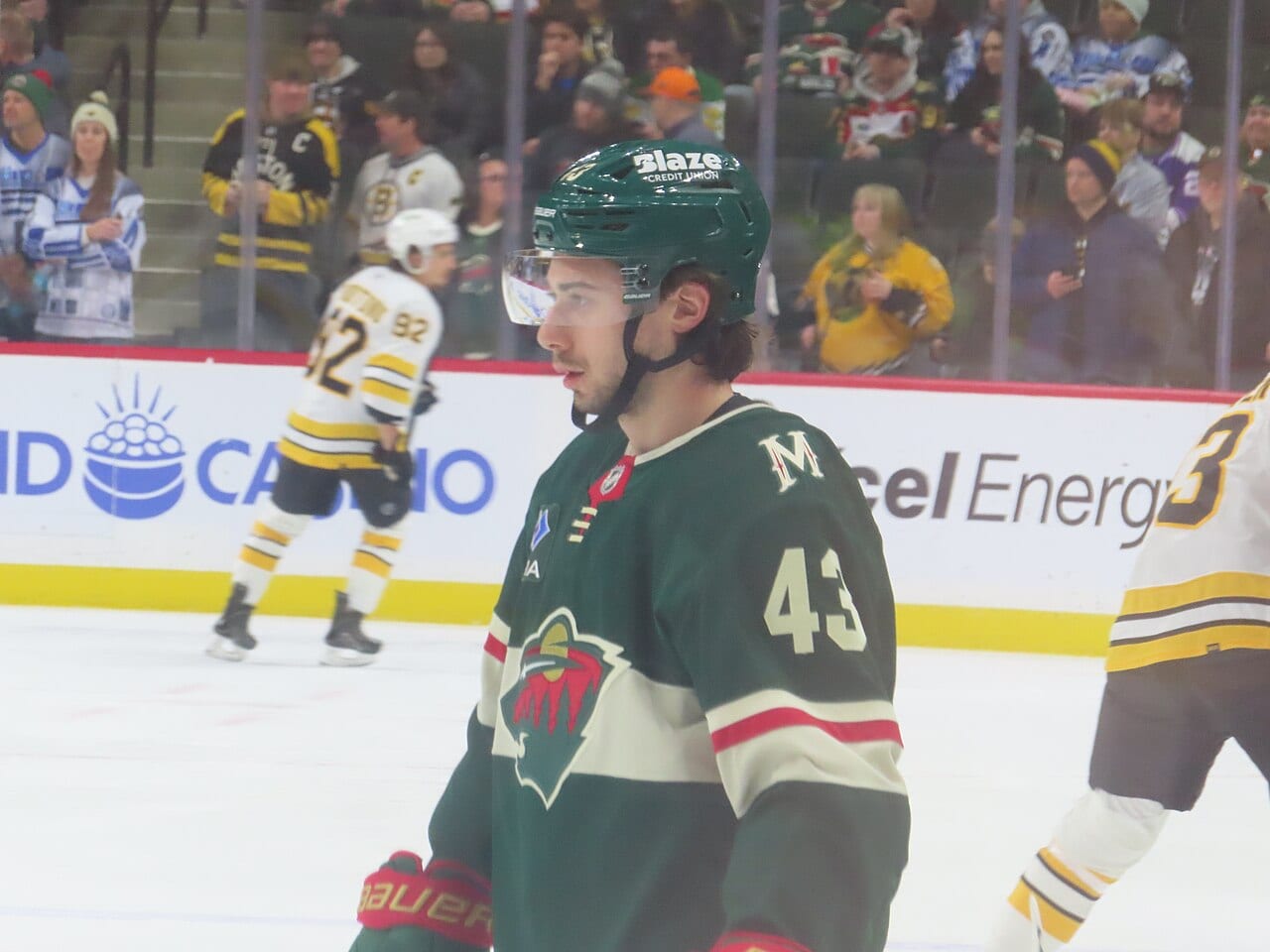
Minnesota paid four pieces in December for a season and a half of Quinn Hughes. That is the whole problem, and it is why the trade talk now building around him has the arithmetic backwards.
The Wild sent Marco Rossi, Zeev Buium, Liam Ohgren and a 2026 first-round pick to Vancouver on December 12, 2025. What came back was a defenseman signed only through 2026-27 at a $7.85M cap hit, plus the exclusive right to negotiate with him before anyone else can. He is still unsigned on August 5. So the question now circulating, whether Bill Guerin should move Hughes while somebody will still pay a real price, sounds like prudence.
It is the opposite. Trading him does not recover what Minnesota spent. It converts a paper loss into a permanent one at the worst available exchange rate, and it does so at the exact moment the only route back to par is sitting on the table.
Here is the part nobody covering this has put on the board. The extension everyone is treating as a decision standing next to the December trade is actually the second half of that trade’s price, and it is the only half Minnesota still controls. Signed, those four pieces bought four and a half seasons of Hughes. Unsigned, they bought a season and a half.
What Eleven Months of a No-Clause Star Sells For
Start with the mechanic that makes any of this a live option. Hughes has no trade protection. Neither CapWages nor The Stanley Cap lists a no-movement or no-trade clause on any of the six seasons of the contract he signed with Vancouver on October 1, 2021, and Vancouver moved him in the middle of that deal without a reported consent issue. Guerin does not need his permission. He needs a buyer.
That is where it stops being a hypothetical and starts being a markdown. A team trading for Hughes today acquires one season of a defenseman who becomes an unrestricted free agent in July 2027, at 27, with a publicly reported preference for a short contract and two brothers under contract in New Jersey. Every general manager in the league can read that. The acquiring team is not buying a franchise defenseman. It is buying eleven months and a coin flip, and it will price the deal accordingly.
That discount says nothing about his quality. Hughes is one of the two defensemen driving the defenseman market reset now underway, which is exactly why a one-year window on him is worth so much less than the player is.
Minnesota, meanwhile, did not buy eleven months. It bought a player it expected to keep.
Read that as a bargaining position and the gap is five years wide. Read it as a description of leverage and it is not close. Minnesota is the side that already paid.
Vancouver Is Already Playing Three of the Four Pieces
The other half of the ledger is no longer a projection. It is a box score.
Eight months later, that list reads differently.
Rossi finished 2025-26 with 12 goals and 35 points in 50 games. Buium, 20 years old, played 76 games on the blue line and put up 26 points. Ohgren added 18 points in 69 games. That is 195 games of NHL service across three players, all of them 24 or younger, all of them on cost-controlled contracts, all of them now Vancouver’s (NHL API, as of August 5, 2026). The 2026 first-round pick is a fourth asset that has not started paying anything yet and will not for years.
Set that against what Minnesota has actually received: roughly half of last season and all of the coming one.
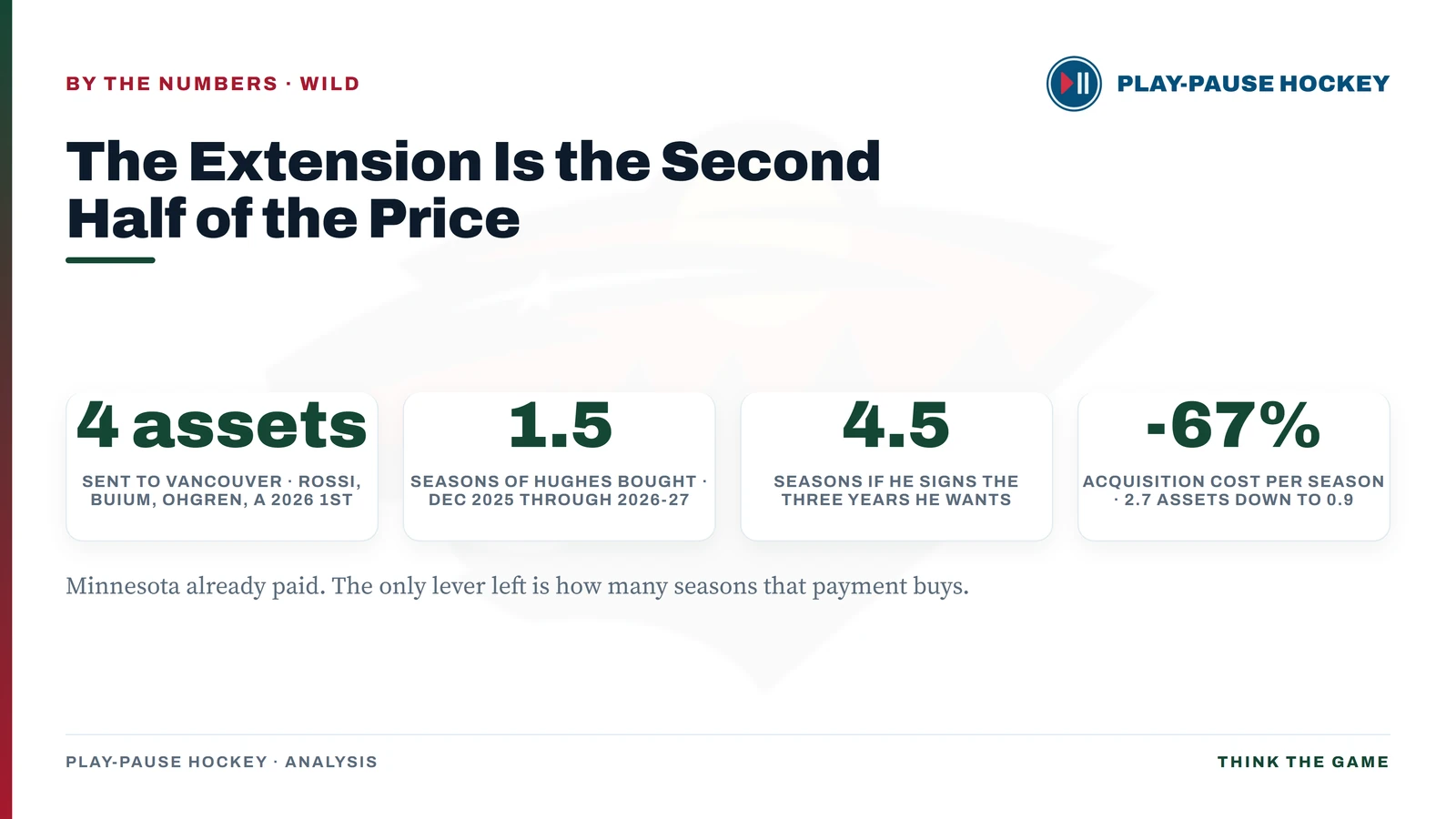
Run it as a rate and the whole argument falls out. Four assets across a season and a half is 2.7 assets for every season of Hughes the Wild get to use. Four assets across four and a half seasons, which is what a three-year extension starting in 2027-28 would produce, is 0.9. Signing him does not undo the price Minnesota paid. It divides it by three.
That is what the keep-or-trade framing keeps missing. Guerin is not choosing between two ways of valuing Hughes. He is choosing whether to finish paying for him.
Four Assets Is a Count, Not a Valuation
Here is the fair objection, and it lands on the number this entire piece rests on: counting assets is not the same as valuing them. Four pieces sounds enormous. Buium was a minus-33 as a rookie. Ohgren scored eight goals. A pick made in the twenties is a lottery ticket that busts more often than it hits. Line them up honestly and Minnesota gave up one good young center, one high-end defense prospect who had a hard first year, a bottom-six winger and a maybe.
Concede all of it. The rate still holds, because it holds on the two real pieces.
Discount Ohgren and the pick to nothing and Minnesota still traded a 24-year-old top-six center and a 20-year-old defenseman with All-Rookie votes for a season and a half.
Rossi and Buium alone, for a season and a half of anybody, is a bad exchange. It only stops being one if that season and a half becomes four and a half years. And that reframing cuts against the trade case rather than for it, because a rental market pays for exactly the thing Minnesota has the least of.
There is a second objection worth naming, the cap one. Minnesota has roughly $3.9M in space under the $104M ceiling for 2026-27, per CapWages, which sounds like a team that cannot afford a $17M defenseman. It is not the constraint people think. An extension signed now would not begin until 2027-28, a season for which the Wild have about $41M committed against a ceiling reported at $113.5M. The money fits. The years are the fight.
Take the Three Years
We wrote in July, when the Quinn Hughes extension talks were still about term, that a three-year deal would mean Hughes quietly winning the negotiation. That was right, and nothing since has changed it. He would reach free agency at 30 with the cap climbing, having given Minnesota the shortest commitment on the table.
Take it anyway.
The alternative being floated is not a rescue. It is the same loss, realized in public, for a return that arrives as picks and prospects a rebuilding team would want and a team that just mortgaged its future for a Cup window cannot use. Minnesota is not rebuilding. It traded like a club that believes its window is open, which means the asset it needs is Quinn Hughes on the ice in 2027-28, not a package of the things it already spent.
The 2027 Deadline Is a Floor, Not a Plan
If he refuses everything, the 2027 deadline is the floor, and a deadline rental does at least beat losing him for nothing on July 1. That is a fallback, not a strategy, and the distance between them is the whole argument above: 0.9 assets per season against 2.7.
Watch the calendar rather than the leaks. Colorado is working against the September 15 term deadline on the eighth year of a Cale Makar deal, and the same CBA change trims Minnesota’s maximum offer from eight years to seven after September 16. That matters less here, since nobody expects Hughes to sign eight. What matters is that every week without a signature moves him closer to the only market where his price is set by somebody other than the team that paid for him.