


The Next Maple Leafs Contract Expires in 689 Days
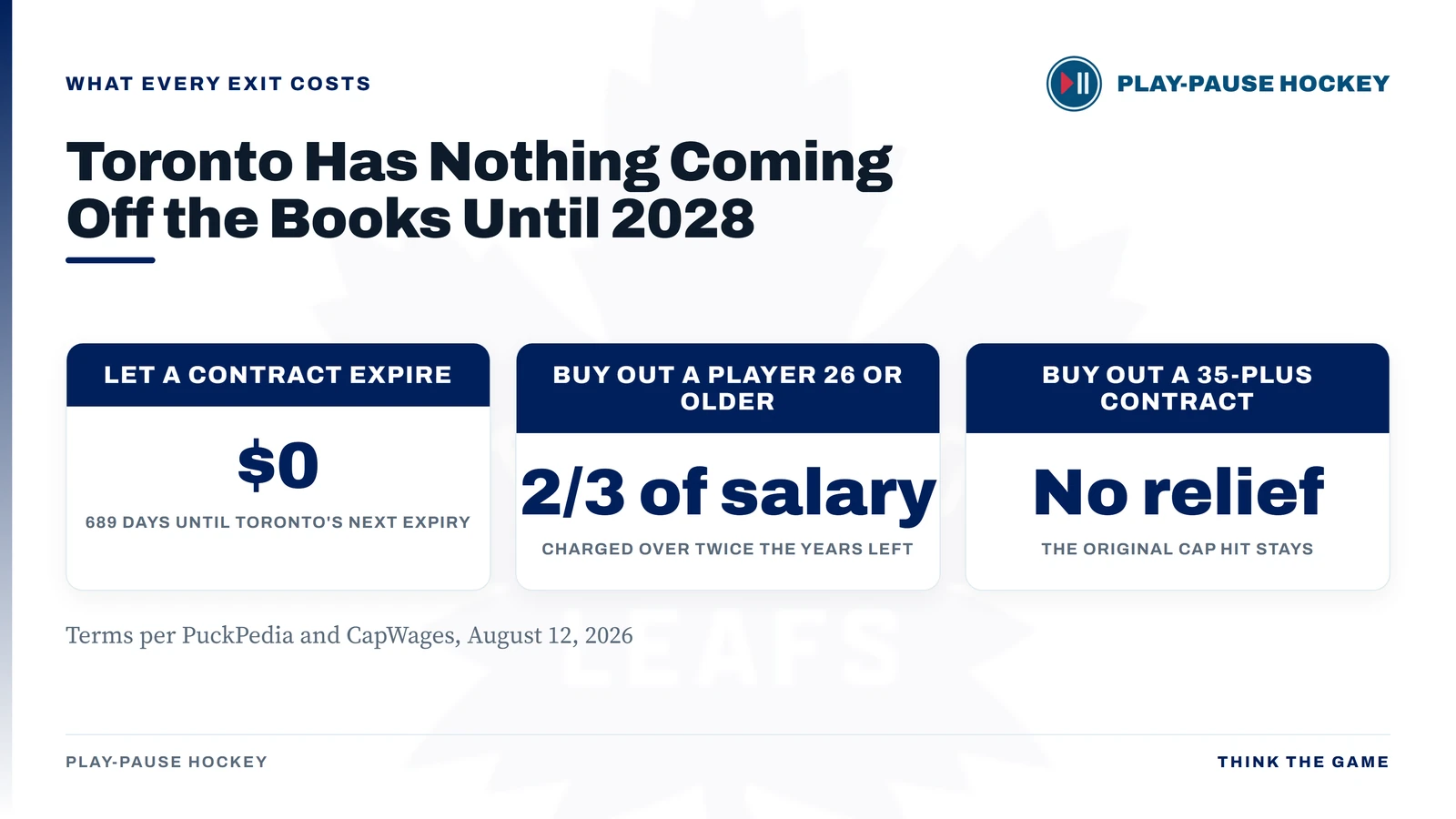
Count forward from today to the next date a Toronto contract comes off the books and you get 689 days. An expiring contract is the only way an NHL team removes a player without paying for the privilege, and the Maple Leafs have arranged not to have one until the summer of 2028.
Not one deal on the roster, forward, defenseman or goaltender, runs out at the end of this season. The earliest of them expire a year later still, after 2027-28. The Hockey News put the fact into circulation last week, sourcing PuckPedia, and the individual contracts hold it up. Auston Matthews is signed through 2027-28. John Tavares and Sergei Bobrovsky run through 2028-29, Matthew Knies through 2030-31, William Nylander through 2031-32. Nothing rolls off until the summer of 2028.
Per The Hockey News, Toronto is the only club in the league with no expiring contract on its projected roster within the next two seasons. Florida is the nearest, with Lars Eller and Garnet Hathaway both due to become unrestricted free agents after 2026-27.
That has been treated all week as a piece of trivia with a debate attached, good or bad, stability or trap. The framing skips the part that actually costs Toronto something. Every route off a roster other than an expiry is written into the collective bargaining agreement with a price attached, and John Chayka has spent his first summer as general manager signing away the free one.
Every Other Team Gets a Free Edit Once a Year
Here is what the rest of the league does every June. A fourth-liner who did not work out, a depth defenseman signed one year too long, a backup who lost the crease: their contracts run out. The cap hit disappears on July 1. No buyout charge, no retained salary, no trade call, no negotiation. The general manager wakes up with the same money and a different decision to make, and he did not spend an asset to get there.
That is the cheapest tool in roster building, and Toronto does not get to reach for it next summer. The first Leafs contract to run out does so on July 1, 2028. One correction cycle skipped, every current deal carried through two entire seasons.
The money is not the constraint. The upper limit climbs to $104 million this season and, in the payroll ranges the NHL and the NHLPA have announced through 2027-28, to $113.5 million the year after. Those are the two largest single-year jumps since the cap was introduced in 2005. Chayka will have room. What he will not have is a year in which a decision he has already made stops being his problem on its own.
What the CBA Charges When You Cannot Wait for an Expiry
Start with the buyout, because it is the one fans reach for first. For a player 26 or older, a buyout pays two thirds of the money still owed and charges it against the cap over twice the remaining years. A two-year mistake becomes a four-year line item. Under 26 the fraction drops to one third, which is why the escape hatch is real for young contracts and close to decorative for the veterans a contending team actually regrets.
A trade needs a willing partner, and if the contract is the problem the partner usually wants salary retained. A club may carry only three retained-salary contracts at a time, so that lever is not only expensive, it is countable, and it competes with itself.
Waivers and a demotion bury only part of a cap hit, and only if the player clears, which the useful ones rarely do. Long-term injured reserve requires an actual injury. None of these are loopholes. They are priced exits.
The One Contract the Buyout Rules Cannot Reach
Toronto’s crease is where the price list stops being theoretical. Sergei Bobrovsky signed on July 1 at 37 years old, three years and $21 million, a $7 million cap hit running through 2028-29. Because he was already past 35 on the June 30 before the deal began, it is a 35-plus contract under the CBA. That classification carries one consequence above all others. A 35-plus deal can be bought out, and the buyout returns no cap relief: the original hit stays on the books every season regardless. Nothing in the summaries the league and the players’ association have published about the agreement taking effect on September 16 changes that rule, though the full text is not public.
He also won back-to-back Stanley Cups in Florida in 2024 and 2025, which is presumably the version Chayka is buying. Both things are true. The relevant one here is that if the .877 is the real signal rather than the rings, Toronto owns the consequence in full until the summer of 2029, and there is no mechanism anywhere in the agreement that shortens it.
One Depth Signing in September Breaks the Zero
There is an obvious hole in all of this, and it deserves naming before somebody else names it. The zero is partly an artifact of the calendar. Every team signs bodies in September, a seventh defenseman, a thirteenth forward, a professional tryout who earns a deal, and those are almost always one-year contracts. Toronto will do it too. The literal number will be gone by October.
That objection is correct, and conceding it sharpens the point rather than dissolving it. A one-year depth signing restores the count, not the flexibility. The contract that expires next summer will belong to the thirteenth forward, and the thirteenth forward was never the problem. The players a general manager wants a free exit from are the ones carrying term, money and a role, and every one of those in Toronto is signed through at least 2027-28.
Chayka’s own account of his summer runs the other way, and in his terms he is not wrong. Explaining a trade to reporters in July, quoted by The Leafs Nation, he put it like this:
“Flexibility and optionality are great assets to any great organization.”
He said that about a specific deal rather than about this week’s story, and the flexibility he meant was cap room and acquisition capacity. On that measure Toronto is genuinely well positioned. Flexibility to acquire and flexibility to release are different assets, though, and he has bought a great deal of the first by spending most of the second. It is worth remembering that he arrived in this job and immediately cleared the building: Chayka’s Leafs front-office purge cleared as many as fourteen staff out of the building in July, the analytics department included. He is not a man who dislikes making changes. He has simply built a roster where the cheap ones are unavailable.
The Bet Chayka Actually Made
The timing is not an accident either. Contracts signed before September 16 keep the old maximum lengths, and Chayka did his shopping on the right side of that line, the same countdown Colorado is working against on the September 15 term deadline and Pittsburgh already cashed with the eighth-year option. Long term was on sale this summer for everybody. Toronto bought more of it than anyone.
So the bet is legible. Chayka inherited a team that had just used Toronto’s No. 1 pick on Gavin McKenna, decided the enemy was churn rather than commitment, and locked the supporting cast around that timeline for two full seasons. If the group is right, he never needed the exits and the stability is worth exactly what the optimists say it is.
If it is wrong in one place, he pays for it in cap charges instead of calendar pages. And Toronto’s Bobrovsky bet is the place where a wrong answer is most expensive, because it is the one contract on the roster that the buyout rules do not touch at all. Six hundred and eighty-nine days is a long time to be right about twenty-odd players at once.