
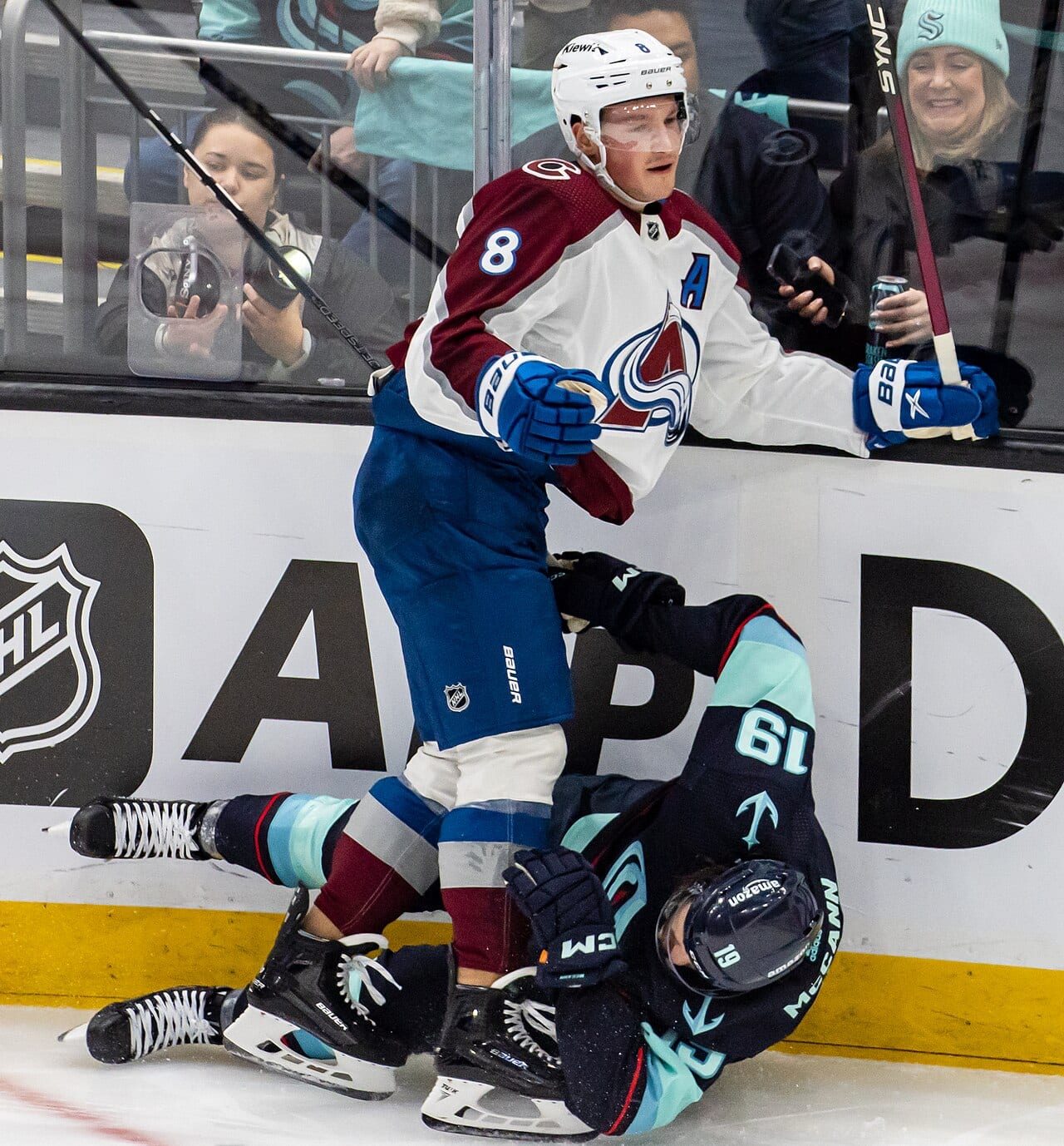
Joe Sakic said in June that Cale Makar was going to finish his career in Colorado, and that the extension would be signed this offseason. It is August 2. There is no extension.
That is not a crisis. Makar has been extension-eligible only since July 1, he is under contract for all of 2026-27, and nobody is suggesting he wants out of Denver. What it is, though, is a countdown, and the Avalanche appear to be the last people counting. On September 16 the new collective bargaining agreement takes effect, and with it the maximum length of a re-signing drops from eight years to seven. Every deal signed on or after that date is capped at seven. Colorado has roughly six weeks left to buy a year of contract it will never be offered again.
The Eighth Year Stops Existing on September 16
The current CBA expires September 15, 2026. The agreement the league and the union ratified in 2025 runs from September 16, 2026 through September 15, 2030, and it shortens contracts: seven years maximum to re-sign with your own club, six to sign with a new one, down from eight and seven. The limits attach to the date the contract is signed, not the date it covers, and everything signed before September 16 keeps its term.
That is not a reading of the fine print. It is what the league has been doing all summer. Montreal agreed to an eight-year extension with Ivan Demidov on July 1 that runs from 2027-28 through 2034-35, which is to say every single season of it falls under the new agreement. The Marino extension in Utah, also eight years, followed later in the month. Both are legal because of when they were signed. Neither would be if the same paperwork were filed in October.
That is the whole mechanism, and it is why the Avalanche’s calm is expensive. Makar’s next deal starts in 2027-28 either way. But a deal papered on September 14 can run eight years and a deal papered on September 17 cannot, and the difference is not a rounding error on a contract this size.
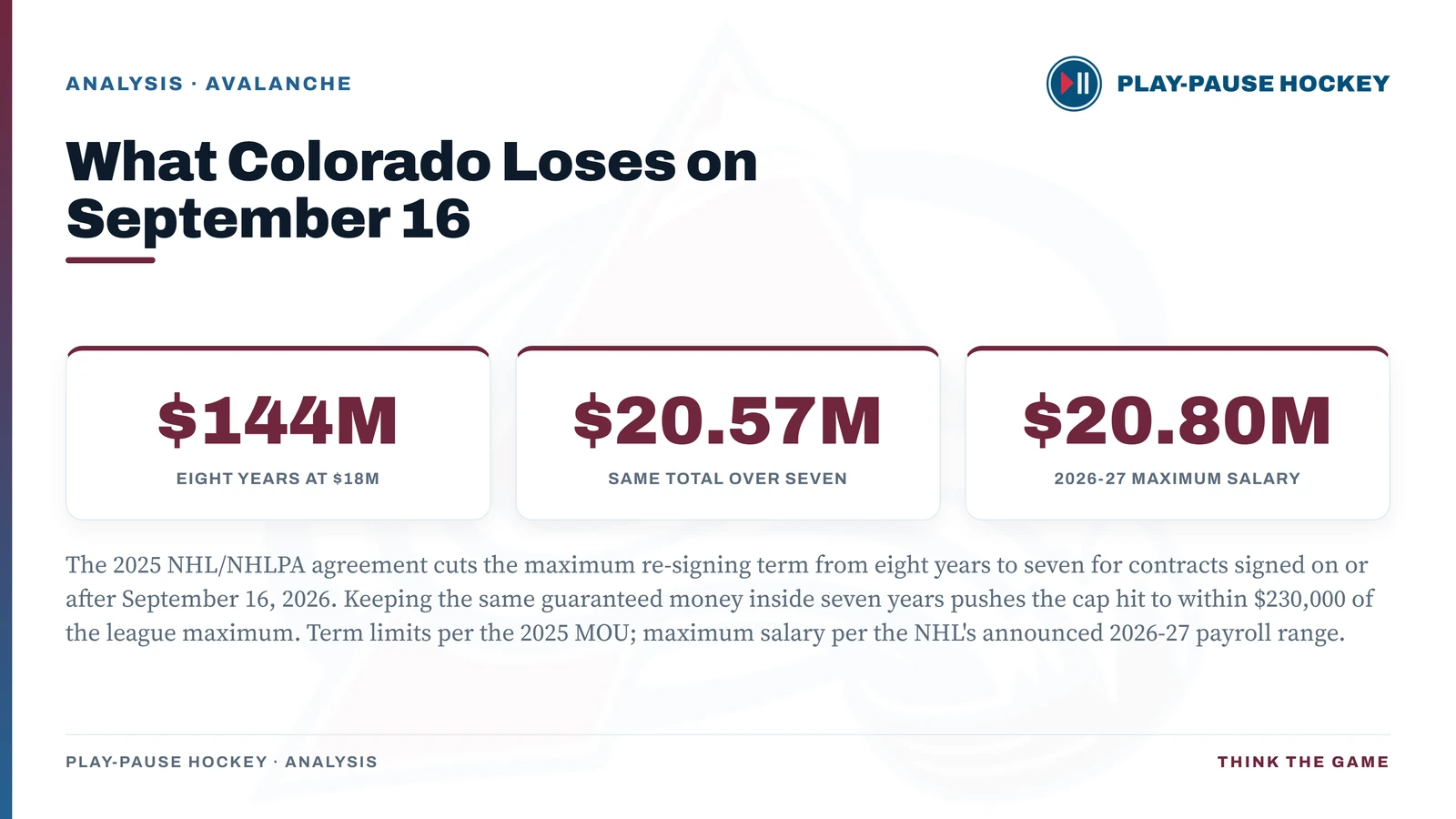
Run the arithmetic on the number we projected for him in July, which is also the one the market keeps circling: $18 million a year. Eight years at $18 million is $144 million. Take the eighth year away and hold the money constant, and the same $144 million over seven years is a $20.57 million cap hit.
For scale, twenty percent of the $104 million upper limit is $20.8 million, and that is the most the CBA lets any player earn in 2026-27. The seven-year route puts a defenseman’s cap hit within $230,000 of that line. It buys Colorado nothing for the difference. It is the same money, wearing a worse shape.
No deal exists yet, so $18 million is a working number and not a fact. It is worth noticing that the argument does not depend on it. Seven years at the league maximum comes to $145.6 million. Divide that across eight years and you get $18.2 million. Anywhere above that, and most projections for Makar reach it, the eighth year is not expensive to replace inside a shorter deal. It is arithmetically impossible to replace.
Why Sakic Needs That Year More Than Makar Does
The instinct is to read a long term as something the player wins. Here it is backwards.
Makar is 27, a two-time Norris Trophy winner, and coming off 79 points in 75 games with a plus-32. He is going to be paid at the top of the defenseman market whenever he signs and whatever the term. What the eighth year does for him is add security he does not especially need at his age. What it does for Colorado is act as a denominator.
Sakic said that on June 11. Take him at his word about the intent and the deadline still bites, because intent is not a signature and the calendar does not care which one you have.
Look at what Colorado is already carrying. Nathan MacKinnon is at $12.6 million through 2030-31. Martin Nečas is at $11.5 million starting this coming season. Add a Makar deal at $18 million and three players account for $42.1 million, about 37 percent of the projected $113.5 million cap in 2027-28. At $20.57 million instead, the same three take 39.4 percent. That gap, 2.3 points of cap share every year for the length of the deal, is what an eighth year is worth to a team trying to keep a contender together.
The Argument for Waiting, and What It Costs
There is a real case for patience, and it is the one the field keeps making. Quinn Hughes’ extension in Minnesota is still unsigned, reportedly somewhere in the $16 to $18 million range with the term unresolved. Whoever signs second negotiates against the first number rather than against a projection, which is the standoff we laid out when we argued that the defenseman market reset would push Makar and Hughes past Connor McDavid’s share of the cap. Sitting still has a payoff.
On June 29, per Pierre LeBrun of The Athletic (relayed here), "there really hasn't been much work done on it yet" on a Makar extension, with both sides intending to get to it sometime this summer. Nothing has been announced in the five weeks since.
The problem is that the payoff and the deadline are pulling in the same direction only until mid-September, and after that one of them is simply gone. Waiting for Hughes to set a benchmark is a strategy with an expiry date now. The coverage that followed Celebrini’s extension priced the dollars and skipped the calendar.
The eighth year is not a favour to the player. It is the only legal tool Colorado has left for making a $144 million commitment fit under a cap, and it evaporates on a Tuesday in September.
Nobody Wants Eight Years Anymore, and That Is the Real Objection
Here is the pushback, and it is the strong version. The market has moved away from max-term deals. Celebrini’s record extension in San Jose runs five years, not eight. Connor Bedard took five in Chicago. An eighth year on a contract beginning in 2027-28 is a mid-30s season for Makar, and mid-30s seasons at a top-of-market cap hit are exactly the contracts that strand franchises. Read that way, September 16 is not a deadline. It is the league doing Colorado a favour.
Half of that is right. The players taking five years are 20 and 21 years old and buying themselves a second trip to this negotiation while the cap is still climbing. Makar is 27. This is his last contract negotiated from maximum leverage, and he has no reason to bridge.
The other half misreads what removing a year actually removes. It does not remove the money. It concentrates it. A bad final season is a problem a team can trade, retain salary on, or absorb once. A cap hit 2.3 points higher is a problem the Avalanche pay for on every single day of the contract, including the good years, including the years they are trying to add a winger at the deadline. And if Makar would genuinely rather have the shorter deal and reach free agency again sooner, that is not a shared outcome. It is Colorado losing an option for free, which is the asymmetry worth naming.
What Has to Happen Before September 15
Sign it. Not because Makar is a flight risk, and not because $18 million is a bargain, but because the eighth year is the cheapest thing on the table and it is the only item with an expiry date.
Two things to watch between now and then. If Hughes signs in Minnesota in August, expect Colorado to move within days, because the benchmark excuse dies and the calendar does not. And if nothing is announced by the first week of September, watch for a deal that lands suspiciously fast in the days right before the 15th. A rush that late is not a breakdown in talks. It is a front office that finally read the calendar.