

Leo Carlsson has never scored 30 goals in an NHL season. On Friday, the Philadelphia Flyers made him the highest-paid player in the sport. Both of those sentences are true, and squaring them is the entire story of this offer sheet.
The tender is five years and $90 million, an $18 million cap hit that vaults Carlsson past Kirill Kaprizov’s $17 million and every other contract in the league. Anaheim has seven days to match it or let him walk for four first-round picks. The Ducks have already signaled they will match. So the interesting question was never whether Carlsson stays. It’s what, exactly, Anaheim is agreeing to pay for.
Because $18 million isn’t a price. A price is what a player is worth today. This is a projection, a bet on the player Carlsson becomes, and Anaheim is being asked to guarantee five years of it before he has finished his second full season.
The Résumé Doesn’t Match the Paycheck Yet
Start with what Carlsson has actually done. He put up 29 goals and 38 assists for 67 points in 70 games last season, comfortably a career high. That is a very good season for a 21-year-old center. It is also the only 60-point season he has ever posted, in his first full 70-plus-game campaign.
Now line the number up against the company it keeps. An $18 million cap hit doesn’t make Carlsson the highest-paid young center in hockey. It makes him the highest-paid player, full stop, ahead of Kaprizov, ahead of Leon Draisaitl, ahead of Connor McDavid and Nathan MacKinnon and Auston Matthews. Every one of those players has a longer, louder body of work. Carlsson has 67 points and a good spring.
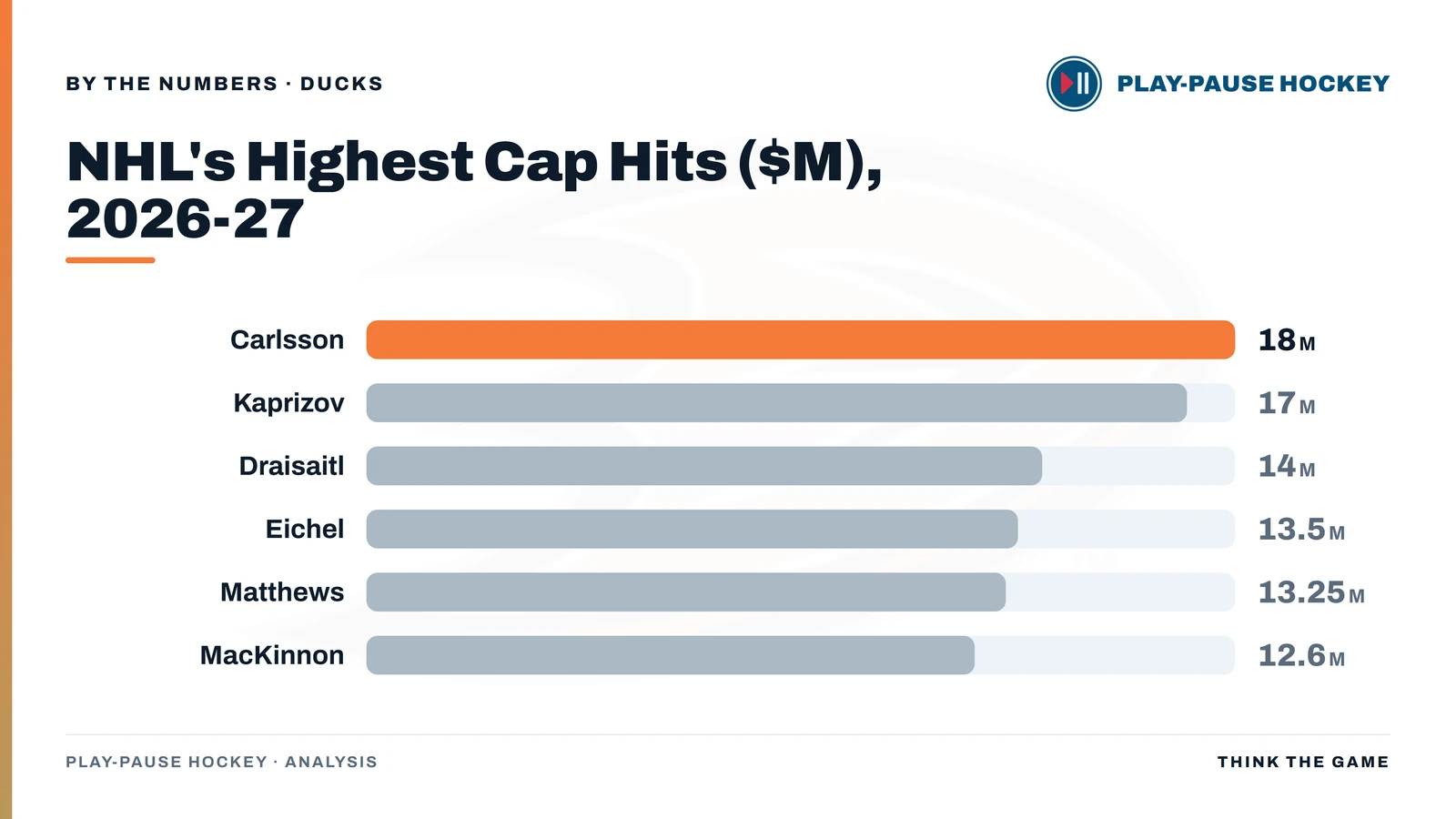
That is the discomfort in one image. The player at the top of the chart is the one with the thinnest case for being there. You don’t pay a rate like this for what a player has been. You pay it for what you are certain he will be.
The Case For Paying Him Like a Superstar Anyway
Here is where the offer sheet stops looking reckless, because the bet is not baseless. Carlsson went No. 2 overall in 2023 for a reason. He is a 6-foot-3 center who skates, and the trend line under the counting stats is steep: he added weight, stayed healthy, and his production jumped the moment his body let it. Then he scored 15 points in 12 playoff games this spring, the kind of run that convinces a front office the ceiling is real and close.
Bet on the arc, not the snapshot, and $18 million for a franchise center entering his age-21 season is not obviously crazy. Elite centers almost never reach unrestricted free agency; the only way to acquire one is to draft him or to overpay for him young. Philadelphia doesn’t have Carlsson to draft. So it did the other thing, and it did it aggressively enough that Anaheim can’t shrug it off.
Why $18 Million Ages Better Than It Looks
The number that scans as absurd today scans very differently in three years, and that is the part the sticker shock hides. The salary cap is not sitting still. It jumps to $104 million this season, then to $113.5 million in 2027-28, part of the steepest climb in league history.
Run Carlsson’s flat $18 million against that rising ceiling and the percentage falls every year. It’s 17.3% of the cap now. By 2027-28 it’s under 16%, and it keeps shrinking through the back half of the deal. A contract that makes him the highest-paid player in the league in 2026 could look like a mid-tier star’s number by 2029, if the player grows into it.
The genius of a long deal on a rising cap isn’t the dollars. It’s that you lock the percentage today and let inflation pay part of the bill tomorrow. That only works if the player is good. If he isn’t, you’ve simply guaranteed the mistake for five years.
That is the whole wager in two sentences. The structure is smart. The exposure is total.
The Real Cost Isn’t the Picks. It’s the Squeeze.
When people say Anaheim “keeps its four first-round picks” by matching, they’re describing the cheap part of the decision. The expensive part is what $18 million does to the rest of the roster.
The Ducks are projected to have roughly $35 million in space. Slot Carlsson in and about $17 million is left, with a 23-man roster still to finish and two of their best young players unsigned. Cutter Gauthier is a restricted free agent who could command north of $8 million on his next deal. Pavel Mintyukov is another raise waiting to happen. Pay Carlsson the freight and the money to keep the players around him gets tight in a hurry.
Per multiple reports, Anaheim informed the market it would match any offer sheet on Carlsson; GM Pat Verbeek was described as caught off guard by the Flyers' term and value.
This is the offer sheet’s actual weapon, and Philadelphia knew it. You don’t send a tender like this expecting to land the player. You send it to make a rival either lose a cornerstone or pay so much for him that the rest of the roster suffers. Either outcome is a win for the team writing the offer. Carlsson was never really the target. Anaheim’s flexibility was.
Should Anaheim Just Take the Four Picks?
Say it out loud, because almost no one will: four first-round picks is a genuinely enormous return, and there is a version of this where a rebuilding-adjacent team takes them and doesn’t blink.
Four firsts over 2027 through 2030 is the entire foundation of a retool. Offer sheets almost never actually move players precisely because that compensation is punishing; only four have changed teams this way in twenty years. A team truly unsure whether Carlsson is a $9 million player or an $18 million one could bank four lottery tickets, spread the cap room across a deeper roster, and be defensible doing it.
Anaheim won’t, and its certainty is the most revealing thing in this whole saga. The Ducks are telling the league that five cost-controlled years of Leo Carlsson are worth more to them than four first-round picks and $18 million of annual flexibility. That is not a small statement. It’s a franchise deciding, in public, that the projection is the sure thing.
They’re probably right. Carlsson is the kind of player you build around, and letting him leave for picks you’d spend years trying to turn back into a player like him is how rebuilds get stuck. But “probably right” is the honest ceiling here, and it’s worth remembering what that phrase is doing. It’s carrying $18 million a year, for five years, on the back of one healthy season. Anaheim is matching. Now it has to be sure.