


Macklin Celebrini said the quiet part out loud, and he put a number on it. Asked by ESPN whether he would take less than market value to help San Jose build a winner, the 20-year-old center didn’t hedge for a second: “Yeah, 100%.” It is the kind of line that gets a young star canonized in a rebuild city, the franchise cornerstone volunteering to leave money on the table so the roster around him can get better. It is also, if the Sharks read it wrong, the most expensive favor no front office should accept on reflex. A discount is only a gift if the team is close enough to actually spend it.
Per ESPN's Greg Wyshynski (July 14, 2026), Celebrini said he would "100%" consider an extension below market value: "That's why all of us play. We want to win."
The instinct is to celebrate it, and the instinct isn’t wrong. A 20-year-old coming off a 115-point season telling his rebuilding team he’ll take less is the opposite of the problem most franchises have with their best player. But celebration is the easy part. The hard part is deciding whether San Jose is actually in a position to convert that generosity into wins, or whether it’s about to bank a discount it can’t yet cash.
Why the Timing Beats the Number
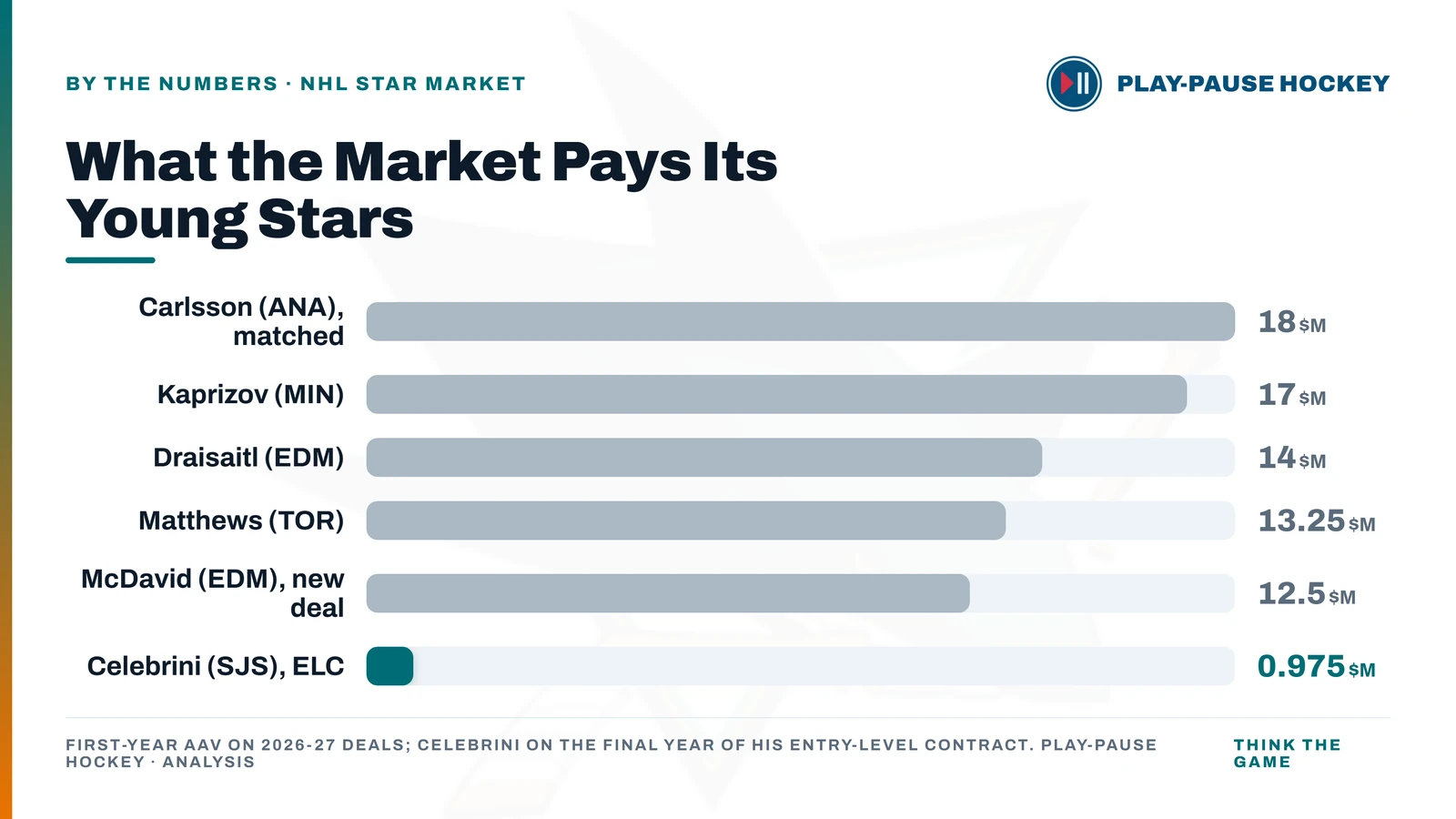
Here is what makes the pledge matter more than the words. Celebrini has exactly one year left on his entry-level contract, a $975,000 cap hit, and he becomes extension-eligible this offseason. He is not negotiating from need. He is negotiating from the best possible leverage a young player can have, coming off a season where he put up 115 points and broke Joe Thornton’s franchise single-season scoring record that had stood since 2007.
And the market didn’t just move under him. It detonated. Anaheim matched Leo Carlsson’s offer sheet at $18 million a year in July, the highest AAV in the league for a player barely older than Celebrini. Kirill Kaprizov signed at $17 million in Minnesota. Connor Bedard, the No. 1 pick a year before Celebrini, is reportedly seeking around $17 million against a Chicago opener closer to $12 million. Celebrini outproduced most of that group last season and is volunteering to price himself below it.
“I think it’s just whenever it makes sense for both sides. I still have a year left. There’s no reason to rush.”
That patience is the tell. Pierre LeBrun reported in late June that there had been “very little in terms of talks” and “zero hurry” on either side, with both camps content to wait for Bedard’s number to land first and set the baseline. Celebrini’s discount comment, then, isn’t a signed concession. It’s a public marker dropped early, shaping the tone of a negotiation that hasn’t formally started. That makes it a strategic signal, and signals are worth reading carefully before anyone calls them a bargain.
Every Discount That Aged Well Shared One Thing
Sidney Crosby, Brayden Point, Aleksander Barkov. Whenever a star takes less, these are the names that get invoked as proof it works, and all three deals did work. Crosby’s 2012 extension, front-loaded and paid out mostly in its first nine years, came in a full percentage point of cap share below the Toews and Kane comparables of the day. Point signed for $9.5 million in 2021, a genuine discount for a point-per-game center, landing below the $10.9 million Mitch Marner had banked two years earlier. Barkov’s $10 million AAV that same summer looked team-friendly the moment he signed it.
Look at what those three teams had in common when the pen hit the paper, though, and the comparison to San Jose falls apart.
Pittsburgh was a mid-dynasty contender that turned Crosby’s discount into two more Cups in 2016 and 2017. Tampa Bay was a reigning champion that used Point’s savings to keep a winning core intact. Florida was an ascending team a few years from back-to-back titles. In every case, the discount was fuel poured into an engine that already ran. The savings had somewhere to go: a deadline addition, a depth re-signing, a roster already close enough that one more piece mattered in May.
San Jose is not that team. The Sharks are still assembling a blue line, still years from a playoff conversation, still closer to the draft lottery than a bracket. A discount banked now doesn’t buy a contender one more player. It buys a rebuilding team cap space it has no urgent use for, in a window where the difference between good and great isn’t yet on the table.
The Case That a Rebuild Discount Is the Low-Risk Play
The honest counter-argument is a good one, and it starts with a fair question: what discount, exactly? Celebrini is on an entry-level deal. He hasn’t earned market value yet, so there’s no established number to go under. Framing this as “leaving leverage on the table” assumes San Jose is already good enough to need every dollar of cap space for a push it isn’t making. It isn’t.
Read it that way and a modest team-friendly extension looks less like a sacrifice and more like cheap insurance. Locking a generational talent in early, before a monster season pushes his price to the Carlsson tier, protects the Sharks from the exact market explosion that just happened to everyone else. There’s a real version of this where patience costs San Jose more than a discount ever could.
The sharpest objection cuts even harder: none of this is real yet. Celebrini can’t sign meaningful term until he’s a restricted free agent in 2027, so the whole “discount” conversation is a quote, not a contract. That’s true, and it’s the strongest reason not to overreact. But the value of the moment isn’t a signed figure. It’s that his camp is already anchoring the negotiation’s tone in public, before Bedard resets the comp, and that’s a lever the front office now has to use well rather than waste. A discount offered early is only worth something if the team is ready to earn it.
What San Jose Has to Prove Before the Ink Dries
Celebrini did his part. He said the thing every rebuild dreams of hearing from its franchise player, and he meant it. The burden now sits entirely with Mike Grier, because a discount from your best player is not a strategy. It’s a subsidy, and a subsidy only works if someone spends it on winning.
That’s the test worth watching, not the AAV. If the Sharks bank Celebrini’s generosity and then sit on the flexibility while the roster around him stays a lottery team, they will have converted their best asset’s goodwill into nothing but a smaller cap hit. If they turn it into real additions, a top-pair defenseman, a legitimate second scoring line, the pieces that move a team from 25th to a wild-card fight, then the discount becomes what Crosby’s and Point’s and Barkov’s were: the down payment on a contender.
Bedard’s deal will set the number. San Jose’s roster moves over the next two summers will set the answer. Celebrini has already told the Sharks he’s willing to help them win. The only question left is whether they’re built to take him up on it.