

Somewhere between a podcast studio and a group chat, Cutter Gauthier became the most expensive winger in hockey. He has not signed anything. He cannot be signed by anyone except Anaheim. And the number now attached to his name, a reported unwillingness to take a dollar less than Leo Carlsson’s $18M, is the kind of figure that dissolves the second you hold it up to a cap sheet.
The Bluff Anaheim Should Call
Let’s be clear about what Gauthier is, because it matters to what he is owed. He is a genuinely dangerous young scorer: 41 goals, 69 points in 76 games at age 22, the team lead in scoring on a bad Ducks team. That is a real, bankable talent, and no honest analysis pretends otherwise.
What he is not is Leo Carlsson. Carlsson is a No. 2-overall center signed to the richest AAV in league history because a rival club forced Anaheim to match. Gauthier is an elite finisher on the wing, and the market pays those two things very differently. Anchoring one to the other is not leverage. It is a negotiating fantasy, and the Ducks are under no obligation to indulge it.
The $9M Ledger That Makes $18M a Fantasy
Here is the part the rumor conveniently skips. After matching Carlsson and extending defenseman Pavel Mintyukov at $7.2M, Anaheim is working with roughly $9M in cap space. Not $9M on top of a Gauthier deal. $9M total, for everything still unsigned.
Cap figures per PuckPedia via NHL Rumors, July 15, 2026. Same-day totals shift with roster moves.
To fit a Gauthier contract anywhere near the reported ask, GM Pat Verbeek has to shed real salary first, likely $10M or more. Frank Vatrano ($4.57M) and Alex Killorn ($6.25M) are the names the market keeps circling. Verbeek has about two and a half months until camp to make that math work. The clock pressures Anaheim, yes, but it pressures a 22-year-old with no other suitor a good deal more.
A Podcast Floater, a Denial, and the Market’s Real Number
The trail of the “Carlsson money” story is worth walking, because it is shorter than you would think. It started with Keith Yandle on Spittin’ Chiclets saying he was “fed a little tidbit” that Gauthier would not take a dollar less than Carlsson. Days later, hockey insider Jimmy Murphy answered it bluntly: “Confirmed, this is not true!” What actually has traction is David Pagnotta’s reporting that the number being discussed has climbed into the “15 range,” up from $10-11M before the Carlsson match reset the room.
Fifteen is not eighteen, and neither survives contact with the comparables. Look at what dynamic young wingers have actually signed for since 2023.
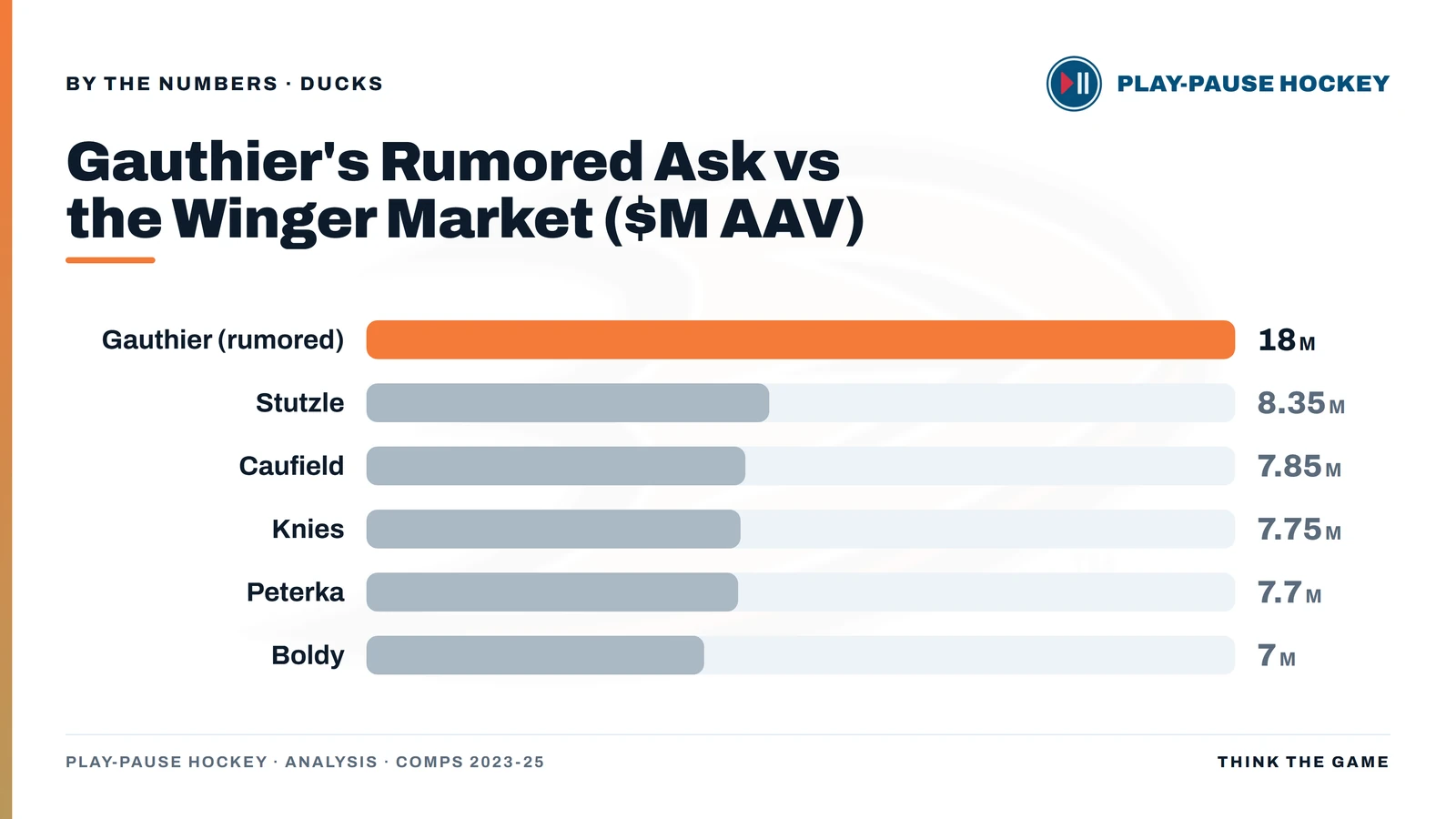
Tim Stutzle tops that group at $8.35M. Not one of them clears $9M. Gauthier’s ceiling season earns him a premium over that field, but a premium is a couple of million dollars, not a doubling. And the strongest reason the Ducks can hold the line has nothing to do with comps at all.
That is the whole ballgame. Carlsson got $18M because Philadelphia could tender him an offer sheet and Anaheim had to match or lose him. Gauthier cannot be offer-sheeted. He has no arbitration rights. His only path to a raise runs through the one team already holding his rights. The player has one move, and it is to sign.
The Case for Just Paying Him
The honest counter starts with the goals. Forty-one of them, at 22, on an entry-level deal, is the profile teams talk themselves into overpaying, and Gauthier’s arrow points up. There is also history the Ducks cannot ignore: this is a player who refused to sign in Philadelphia and forced a trade rather than play somewhere he did not want to be. Push a proud young star too hard and you risk turning a contract standoff into a relationship problem.
The sharpest version of the pro-Gauthier case is structural, not emotional. Why not just hand him a longer deal to bring the annual cap hit down? Because term does not manufacture space in the season that matters. Stretching the years can shave the AAV, but it cannot conjure the $10M Anaheim still has to clear this summer to make any of it legal. The mechanism people reach for to justify the big number runs straight back into the same cap wall.
How This Actually Ends
This gets done, and it gets done closer to the comps than to the rumor. The likeliest shape is a shorter bridge, three to five years in the low double digits, that pays Gauthier as the very good winger he is while Anaheim clears a veteran salary to fit it. Watch Vatrano and Killorn. Watch whether Verbeek lets this drift toward camp, because every week that passes is a week the player’s only leverage, the calendar, works against him as much as it works against the team.
Gauthier is worth paying. He is not worth pretending the cap sheet says something it doesn’t. The Ducks can afford to wait, and they should.