


Everyone keeps reacting to the $17 million like it’s the outrageous part. It isn’t. Connor Bedard’s camp is reportedly seeking an AAV that matches Kirill Kaprizov’s record contract in Minnesota, and it lands below the $18 million ceiling Leo Carlsson set league-wide just four days earlier. The number that should actually raise eyebrows is Chicago’s, reportedly sitting in the $12.5 million to $14 million range. That’s in the same neighborhood as what the Blackhawks just committed to their own top-pairing defenseman. A team with $29.3 million in cap room isn’t underpaying its franchise center because it has to. It’s underpaying him because it can, for now.
That was the report that made the number real. Once it landed, the comparison writes itself.
What $17M Actually Buys in a $104M Cap
Context is the whole story here. The league’s cap jumps to $104 million for 2026-27, up nearly 9% from last season, specifically because deals like this were coming. Run the actual math and Bedard’s ask is the conservative one.
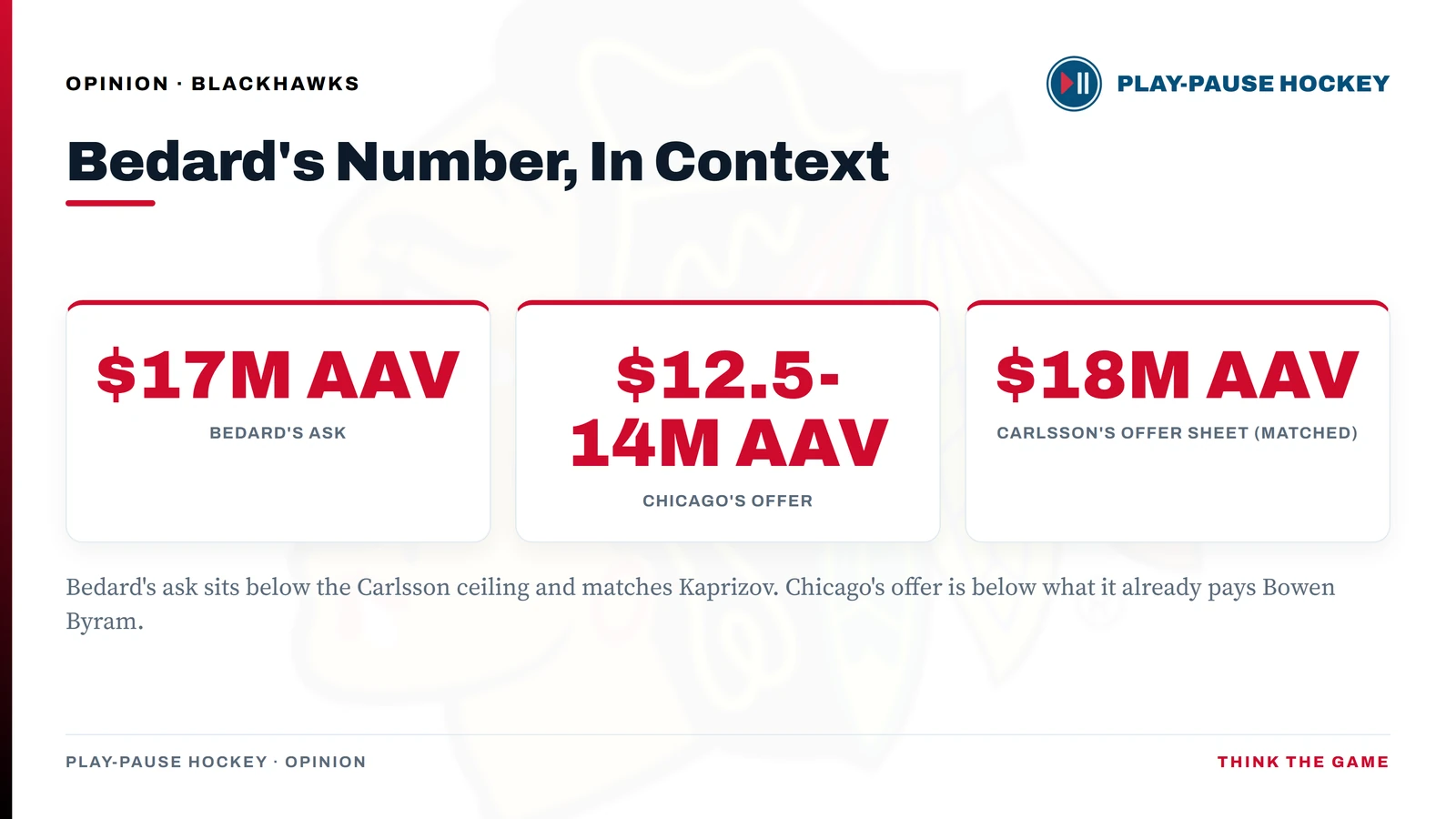
Carlsson, matched by Anaheim on July 9 at $90 million over five years, is the closer comp than Kaprizov. Same age bracket, and a nearly identical regular-season line: 29 goals and 67 points in 70 games, then a first-round upset of Edmonton where he outscored nearly every NHL player 21 or younger. Philadelphia still felt comfortable pricing him a full percentage point above Kaprizov’s cap share. Bedard out-produced him, 30 goals and 75 points in one fewer game, and his camp is asking for a smaller share of a bigger cap than Carlsson just got. That isn’t Bedard reaching. It’s him asking for less, relative to the pie, than a comparable player just got.
The Byram Problem
Here’s the fact that doesn’t get repeated enough: Chicago’s own reported offer to its franchise center sits in roughly the same range it just committed on the back end. Bowen Byram signed a six-year, $75 million extension in Chicago this summer at a $12.5 million AAV (the cap hit kicks in for 2027-28), a deal ESPN flatly called “no debating… overpayment” for a defenseman who’d been moved on from twice.
Bedard posted 30 goals and 45 assists in 69 games last season, a point-per-game pace, after three seasons and 219 career games in Chicago, per Hockey-Reference's career logs.
Put those two numbers side by side and the offer to Bedard reads less like a negotiating position and more like an accident of internal math nobody stress-tested against the guy who’s actually driving the offense. A front office willing to pay $12.5 million for a top-four defenseman has no principled ceiling for capping a point-per-game center, still on his rookie deal, at roughly the same number or less.
The Honest Case Against Bedard
None of this means Chicago is wrong to negotiate hard. The Blackhawks finished 29-39-14 last season, dead last in the Central, and Bedard has played zero playoff games in his career. His production also cooled noticeably after a shoulder injury, 44 points in his first 31 games against 31 points in his final 38. Locking in max term and max money on a player who hasn’t yet proven he can carry a team anywhere in the spring is a real bet, not a sure thing, and any team writing that check should say so out loud instead of pretending it’s obvious.
The stronger response isn’t Carlsson’s résumé, it’s Chicago’s own. The Blackhawks can point to Bedard’s unproven playoff pedigree all they want, but that doesn’t explain why the same front office already paid $12.5 million to a twice-traded defenseman while treating that same number as a ceiling for the player driving its offense. A real bet on term is a defensible position. A team paying more for a name it moved on from than for its best player isn’t caution. It’s an accounting problem dressed up as prudence.
Why Chicago Blinks First
This isn’t a standoff with two reasonable positions converging toward a bridge deal. It’s a team whose own recent spending already undercuts its stated price for the player who matters most. Bedard’s camp isn’t asking the Blackhawks to set a new market. They’re asking Chicago to pay him like the team already paid someone else, on a smaller share of a bigger cap than the league’s own benchmark. The gap here isn’t about whether Bedard is worth $17 million. It’s about how long a front office with $29.3 million sitting unspent can keep pretending the number is the problem.