


Connor Bedard just signed the most interesting contract of the summer, and the interesting part is not the fifteen million dollars a year. It is the number sitting next to it: five. Chicago’s franchise center could have taken the eight-year maximum, locked in security deep into his thirties, and never thought about a contract again until he was nearly 30. He took five instead. That choice, not the salary, is the story.
Bedard Didn’t Take the Max. That’s the Whole Story.
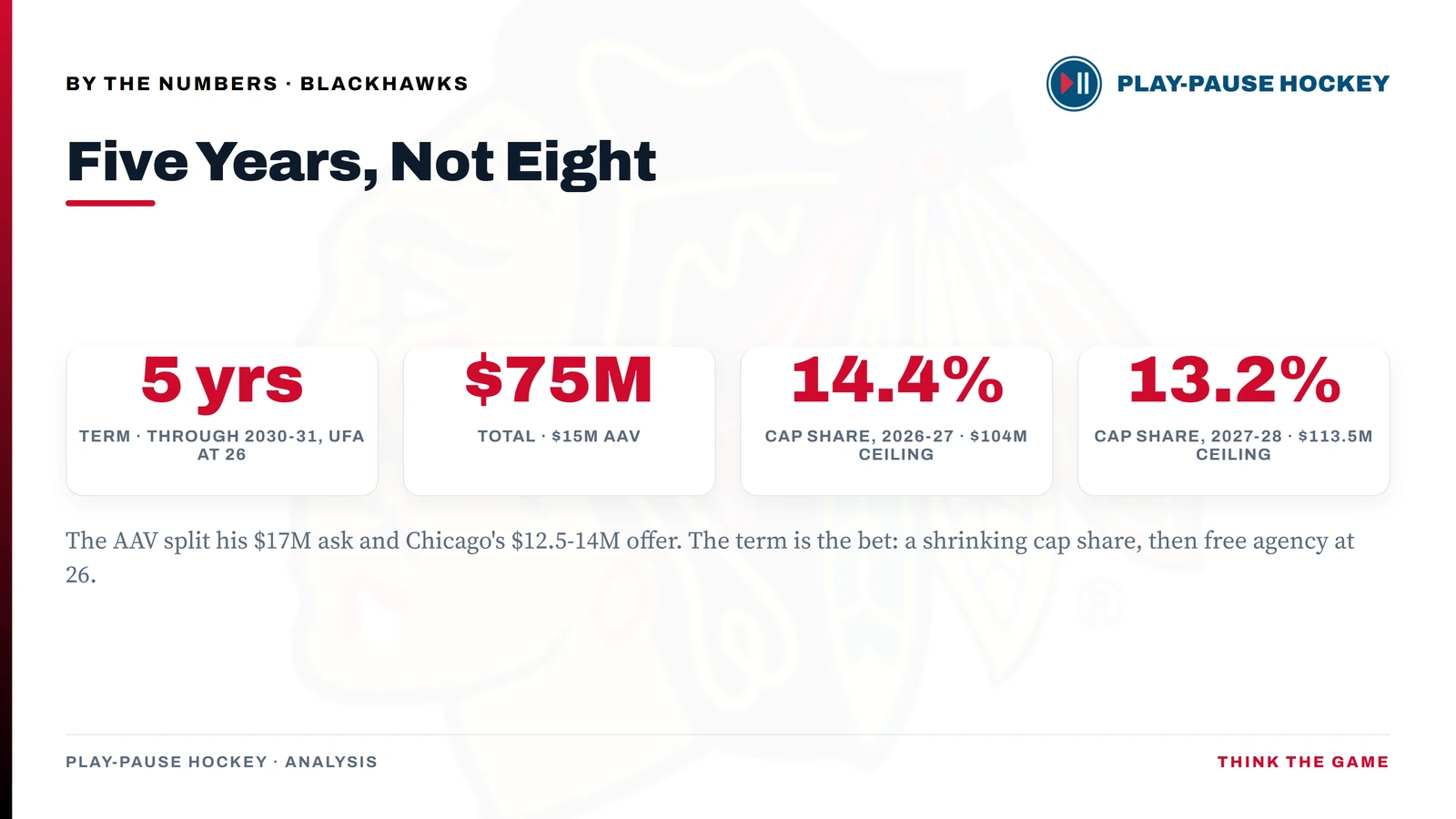
The deal is five years, $75 million, a $15 million average annual value, signed the day after his 21st birthday.
Per the Blackhawks' official announcement (July 18, 2026). GM Kyle Davidson: "Connor has continuously defied our expectations since being drafted, and has quickly established himself as an elite player in the NHL."
The AAV splits the difference between the $17 million his camp was reportedly chasing and the $12.5 to $14 million Chicago had floated. Stop at the money and this reads like a tidy compromise: he came down, they came up, everybody shook hands. But the money is the boring half of this contract. The term is where Bedard actually made a decision, and it is the opposite of the safe one.
Why Five Years Resets Chicago’s Timeline
A five-year deal runs through 2030-31. It walks Bedard to unrestricted free agency the summer he turns 26, square in the middle of his prime, on a salary cap that will look nothing like today’s. That is a problem Chicago handed itself on purpose. The Blackhawks do not get to pencil their best player in as a cost-controlled cornerstone through the back end of the rebuild. They get five years, and then they have to win this negotiation all over again, from weaker footing, against 31 other bidders.
Chicago had the room to go longer. When we broke down Bedard’s contract last week, the Blackhawks were sitting on roughly $29 million in cap space with a reported opening bid in the $10 to $12 million range, per the Fourth Period. Length was never the obstacle. Both sides chose a shorter term because a shorter term is what each of them actually wanted.
The Cap-Share Math That Turns $15M Into a Discount
Here is what the “$75 million!” headlines miss. A cap hit is only ever as big as the cap it sits under. Bedard’s $15 million is 14.4% of next season’s $104 million ceiling. The NHL and the players’ association have already locked the ceiling at $113.5 million for 2027-28, which quietly drops that same $15 million to 13.2% before Bedard plays a shift. Keep the cap climbing the way the league keeps signaling, and by the back half of this contract a generational center is earning something closer to a strong winger’s share of the books.
Five days ago we argued Bedard’s $17 million ask was math, not greed. He signed for two million less. On a shrinking cap share and a five-year term, that is not a climbdown. It is a sharper version of the same bet, and he was not the only RFA who saw it coming.
Pope had the mechanism in June. Bedard, Leo Carlsson and Adam Fantilli were not holding out for more money so much as waiting to see who set the ceiling first. Carlsson’s $18 million offer sheet set it. Bedard signed comfortably under that number, then used the term to buy himself another swing at the market in 2031, when the ceiling will be higher again.
The Risk He Just Put on His Own Shoulder
The honest other side: a short term cuts both ways, and Bedard is not signing this from a position of perfect health. He is coming off left shoulder surgery after an offseason fall, out roughly four months, and he will not play a game on this new contract until around November. A five-year bet on yourself assumes the self stays healthy and keeps climbing. If the shoulder lingers, or the scoring flattens, he just reset his own price downward on schedule.
Then there is the objection a Chicago fan types first: why would the Blackhawks ever agree to hand their franchise player back to the market in his prime? Because the short term protects them too. A rebuild that has not produced a single playoff game yet is exactly the wrong place to bury an eight-year, Kaprizov-scale anchor. If Chicago is good by 2031, they re-sign him from strength. If they are not, they are not the team trapped paying $15 million to a late-20s star who wants out. Neither side had to stake eight years on an unproven situation, so neither did.
What to Watch When He’s Back in November
The contract is signed. The interesting part starts now. Watch the shoulder first, because a clean return sets the floor: Bedard put up 75 points in 69 games last season and has 203 in 219 as a pro, with a Calder already on the shelf. Watch the cap number keep climbing while his hit sits still. And watch the calendar, because this deal was built around a date. In the summer of 2031 a Bedard who just turned 26 walks into a market Chicago will have to out-bid all over again. He did not take the security. He took the option. On a player this good, the option is worth more than the eighth year ever was.