
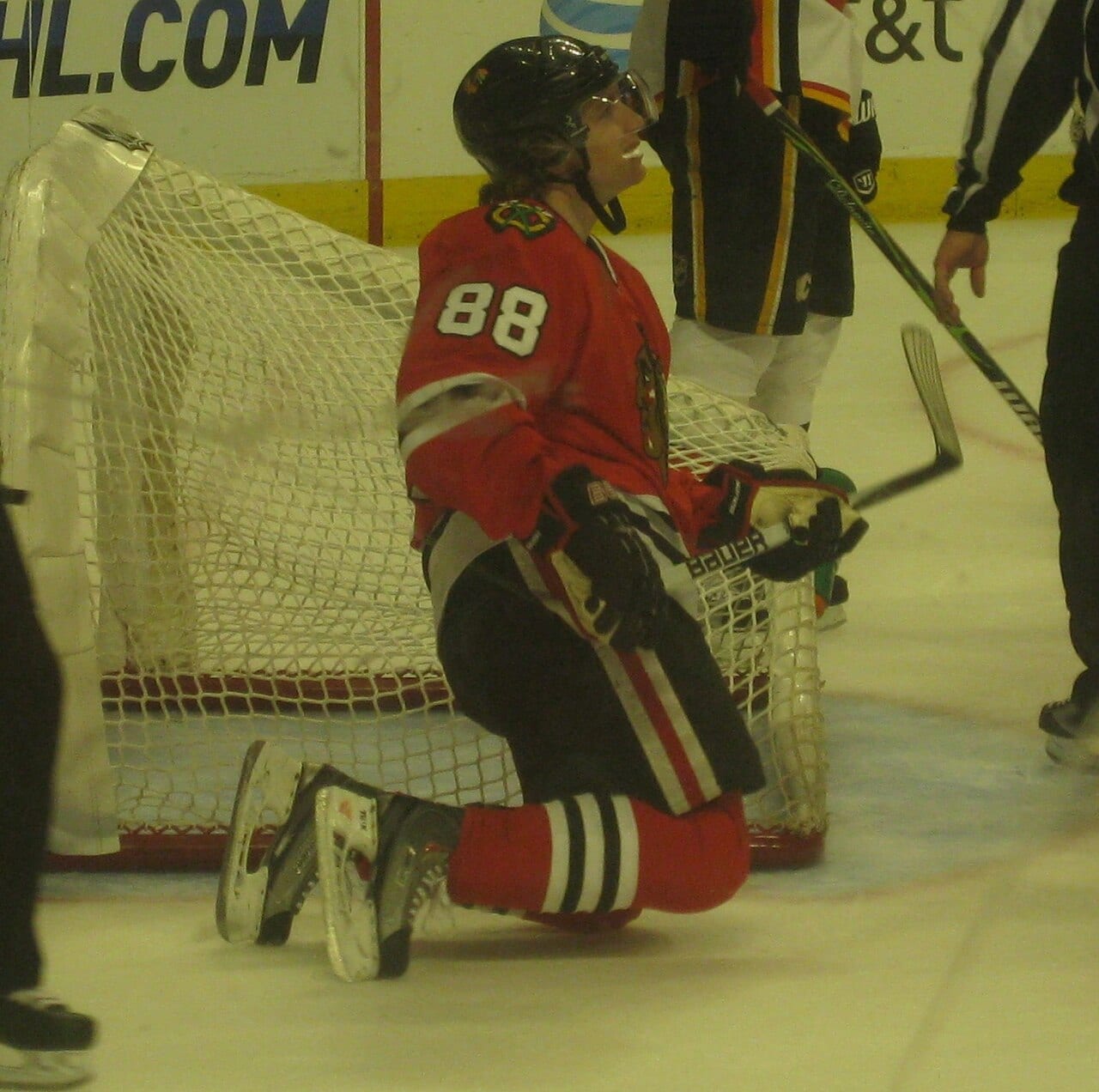
Patrick Kane is a Blackhawk again, and the number attached to the homecoming is the story. Chicago re-signed him on July 23 to a two-year, $16 million contract, an $8 million cap hit with a full no-move clause that runs through 2027-28. That is not what a 37-year-old winger coming off 57 points costs in this market. We know precisely what that player costs, because another team set the price eight days earlier, and Chicago paid 68 percent over it. This deal was never about wins. It was about bringing Patrick Kane home, and the Blackhawks paid a premium to do it.
The circle is complete, and it cost more than it should have. That is not a knock on Kane. It is the whole point.
Eight Million Dollars Is Not What Kane’s Season Was Worth
Start with the production, because it is real and it complicates the easy version of this story. Kane put up 57 points in 67 games for Detroit last season, 16 goals and 41 assists, on a one-year, $3 million deal. In January he passed Mike Modano to become the highest-scoring American-born player in NHL history, and he scored his 500th career goal the same month. He is not a passenger, he is not hanging on, and any team that adds him is better than it was the day before.
Now put the price next to the player. Kane earned $3 million last season. Chicago just handed him $8 million a year, a raise north of 160 percent, at an age when wingers are supposed to get cheaper, not richer.
You do not pay that raise for the hockey. You pay it for the name on the back.
Why the Reunion Had to Happen the Summer Bedard Got Paid
The timing is not a coincidence. Five days before Kane signed, Connor Bedard put his name to a five-year, $75 million extension, $15 million a year, the richest annual salary in franchise history. Chicago’s rebuild finally has its franchise center locked down and paid. What it did not have was a reason for anyone outside the 312 to care about the Blackhawks in 2026-27.
Kane is that reason. General manager Kyle Davidson framed the signing entirely in the past tense: “Day in and day out for 16 seasons, Patrick captivated the city of Chicago with his dazzling skill, creating some of the most memorable moments in Blackhawks history as he helped bring our storied franchise back to the pinnacle of our sport.” Read it again. That is a tribute, not a plan. Nobody in the building is pretending this is the piece that makes Chicago a contender.
“That would be incredible to get to play with him and learn from him.”
That is Bedard, who campaigned for the reunion in public before it happened. The word that matters is “learn.” The 21-year-old franchise center describes the 37-year-old as a teacher, not a running mate. Everyone attached to this signing is telling you what it is.
Anthony Mantha Set the Price. Chicago Paid 68 Percent Over It.
Here is the comparison the celebration skips. On July 15, New Jersey signed Anthony Mantha to two years at $4.75 million. Mantha is 31. He scored 64 points last season, more than Kane, and he carries the size teams claim to prize. Eight days later, Chicago gave Kane $8 million on the same two-year term.
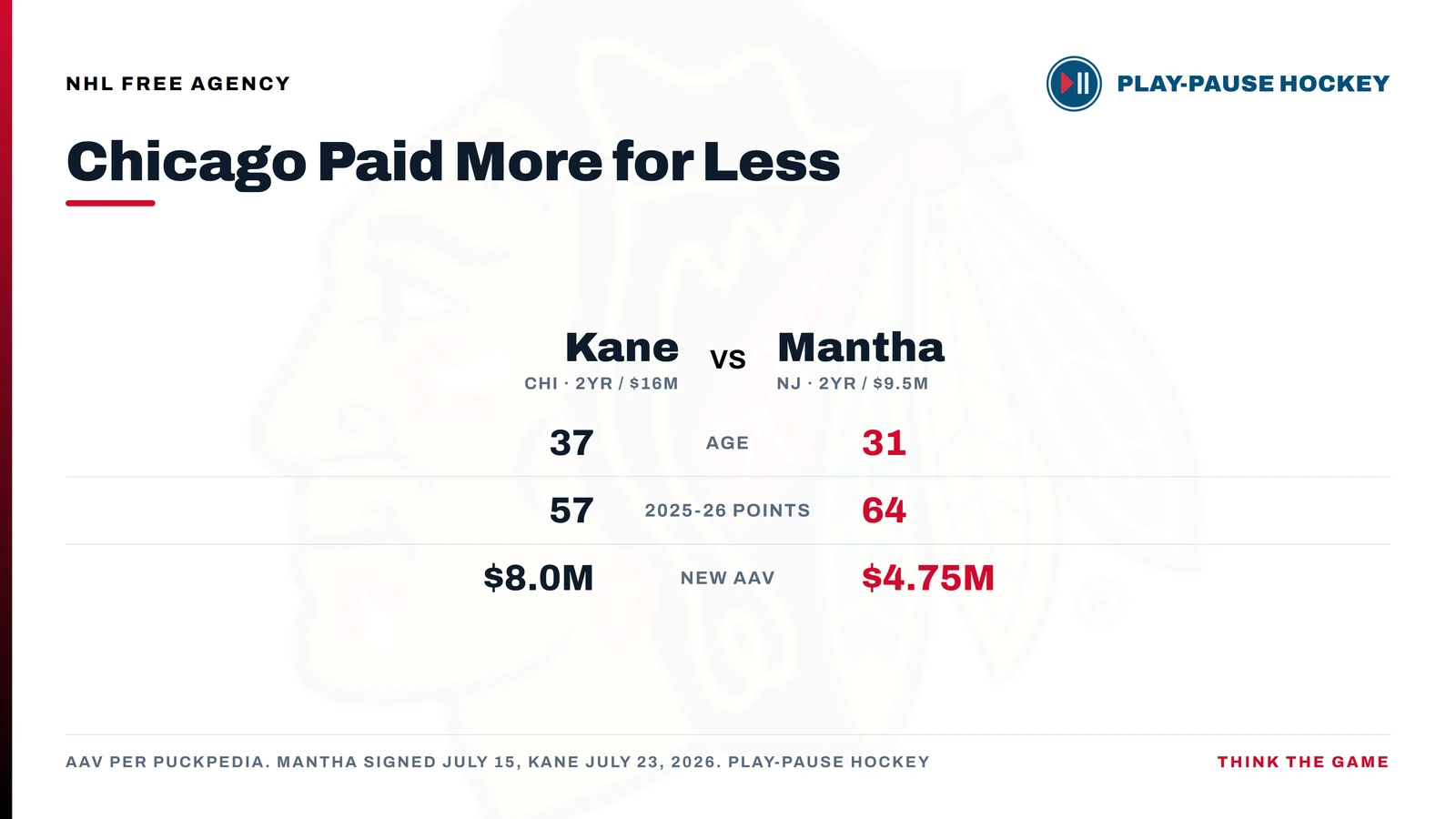
That $4.75 million is the going rate for a productive top-six winger on the wrong side of 35, and Chicago paid 68 percent above it. We wrote three weeks ago, when Patrick Kane’s unsigned summer stretched into its third week, that the 2026 aging-winger market had been repriced and that the number to watch was not the destination but the term. The term came in at two years, and the money came in high. Kane did not get squeezed by the July free-agent freeze the way Tarasenko, van Riemsdyk and Perron still are. He got the one thing the market was handing no one else his age: a raise. Chicago was the only bidder that was never buying a hockey player.
Yes, Kane Still Scores. That Was Never the Objection.
Take the strongest defense of the deal seriously, because it is a fair one. Eight million dollars for a top-six scorer is not an overpay by raw market rate. Plenty of 55-to-60-point wingers make that number and no one blinks. If Kane slots onto a scoring line and posts 55 again, the cap hit is justifiable on production alone, and the whole premium framing looks like nitpicking.
Correct on the number. Wrong on the point.
The objection was never that $8 million buys nothing. It is that Chicago paid it to a player who turns 38 this fall, on a team that is not making the playoffs next season, in the same summer the market valued a younger and more productive version of him at $4.75 million. Every other general manager saw that math and passed. The Blackhawks did not, because for them the math was never the point. Paying the market rate would have been the surprise.
What Two Years Tells You, and What November Will
The term is the honest part of this contract. Two years, not the five the Kane-in-Chicago mythology invites, is management quietly conceding that this is a bridge, not a cornerstone. It self-liquidates before the rebuild is supposed to matter and leaves the books clean for the core Davidson is actually building around: Bedard’s five-year deal and Bowen Byram behind him.
One thing to watch before the reunion even starts. Bedard is out until November after offseason shoulder surgery, which means the pairing the entire signing is built around does not exist when the season opens. Kane’s first game back at the United Center will bring the building down. Bedard will be watching it in a suit. The marketing reunion is immediate. The hockey one has to wait, and by the time it arrives we will learn whether Chicago bought a mentor, a linemate, or an $8 million banner to hang while the kids grow into the team that is actually the plan.