


The Blackhawks did not get worse on Tuesday. They added a legitimate top-pair defenseman, a plus-15 in all 82 games, the kind of player most rebuilds spend years trying to develop. Then they bet a top-four pick that their contention window opens before Bowen Byram’s contract does. Both of those things are true. Only one of them is the trade Chicago actually made.
Buffalo sent Byram and fourth-liner Jordan Greenway to Chicago for the No. 4 and No. 45 picks in this year’s draft plus defenseman Louis Crevier. ESPN graded it a D for the Blackhawks and an A for the Sabres, and the gap between those grades is the whole story.
Chicago Traded the One Asset That Fit Its Rebuild
Start with where this team is, not where it wants to be. The Blackhawks finished 29-39-14, last in the Central Division, with the league’s second-worst points percentage. The draft lottery handed them the No. 4 pick. They turned around and shipped it to Buffalo.
A top-four pick is the most timeline-flexible asset in hockey. It is cheap for seven years, it peaks exactly when a young core matures, and it is the currency a rebuild is supposed to hoard. Connor Bedard is 20 and about to sign an extension that will eat $13 million to $16 million of the cap. The job this summer was to surround him with controllable, cost-shaped talent. The No. 4 pick was that. Byram, at $6.25 million with two years left, is something else.
Byram Is Good Enough to Make This Tempting
Here is the part the pile-on gets wrong: Byram is real. He just turned 25, he plays 22 minutes a night, and he is coming off the best season of his career, 11 goals and 31 assists for 42 points with a plus-15 rating, every game played, plus four goals in 13 playoff games as Buffalo won the Atlantic and a round for the first time in over a decade.
That résumé is exactly why this is a trap, not a steal. A defenseman this good is easy to talk yourself into. He looks like the answer to a question Chicago will eventually have to answer. The trouble is the word eventually, and the contract attached to it.
Two Years of Control, and a Window That Opens Into Them
This is the math that should have stopped the deal. Byram carries a $6.25 million cap hit for 2026-27, and then he is an unrestricted free agent. Chicago, by its own front office’s framing, is targeting a playoff push in 2026-27. So the window is projected to open in the exact season Byram’s deal runs out.
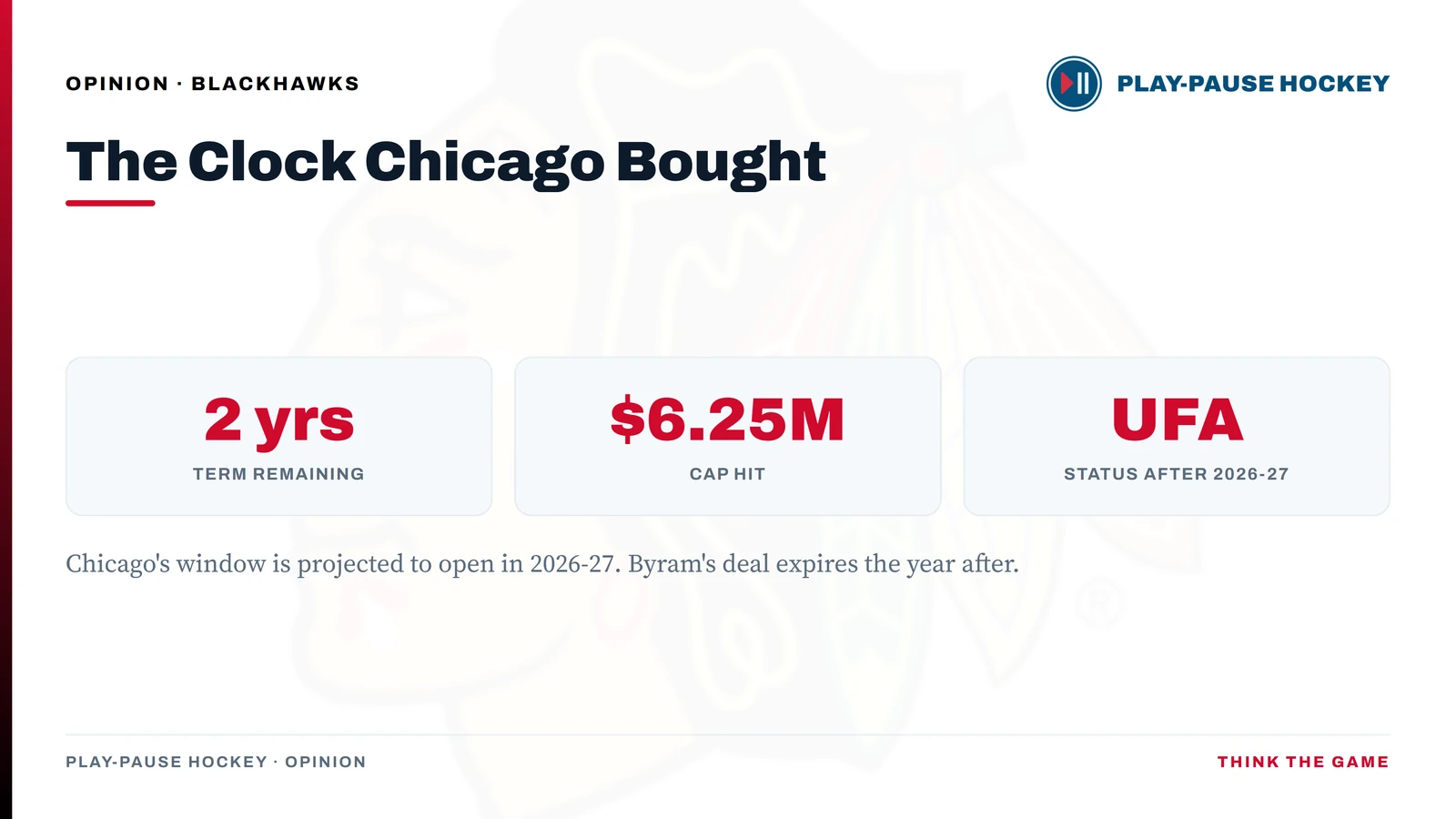
You do not trade a seven-year asset for a two-year one unless you believe the next two years are the ones that matter. Chicago is not there. The Blackhawks have one first-round pick and three second-rounders left in this draft and three first-rounders next year, which is the profile of a team that knows it is still building. Spending the best of those picks on a rental-length deal is the move of a team trying to be two different things at once.
Byram's deal carries a $6.25 million cap hit through 2026-27, after which he can reach unrestricted free agency, per ESPN's trade grades.
The Case Chicago Is Actually Making
Give the Blackhawks their argument, because they have one. The honest version of this trade is that Kyle Davidson thinks the rebuild is closer to done than the standings suggest, and that a 25-year-old who fits Bedard’s prime is worth more than a teenager three years from helping. Add an extension this summer and the two-year window becomes a six- or seven-year partnership. Re-sign Byram, and the UFA clock stops being a problem at all.
That is a real plan. It is also a bet stacked on two other bets: that Byram signs long-term in a market where defensemen of his age and quality routinely test free agency, and that Chicago’s window actually opens on the schedule the front office is selling. Miss on either, and the Blackhawks rented two years of a good defenseman for the price of a cornerstone, with Greenway and a moved-on Crevier as the rounding error.
What Has to Happen for This to Work
The verdict is not that Byram is bad or that adding him is crazy. It is that Chicago paid a contender’s price at a rebuilder’s stage, and the only way that reconciles is if the rebuild is over faster than its own roster says it is.
Look at it from Buffalo’s chair and the contrast sharpens. The Sabres were staring at a defenseman who could have walked for nothing in free agency, and they turned that walk-year into the fourth pick in the draft. That is the asset management a rebuild is supposed to practice, and it is the exact instinct Chicago sold off.
So watch two things. First, the extension: if Byram signs through his late twenties before next summer, the math changes and this trade gets defensible in a hurry. Second, the standings: a real step toward a playoff spot in 2026-27 would mean the window opened on time and the urgency was earned. Until both land, this is a good player bought a year early, and the team that sold him is the one that got the future right.