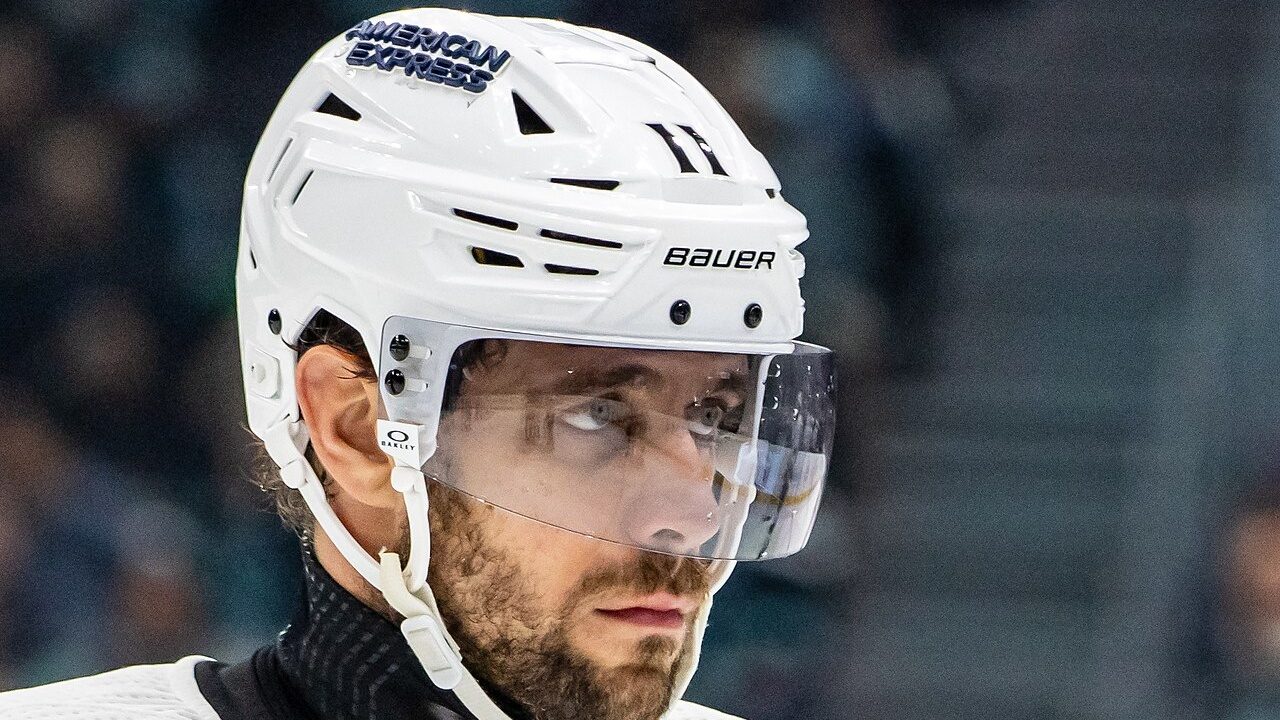
In the two springs Los Angeles won the Stanley Cup, nobody in the NHL outscored Anze Kopitar in the playoffs. He did not win the Conn Smythe either time. On February 24, 2027, the Kings are going to put him in bronze.
Anze Kopitar spent twenty seasons collecting hardware, and the hardware kept naming something other than what he actually did on the ice. Two Selke Trophies for defense. Three Lady Byngs for sportsmanship. A Mark Messier Leadership Award. A trophy case most Hall of Famers would take, and not one line in it that says: this man scored. The jersey retirement announced on August 7 is the first honor of his career that describes the player rather than the job.
Here is the thing nobody has put next to the ceremony. In 2014, the year he led every skater in the league with 26 playoff points, 21 of those points were assists. Four out of every five points he produced went into the box score under somebody else’s goal.
What Los Angeles Is Actually Putting in Bronze on February 24
The Kings announced the ceremony on August 7, 2026. No. 11 goes to the rafters and a bronze statue goes up outside Crypto.com Arena, before a game against Montreal, sculpted by Julie Rotblatt Amrany and Omri Amrany.
Two details matter more than the date. He becomes the eighth King with a retired number, joining Rogie Vachon, Marcel Dionne, Dave Taylor, Wayne Gretzky, Luc Robitaille, Rob Blake and Dustin Brown. And he becomes only the fourth with a statue, after Gretzky, Robitaille and Brown.
That second list is the interesting one. Three of the four came out of a championship era, which invites the obvious reading: the statues are a banner list, not a greatness list. Kopitar is the name that survives that reading. Strip the 2012 and 2014 banners out of his résumé and he is still the franchise leader in games played, assists and points.
“Anze Kopitar has defined what it means to be a Los Angeles King for the past two decades,” said Kings president Luc Robitaille, whose own statue Kopitar’s will join.
Two Selkes, Three Lady Byngs, and Not One Scoring Award
Lay the ballots out and the pattern is hard to unsee.
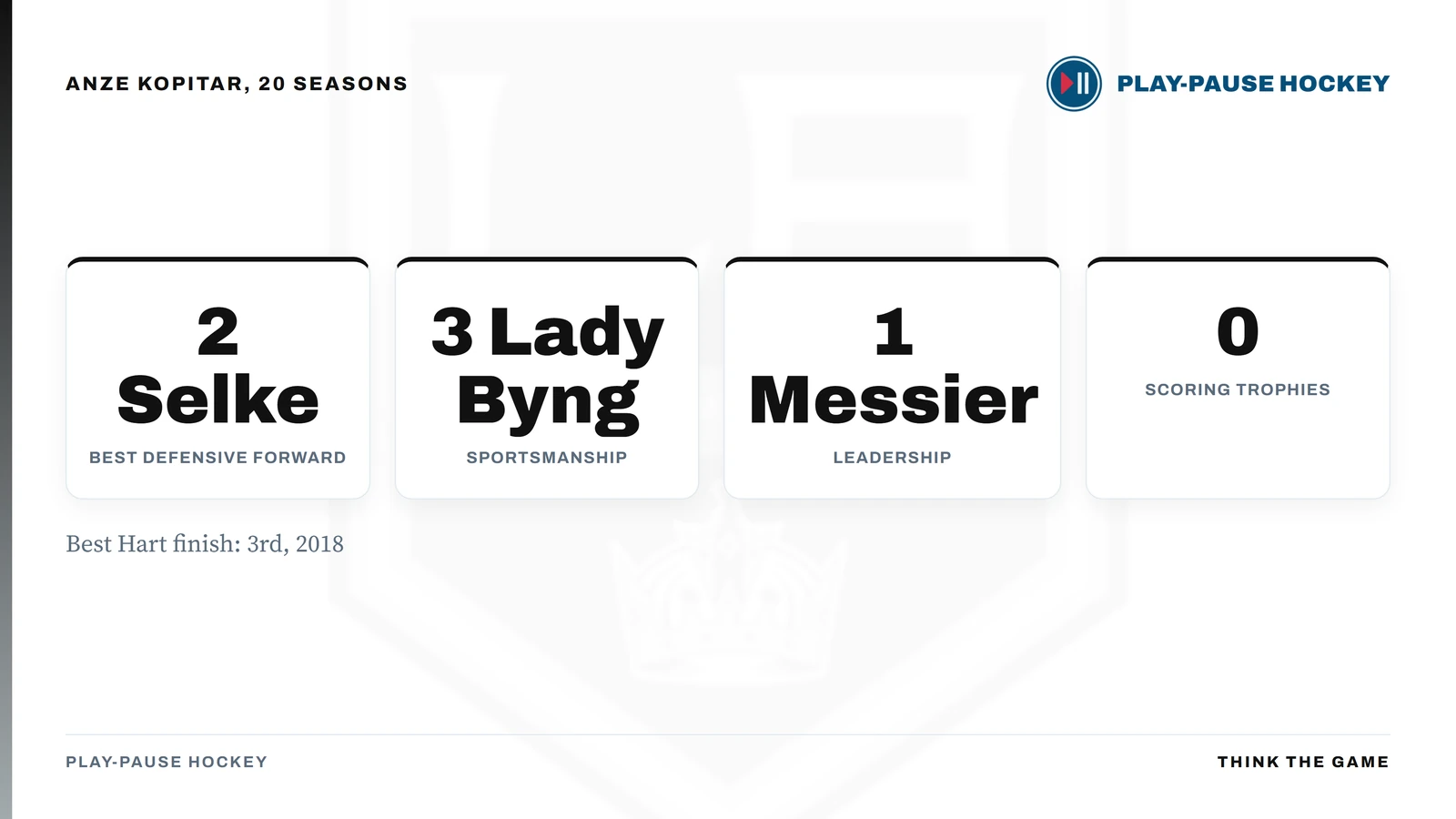
He won the Selke in 2016 and 2018. He won the Lady Byng in 2016, 2023 and 2025. He won the Messier in 2022. He was a Hart Trophy finalist exactly once, in 2018, and finished third. Across twenty seasons and 1,316 points, his award record contains no scoring honor at all: no Art Ross, no Rocket Richard, no Conn Smythe.
The assist share is why. Of his 1,316 regular-season points, 864 are assists, which is 65.7 percent of his career output. In the playoffs the tilt is sharper: 62 assists inside 89 points, or roughly 70 percent. And in the single spring he was the best offensive player in the sport, the number hits its extreme.
This is not a conspiracy against him. It is a mechanism. Awards voting rewards the finish, and Kopitar’s game was the two passes before it. In 2012 he tied Dustin Brown for the playoff scoring lead at 20 points each, and Jonathan Quick took the Conn Smythe on a .946 save percentage across all twenty games, which was a defensible call by any measure. In 2014 he led outright with 26, and Justin Williams took the trophy with 25, on the strength of elimination games. Twice nobody in the tournament outscored him, and twice the award went to a teammate whose contribution came with a cleaner highlight attached. Brown, his co-leader that first spring, already has a statue outside the building.
The franchise record has the same shape. Kopitar passed Marcel Dionne for the Kings’ all-time scoring lead in March 2026, finishing at 1,316 points to Dionne’s 1,307. He needed exactly 600 more games to do it: 1,521 to Dionne’s 921, which is 0.865 points per game against 1.419. We have run this argument in the other direction before, on what a cost per point ranking actually measures. Volume records reward the career. They do not settle who was better on a given night, and Kopitar’s own record book is the cleanest example of that on the West Coast.
The Case That Kopitar Was Never Underrated at All
The strongest case against this piece is that the premise is soft. He won two Cups. Nobody in the league outscored him in either run. He got two Selkes, three Byngs, a Messier, a Hart finalist nod, five All-Star Game invitations, a captaincy he held for a decade, and an eight-year, $80 million contract in 2016 that paid him like the best player on his team, because he was. That is not the résumé of an overlooked man. Nobody builds a statue for somebody the sport ignored.
Fair. And the 2012 Conn Smythe is genuinely not an injustice: Quick started all twenty games and stole several of them, and no reasonable voter picks the center over that goaltender.
The claim here is narrower and harder to dodge. Kopitar was recognized precisely, repeatedly, and always for the same thing. Every trophy he actually won is a trophy about how he plays without the puck, or how he behaves, or how he leads. The one award class that would have said he was among the best offensive players in the world is the one class that never came, in the years he was demonstrably among them. A player can be honored constantly and still be filed under the wrong heading for twenty years.
Award years, franchise records and playoff totals per the Kings' official announcement of August 7, 2026 and NHL award records. Career totals as of his retirement following the 2025-26 season.
The Statue Settles What the Ballots Left Open
A statue does not have a category. That is the whole point of it. The Selke says defensive forward, the Byng says sportsmanship, the Messier says leader, and every one of those is a qualifier bolted onto the front of the compliment. Bronze outside the arena says the thing without the qualifier: for twenty years this was the Los Angeles Kings.
Daily Faceoff ran the analytics version of this case in March, ranking him fourth among all NHL forwards by wins above replacement since 2007-08 and calling the profile high floor, low ceiling. The floor framing is right and it is also the trap. A player who never had the loudest season in the league had the most consistently valuable two decades in his franchise’s history, and the voting record has no column for that.
Why the Ovechkin Version of a Career Is Easier to Honor
Set it beside the kind of career the sport finds easiest to honor. Ovechkin’s 1,000-goal chase is two decades of work that fits inside a single number, and the number does the arguing on his behalf. Kopitar’s twenty years cannot be stated without a paragraph, which is most of the reason the ballots kept reaching for a category instead of a verdict.
So watch what actually happens on February 24. The banner goes up, the tarp comes off the bronze, and for the first time in twenty years Los Angeles honors Anze Kopitar without a qualifier bolted to the front of it. No category, no trophy name, no explanation of which part of his game the award is for. Just the player, outside the building, at the size the Kings think he was.