


Pittsburgh Did Not Spend $32 Million. It Spent an Expiring Option.
The eight years Kyle Dubas handed Ville Koivunen on Thursday are not remarkable because of the money. Four million against the cap is a depth-forward price in a $104 million league, about 3.85 percent of the ceiling, and Pittsburgh will not miss it. What makes this contract worth stopping on is the number eight itself, because in six weeks nobody will be allowed to write it down.
The 2025 agreement between the league and the union cuts the maximum re-signing term from eight years to seven, and from seven to six for a player joining a new club. The limits attach to the date of signature, not the seasons covered, so everything inked before September 16 keeps its full length. That makes an eighth year a use-it-or-lose-it option held by the team, and Pittsburgh just used its own on a right winger with 14 career NHL points.
Contract terms per Pro Hockey Rumors, citing PuckPedia's filing: eight years, $32M, a $4M cap hit running 2026-27 through 2033-34.
The Deadline Is Squeezing the Bottom of the Roster, Not the Top
We wrote about this clock last week from the other end, where an eighth year on the $18 million a year the market keeps projecting for Cale Makar would be $18 million of guaranteed money by itself. Here is the part that piece could not show: the September 15 term deadline is not just inflating superstar contracts. It is pushing maximum term downward, onto players who would never command it in a normal August.
Read the order of operations and it gets sharper. Makar has all the leverage in his negotiation and he is still unsigned in August. Koivunen walked into his with 47 NHL games behind him, and he is committed through 2034. The deadline did not reward the players who could argue. It rewarded the teams holding an option about to expire, and those teams cashed it where it was cheapest.
Forty-Seven Games of Evidence, Eight Years of Term
Koivunen has played 47 NHL games across two seasons. Two goals, 12 assists, 14 points, a minus-10. Look closer at the split and you find the profile Pittsburgh is actually betting on: 12 of those 14 points are assists, and the two goals came on 51 career shots. He has been a passer who has not finished, which is a normal thing for a 23-year-old to be and a nervous thing to buy eight years of. Last season he dressed 39 times and produced seven points. The case for him lives almost entirely one level down, where he put up 41 points in 34 games for Wilkes-Barre/Scranton last season, and that is a genuinely good AHL scorer. It is also not proof of anything at the level he is now paid through 2034.
Eight seasons is more than 650 regular-season games. Pittsburgh has watched 47 of them.
The strongest evidence that the calendar is driving this, and not the scouting, sits six days earlier on the same transactions page. Tommy Novak, 29 years old, 285 NHL games, 159 career points, 42 of them last season alone, signed a three-year extension on July 31 at $4.65 million. Same front office, same week, a higher cap hit and less than half the term for a player with six times the NHL production.
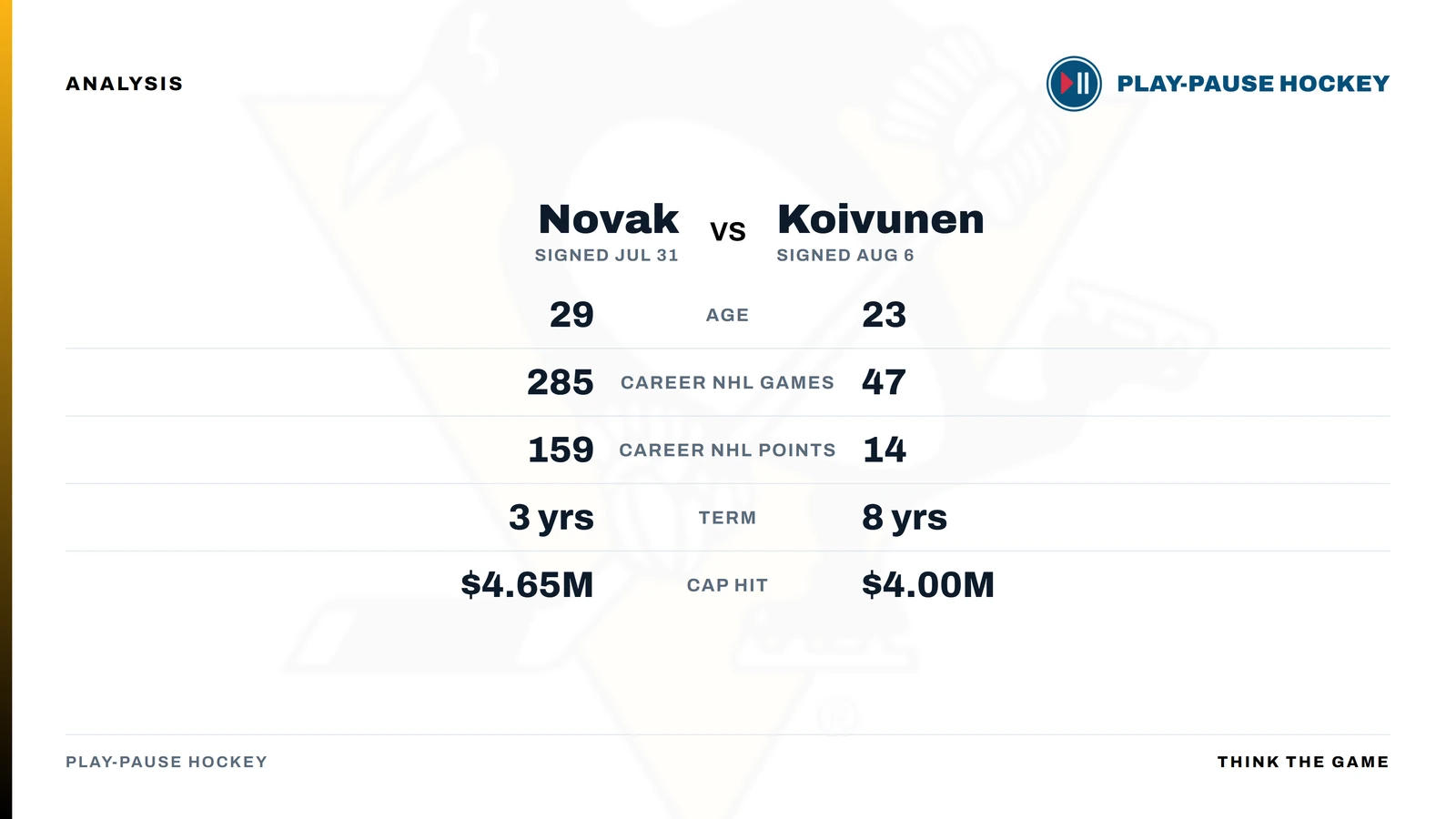
Pittsburgh is not alone in front-running the change. Montreal locked Ivan Demidov into eight years and $73 million on July 1, and Philadelphia did the same with Tyson Foerster at eight years and $56.8 million. Neither of those contracts even begins until 2027-28. Both clubs signed a year earlier than they needed to, for one reason: waiting costs them a year of term they can never buy back. Koivunen is that same behavior applied to a player who has not yet made the on-ice case.
Yes, They Can Buy Him Out. That Is Not the Defense It Sounds Like.
The first reply to all of this is a fair one, and it is about the escape hatch. A buyout of a player under 26 costs a third of the remaining salary rather than two thirds, Koivunen is 23, and $4 million is small. Walk away in a couple of summers and the damage looks trivial.
The damage is smaller than the alarmist version, and Dubas clearly priced that in. It is not free. Signing bonuses are paid in full and keep counting against the cap even after a buyout, and the year-by-year filing has this deal front-loading $2 million of bonus into each of the first two years. That $4 million is gone the moment the ink dries, whatever happens next. Run the rest of it: buy him out in the summer of 2028 and the remaining $26.25 million of salary becomes an $8.75 million charge spread across twice the remaining term.
The cheap exit only opens after the money Pittsburgh can never recover has already been paid.
That is not a catastrophe. It is a dead-weight line item landing in exactly the years the Kyle Dubas rebuild expects its drafted players to arrive, on a team that spent this summer running into Pittsburgh’s closing problem.
What Koivunen Has to Become Before 2029
The verdict is narrower than either the panic or the applause. This is a well-priced option on a good AHL scorer, bought with a coupon that was about to expire, and the term is the whole point of it. San Jose looked at a similar profile and took three years on the Graf contract at a flat $4.25 million. Pittsburgh took eight because eight was still legal.
Judge it on one thing over the next two seasons, because that is exactly how long the cheap exit lasts. Koivunen turns 26 during the 2029 buyout window itself, which makes the summer of 2028 the last clean shot at the one-third tier. He has to turn seven points in 39 games into a real NHL top-nine season before then. Clear that and the eighth year is the shrewdest thing Dubas did all summer. Miss it, and Pittsburgh spent its last one on a player it is still paying to go away in 2040.