

Gary Bettman gave Texas a date. Nobody has given it a building.
On June 23 the commissioner told the Board of Governors that the league would spend six months exploring an expansion franchise in Houston or Austin, built around a signed term sheet with Dan Friedkin’s family. Five weeks later, deputy commissioner Bill Daly said the league and its owners are “primarily interested” in Houston. Everything written since has read like a two-city race with a frontrunner emerging.
Read the same facts as a construction schedule and the story stops being about which city the NHL likes.
Daly's "primarily interested" line comes from a July 29 appearance on The Sick Podcast, reported by outlets citing that appearance rather than a published transcript. Treat it as a real but singly sourced signal. Reporting the following day described Houston's arena situation as unresolved, which is the opposite of what a frontrunner announcement usually means.
Thirty-Four Months Is Seattle’s Number
The league is aiming for Board of Governors approval by the end of this year, with the team playing in 2029-30. Put those two markers side by side and you get roughly 34 months from signature to first puck drop. The NHL has done this twice in the last decade, and 34 is not the number it hits when things go well.
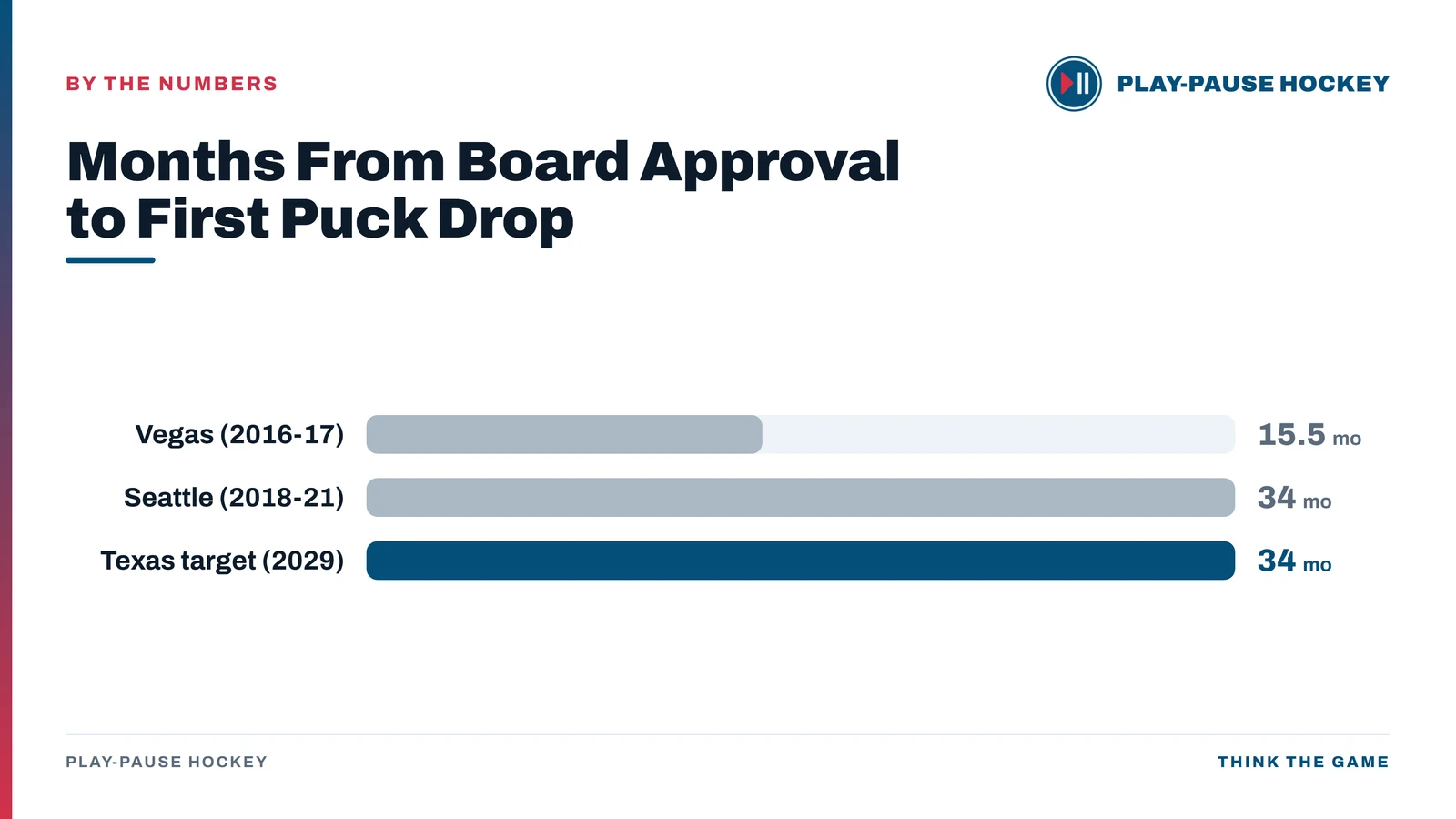
Vegas was approved on June 22, 2016 and played its first game on October 6, 2017. Seattle was approved on December 4, 2018 and did not play until October 12, 2021. Same league, same process, same season-ticket drives, and a year and a half of daylight between them.
One Buyer, Two Cities, One Financing Race
The Houston-versus-Austin framing has the mechanism backwards. There are not two ownership groups competing for a franchise. There is one term sheet, one family, and a choice of address.
That single sentence rewrites most of what followed it. Cities are not bidding for the league’s affection here. An investor is picking a site, and the variable that decides a site is which one can close arena financing.
Note who is not in that sentence. Tilman Fertitta has wanted an NHL team in Houston publicly since at least 2017, and he controls the building the city already has. ESPN reported in March 2025 that Friedkin’s group had emerged as the more viable option; Sportico later put it plainly, calling this a case of the NHL picking Friedkin over Fertitta. Toyota Center is publicly owned but controlled by Fertitta’s Clutch City Sports and Entertainment. The man who runs Houston’s arena is not the man buying Houston’s team.
That last clause is the one worth holding onto. The deal on the table is capitalized to build something.
Vegas Was Fast Because Someone Else Was Already Building
T-Mobile Arena opened on the Las Vegas Strip on April 6, 2016, a joint venture of MGM Resorts and AEG built for a market that wanted a room that size whether or not hockey ever arrived. Bill Foley was awarded his franchise on June 22, two and a half months later. Vegas did not build an arena for hockey. Hockey moved into a building that was already open. Fifteen and a half months.
Seattle had to take Key Arena down to its landmarked roof and rebuild underneath it, and the schedule bent to the contractor rather than the league. Thirty-four months.
Neither Texas city is in Vegas’s position. Austin’s best available venue is the H-E-B Center in Cedar Park, home of the AHL’s Texas Stars, which TSN described as a little over half the size of the NHL’s smallest current rink.
It is smaller than that. The 8,000 figure being quoted is the building’s concert configuration. For Stars hockey the arena lists 6,800, which is under half of Winnipeg’s Canada Life Centre, the smallest building in the league. No Austin arena project for hockey has been publicly named, no site has been announced, and nothing has broken ground in either market.
“I would be surprised if the NHL would be OK with an expansion team that does not have a new arena.”
Brian Mills, associate professor at the University of Texas, to TSN, June 24
But Houston Already Has a Downtown Arena
This is the objection worth taking seriously, because on its face it dissolves the entire argument. Houston has an NHL-standard building in the right part of downtown. In November 2023 the Houston Chronicle reported that Toyota Center lacked only the equipment to make NHL-quality ice, with Rockets president of business operations Gretchen Sheirr saying the goal was “making sure this building is ready for anything, which includes making sure it’s hockey ready.” Add an ice plant, skip the arena bill entirely, play years earlier.
That reporting is real and it is being cited constantly. It is also three years old, and it described an intention rather than a project.
Here is what the project actually says. On April 8, 2026 the Harris County-Houston Sports Authority approved a $180 million Toyota Center renovation. The scope is public and itemized in the arena’s own announcement: a 20,000-square-foot atrium, a Season Ticket Members Lounge, full suite renovations, a new Summit Club, vertical transportation, broadcast fiber, Wi-Fi. We read that release and FOX 26’s coverage of the same approval. Neither mentions ice-making equipment, an ice plant, or hockey.
That is not proof no ice is coming. Plans change and scopes grow. But it does mean the widely repeated idea that Houston is quietly renovating its way to NHL readiness rests on a 2023 statement of intent, not on the $180 million project that was actually approved, and the two are being treated as the same thing. It is the same failure that carried the $19.1M projection on Schaefer’s next contract from outlet to outlet within days: a single estimate hardens into consensus because repeating it is cheaper than checking it.
The deeper problem for the shortcut theory is the transaction itself. A tenancy in someone else’s building, on someone else’s date sheet, is a different deal than the one Friedkin signed a term sheet for. Bettman told the Board in June that both cities would require a new arena.
What Has to Land Before December
The six-month window closes around the end of the year, and the thing to watch is not another quote about which city is ahead. It is a site, a financing structure, and a shovel.
A few honest caveats on the money. The reported split of Friedkin’s $3.5 billion into roughly $2 billion of expansion fee and the rest of arena cost comes from a single Boston Globe report, and the Globe’s own per-team estimate of $50 to $55 million for each of the 32 existing clubs works out to between $1.6 and $1.76 billion, which does not close to $2 billion. Nobody outside the room knows the real number yet, because there is no formal application and no set fee.
What is not in doubt is the direction. Even at the low end of the Globe’s own range, the pot is more than three times the $500 million Vegas paid in 2016, at a moment when the league is still absorbing the NHL’s regional broadcast collapse and rebuilding local media rights market by market. A 33rd cheque is worth a great deal to 32 owners.
Which is exactly why the arena is the only real question left. The buyer is settled, the appetite is settled, and the league has already told you how long a building takes. If a site is not chosen and financed by the time the Board votes, 2029-30 stops being a target and starts being a hope.