


The Larkin List Never Had Pittsburgh on It
Dan Kingerski put a diagnosis in print on August 3 that Penguins fans have been circling all summer. “No, the Penguins are not a top destination right now,” he wrote in a Pittsburgh Hockey Now mailbag, “and the answers are simple, though probably not what you want to hear.” His supporting evidence was Dylan Larkin: “Not being on Dylan Larkin’s shortlist or hearing other players pine to play in Pittsburgh as they did in years past has nothing to do with facilities, coaching, fans, or geography, but everything to do with their current station.”
Per Dan Kingerski, Pittsburgh Hockey Now, August 3, 2026.
The station part is fair. The Larkin part describes an event that never happened.
Larkin’s approved destinations, submitted after his June trade request, were Florida, Minnesota and Vegas. Dallas came aboard on July 9. That is the whole list, four teams, and across the versions reported by ESPN, TSN and Pro Hockey Rumors since June, Pittsburgh has not appeared on one at any point in the Dylan Larkin trade saga. An absence that was never a presence is not a rejection. It is a player with a full no-trade clause naming four teams that were in the playoffs last spring and expect to be again.
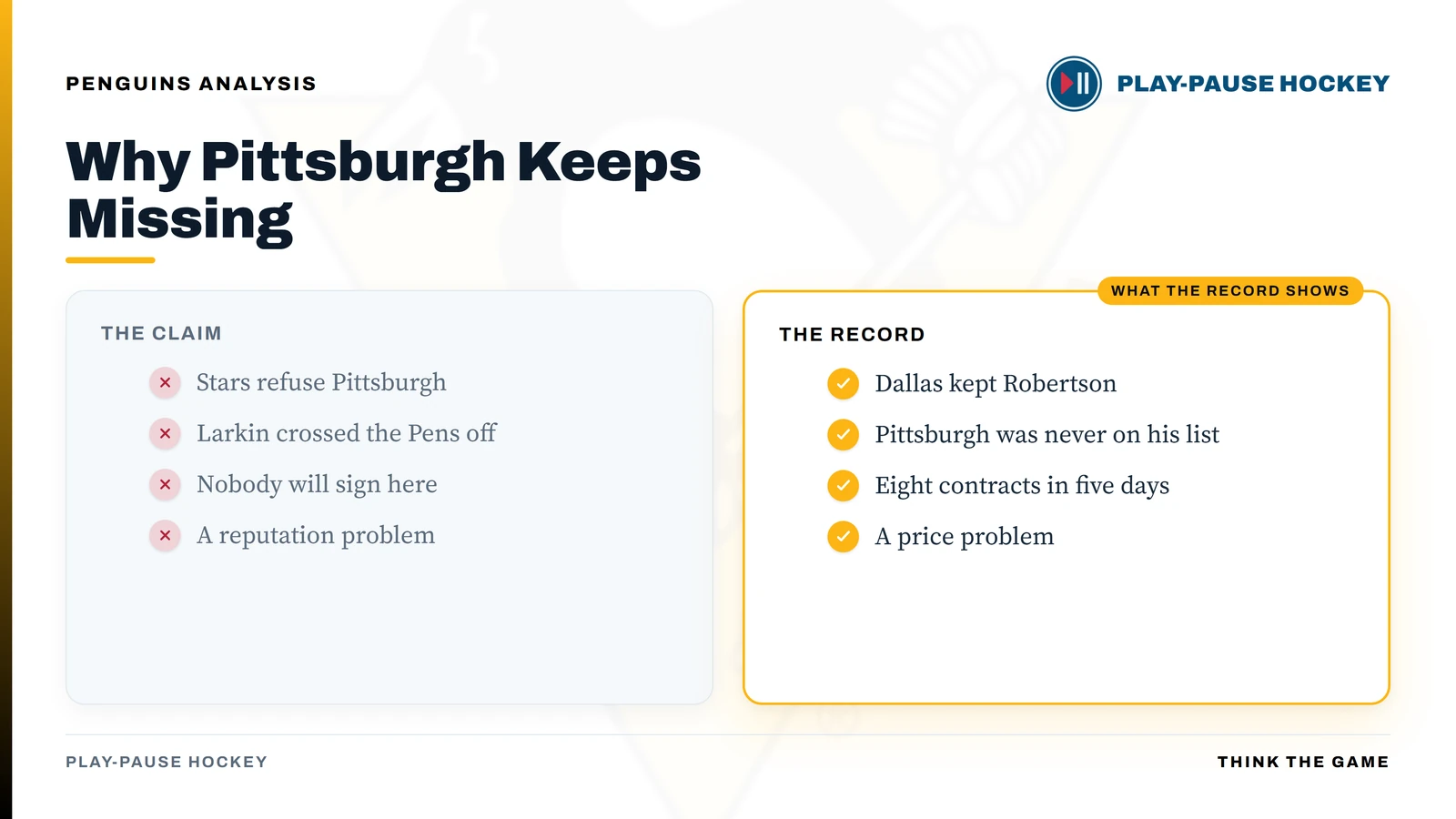
Here is what you will not get from the mailbag or from the aggregators running it today: across Pittsburgh’s three star pursuits this summer, the wall was a rival general manager twice and a no-move clause once. Not one of them was a player weighing Pittsburgh against another team and picking the other team.
Why “Destination” Is the Wrong Word for Pittsburgh’s Summer
Word choice is not pedantry here. It decides who owns the problem.
“Destination” puts the failure inside other players’ preferences. If elite talent has decided Pittsburgh is a place you leave rather than a place you go, no general manager fixes that in an offseason. You wait for the roster to turn, you wait for the wins, and you hope the reputation follows five years later.
A price problem is a different animal entirely. It sits with the man making the offers, and it can reverse in a single phone call.
In Three Pursuits, the Team That Said No Was Never the Player
Take them in order.
The Penguins’ pursuit of Jason Robertson was the loudest of the summer, reported through early July and never remotely close to a resolution, because Dallas was not selling. Robertson re-signed there on July 21, a one-year deal worth $12M, four days before an arbitration hearing he never attended. Robertson was never asked whether he wanted Pittsburgh. Jim Nill simply kept him.
Elias Pettersson is the one case where a player did say no, and it deserves the asterisk it comes with. The Pettersson no-move clause runs through 2031-32 at $11.6M, which makes any deal his call, and he has already declined a Pittsburgh reunion once. But he declined a lateral move, on a contract two down years into its term, to a team that was not obviously better than the one he was on. That is a read on his own situation, not a verdict on the city.
Seattle’s Price Is the Wall on Wright, Not Wright’s Preference
Then there is Pittsburgh’s pursuit of Shane Wright, still unresolved as of today. Seattle agreed in July to find him a new home, and a month later he is still a Kraken. The reason is not a shortage of suitors. When Vancouver asked, Seattle reportedly named Zeev Buium or Tom Willander, and Vancouver hung up. Seattle is asking for a young defenseman a rival club considers untouchable, in exchange for a center it has already agreed to move. That is the market Pittsburgh is bidding into, and it explains the silence better than any theory about the city does. Wright has not been asked what he thinks of Pittsburgh, because no club has gotten far enough with Seattle for a player’s opinion to enter the conversation.
Three names, three different walls, and none of them is a locker room Pittsburgh cannot sell. Dallas held. A no-move clause held. Seattle’s price held. Meanwhile Pittsburgh signed eight players to contracts between July 1 and July 5, including Trevor van Riemsdyk on a two-year, $8M deal in the opening hours of free agency, when a 34-year-old right shot coming off 68 games in Washington had his pick of suitors. Evgeni Malkin re-upped on May 26 for one year at $5.5M and took a no-movement clause with it, which is what a player does when he intends to stay.
Mantha Walked, and That Is the Objection Worth Answering
The strongest pushback is not about Larkin. It is about the player who actually left.
Anthony Mantha scored a team-high 33 goals for Pittsburgh last season, put up 64 points in 81 games, reached the open market and signed with New Jersey for two years and $9.5M. If your leading scorer walks to a division rival for $4.75M a season, “nobody wants to be here” starts to sound less like a slight and more like a description.
Except Pittsburgh had the money and still does. PuckPedia projects the Penguins at $90,322,360 against a $104M ceiling. That is $13,677,640 in room on a full roster with 47 of 50 contracts committed, enough to absorb Mantha’s new cap hit twice and still bank $4,177,640. Nobody outbid Pittsburgh for Anthony Mantha. Pittsburgh declined to bid.
“If you look at the players available, that could be an expensive mistake. And I try to learn from the past.”
Kyle Dubas said that on June 27, four days before free agency, and the reference to learning from the past is not subtle if you remember the Ryan Graves and Tristan Jarry contracts. A market you refuse to enter cannot reject you.
Now the harder version of the objection: if nobody bids and nobody is bid on, is inert not just a slower word for undesirable? Partly, yes. Declining to hand term to a 33-goal scorer on the wrong side of 30 is defensible on a rebuild timeline, and the Kyle Dubas rebuild has been consistent about exactly that. But a defensible choice is still a choice. It is not a verdict the league rendered on Pittsburgh, and treating it as one lets the front office off the hook for the part it controls.
The Answer Arrives With Crosby’s Extension, Not With a Mailbag
There is a reason all of this stayed unresolved through July, and it has one name on it.
Sidney Crosby became eligible to sign an extension on July 1, the day players with a single year left on their deals can start negotiating. Thirty-five days later he has not signed one. His current contract, two years at $8.7M, runs out after 2026-27, and until Pittsburgh knows whether its franchise center is here in 2027-28, it cannot make a coherent pitch to anyone outside the building. A star weighing Pittsburgh right now is being asked to price a roster whose most important variable has not been set.
So watch two things between now and camp. If Wright lands in Pittsburgh, the price theory holds and the destination talk dies quietly, because Seattle blinking is the only thing that ever stood between the two. And watch Crosby’s signature. If September arrives with no star acquired and no extension for the player the whole thing is built around, then “not a top destination” stops being a mislabel and starts being an accurate description of a team that has not decided what it is.
Right now it is not that. Right now it is a general manager sitting on $13.68M and waiting for somebody else to lower their price.