

Jason Robertson said no to the most money any player in hockey will make next season. In doing so, he didn’t just complicate Dallas’s summer. He pulled the pin on half the trade board. The No. 7 pick that was supposed to change hands tonight is still in Seattle, and everyone who was counting on it is scrambling with the draft hours away.
The bare facts are simple. The Kraken offered Robertson an eight-year deal worth roughly $15 million a season, a number that would have made him the highest-paid player in the NHL next year, nudging past Leon Draisaitl’s $14 million. A sign-and-trade was lined up to send Seattle’s first-round pick, No. 7 overall, to Dallas. Robertson turned it down, and the whole structure fell apart.
Robertson Said No, and the Trade Board Stopped Moving
Start with who Robertson is, because the rejection only matters because the player does. He led Dallas this past season with 45 goals and 96 points in all 82 games, then added five goals in a six-game first-round exit. He is 26, he is durable, and he is a restricted free agent on July 1 with arbitration rights. That last detail is the leverage running underneath this entire saga.
Players like that almost never become available. So when Dallas, cap-strapped and unable to close a contract gap of its own, opened the door to moving him, half the league walked through it. The Kraken got furthest. They built a deal that solved everyone’s problem at once: Seattle lands a star, Dallas lands a top-10 pick and cap relief, Robertson lands a record contract. Then the player said no, and the elegant solution evaporated.
Seattle’s No. 7 Pick Was the Hinge for Half the League
Here is why this is a league story and not a Dallas one. That No. 7 pick was not just a sweetener. It was the hinge.
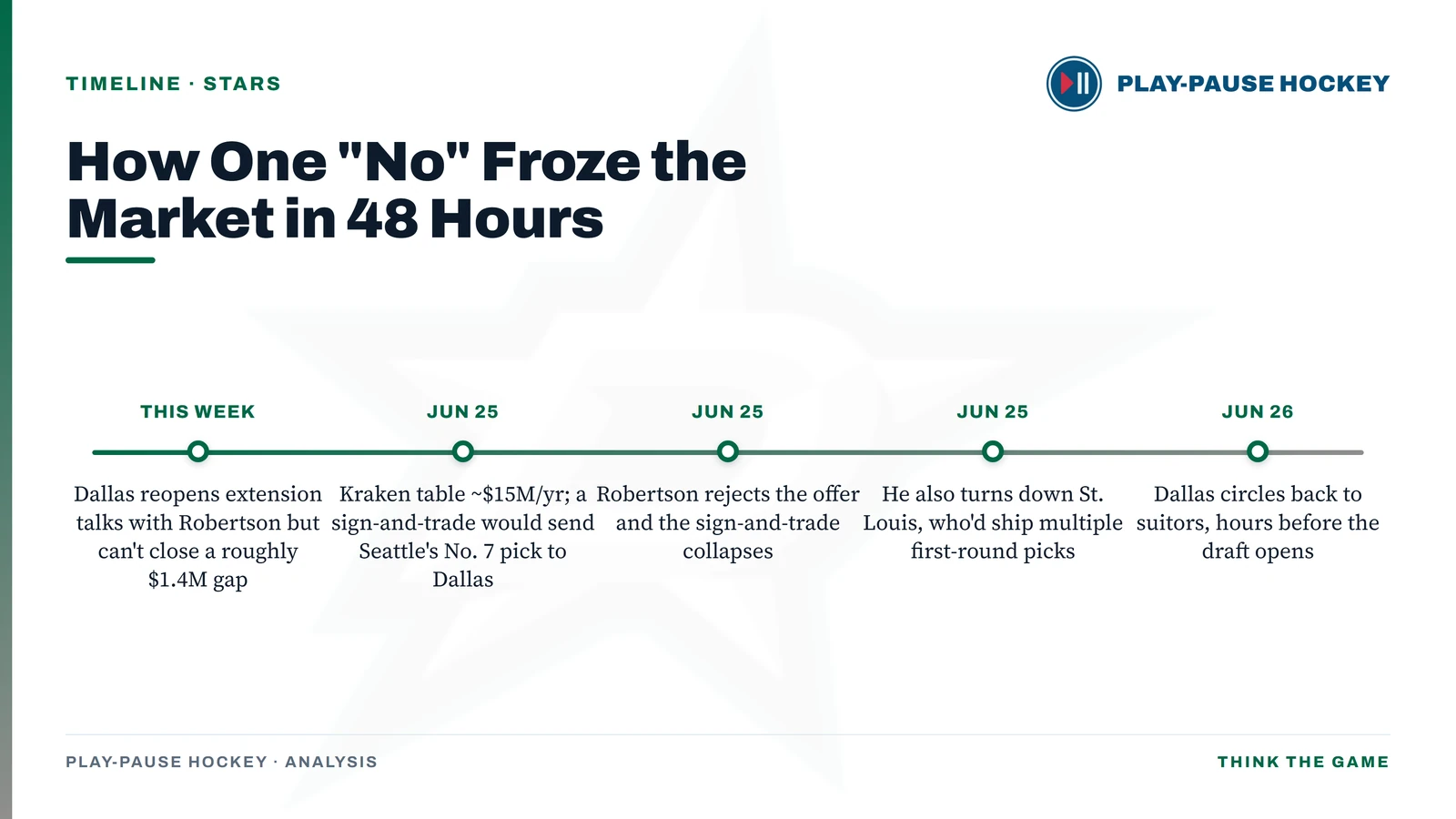
The same pick was reportedly in play as the centerpiece Dallas would have flipped to Toronto in a separate run at Matthew Knies, the Stars hunting a replacement scorer before they had even lost Robertson. St. Louis, meanwhile, was willing to send multiple first-round picks of its own to pry Robertson loose. When one player declines one contract, none of that happens. The pick stays put, Toronto’s conversation loses its currency, and the Blues are left holding offers nobody accepted.
Robertson also turned down St. Louis, who were prepared to send multiple first-round selections to Dallas, per TSN.
Dallas Has the Least Time and the Worst Options
Every team in this story can wait except the one that has to act. Dallas is cap-strapped against the $104 million ceiling, with something like $4.7 million of real wiggle room once you account for Robertson’s own qualifying offer. The Stars cannot simply pay him. They reportedly sat around $10.6 million while Robertson’s camp pushed toward $12 million and, by some accounts, higher. Pierre LeBrun called the ask “eye-opening.”
So the Stars are stuck between three bad doors. Pay a number they can’t fit and force another salary out the side. Trade him and absorb the optics of dealing a 96-point winger for less than the Kraken just offered. Or let an arbitrator set the price and lose all control of it. None of those is the deal they had 48 hours ago, and the draft, where the best trade leverage lives, starts tonight.
The Case That Nothing Is Actually Broken
Give the other read its due, because it’s real. ESPN’s report is that all signs still point to a Robertson extension in Dallas. If that’s right, then this was never about Robertson blowing up his future. It was about him declining Seattle specifically: the wrong city, the wrong team, the wrong fit, not the wrong money.
That version is plausible, and it would mean the freeze is a snapshot, not a crisis. A market can thaw fast. The moment the draft starts and the No. 7 pick either gets used or gets dangled again, every conversation that stalled this week can restart with new information. Robertson holds the cards an arbitration-eligible RFA always holds, and the team that drafted and developed him still wants him. Quiet resolutions happen.
What Has to Break Before the First Pick Tonight
The verdict is not that Robertson did something irrational. He has leverage and he used it. The verdict is that a single player exercising that leverage exposed how much of the pre-draft market was leaning on one asset to clear.
So watch the No. 7 pick when Buffalo is on the clock. If Seattle keeps it and drafts, the Robertson market resets to square one and Dallas spends the summer solving this the hard way. If it moves, the question becomes who finally blinked, and at what price. Either way, one winger’s “no” did more to shape this draft than most of the picks will. The board doesn’t start moving again until someone answers it.