

Doug Armstrong had a clear idea this summer and a muddled price list. He sold three veterans, handed the middle of his lineup to a younger, faster group, and then spent two first-round picks on Mason McTavish, a center whose career high is 52 points and who is coming off a 41-point step back. The retool reads like a plan. The bill reads like a team that hasn’t decided what it actually is.
St. Louis acquired McTavish from Anaheim for the No. 15 and No. 29 picks in this year’s draft, per NHL.com. He is 23, signed through 2030-31 at a $7 million cap hit, and coming off 41 points in 75 games. Every one of those facts is fine. Stacked together against where this franchise sits, they describe a strange purchase.
Two First-Round Picks for a 41-Point Center
Start with the team doing the buying. The Blues went 37-33-12 last season, fifth in the Central and 24th in the league, and missed the playoffs for the first time since 2023-24. This is not a roster a single trade pushes into the bracket, and it is certainly not one a middle-six center vaults into contention.
A first-round pick is the most timeline-flexible currency in hockey. It is cheap for seven years, it peaks when a young core matures, and a rebuilding team is supposed to collect it, not spend it. The Blues had four of them after a busy week. They turned two into a player whose ceiling, on the evidence, is a good second-line center. You make that trade when you are one piece from real contention. St. Louis is several.
What St. Louis Actually Got in Mason McTavish
Be fair to the player, because the pile-on usually isn’t. McTavish is a legitimately useful NHL center: 23 years old, 181 points in 304 career games, a former third-overall pick with size and a competitive streak. There were two teams in on him at the deadline of this deal, with the Rangers pushing hard before they pivoted to Pavel Dorofeyev.
The Rangers and Blues were the two finalists for McTavish before New York turned to Dorofeyev, per TSN's Pierre LeBrun and Sportsnet's Elliotte Friedman.
But “useful” and “worth two firsts” are different sentences. McTavish set a career high of 52 points in 2024-25, then slipped to 41 last season as his role in Anaheim shrank into the playoffs before the Ducks moved on. He has never been a point-per-game driver. If he climbs to 55 or 60 points as a true second-line center, the price ages into reasonable. If he stays a low-40s two-way pivot, St. Louis paid cornerstone money for a complementary part. That is the bet, and a 24th-place team is an odd place to be making the expensive version of it.
The Retool That Genuinely Makes Sense
Here is the frustrating part, because most of what Armstrong did this summer is smart. Moving Jordan Kyrou to Washington for Connor McMichael, prospect Milton Gastrin, and the No. 16 pick wasn’t a salary dump. It was an acknowledgment that Jimmy Snuggerud had forced his way up the depth chart and that Robert Thomas and Dylan Holloway had grown into the top six. Shedding Brayden Schenn and Justin Faulk on top of it cleared veteran money and freed the lineup for the kids.
That is a coherent idea: get younger, faster, and cheaper through the middle, and let a developing core set the timeline. A team committed to that plan drafts its first-rounders and lets the young group breathe for a year. The McTavish trade is the move that doesn’t fit the blueprint the rest of the summer was drawing.
The Carlo Deal Is the Model This Summer Ignored
The proof that the Blues know how to shop well is sitting one transaction over. St. Louis also added Brandon Carlo from Toronto for two third-round picks, at a $3.485 million cap hit with Boston still retaining salary, on an expiring deal. A top-four, shutdown defenseman for almost no cost and zero long-term risk. That is the asset management a retooling team is supposed to practice.
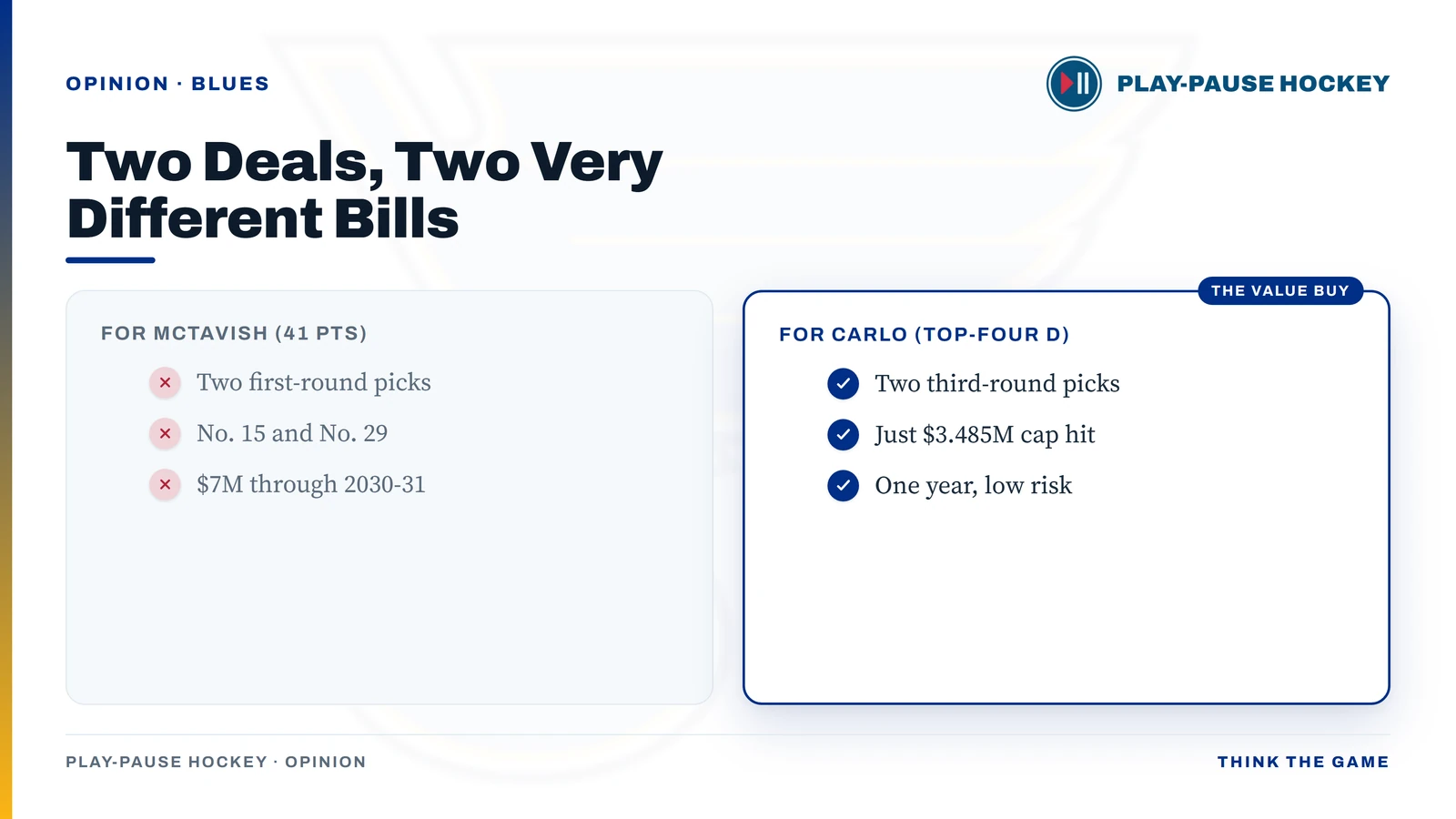
Put the two deals side by side and the contrast is jarring. For a top-four defenseman, Armstrong paid a couple of mid-round picks and protected his cap. For a middle-six center, he paid two first-round picks and committed $7 million a year for half a decade. One of those is the move of a patient team building the right way. The other is the move of a team trying to talk itself into being closer than it is.
What “Positioned to Do Something Big” Leaves Out
The optimistic case, the one you’ll read around St. Louis, is that the Blues hoarded picks and flexibility and are now positioned to do something big, up to and including the offer sheets Armstrong used to land Holloway and Philip Broberg in 2024. Armstrong all but invited the calls: if rival teams want to engage St. Louis near the top of the draft, he said, “they know what we have and I would welcome the call.”
Hoarding only matters if you spend well, and the McTavish trade is the first big spend of the new war chest. It emptied two of those firsts for a player who doesn’t move the needle on a non-playoff team. The Carlo deal shows the Blues can find value when they’re disciplined. The McTavish deal shows what happens when a rebuilding team starts shopping like a contender. Watch which one Armstrong repeats from here, because that, not the pick count, is what tells you whether St. Louis actually knows what it is.