

Jason Robertson just signed for exactly the money Dallas offered him in June. He said no to it then.
That is the whole story, and almost nobody is telling it that way. The one-year, $12 million contract he agreed to on July 21, four days before a scheduled arbitration hearing, lands on the identical average annual value the Stars put in front of him over eight years five weeks ago. He turned that down. He turned down a bigger one from Seattle. Then he accepted the smaller version of the first offer, and the reason is not complicated once you stop looking at the dollar figure entirely.
Robertson Signed for the Exact Number He Rejected in June
Dallas offered eight years at $12 million, matching the Mikko Rantanen deal, per reporting from Yahoo Sports and NHL Trade Rumors in late June. Robertson passed. Seattle then built a sign-and-trade around its own No. 7 overall pick at a reported $15 million a year. Robertson’s rejected Kraken offer killed the sign-and-trade on the eve of the draft.
Line the three up and one variable moves.
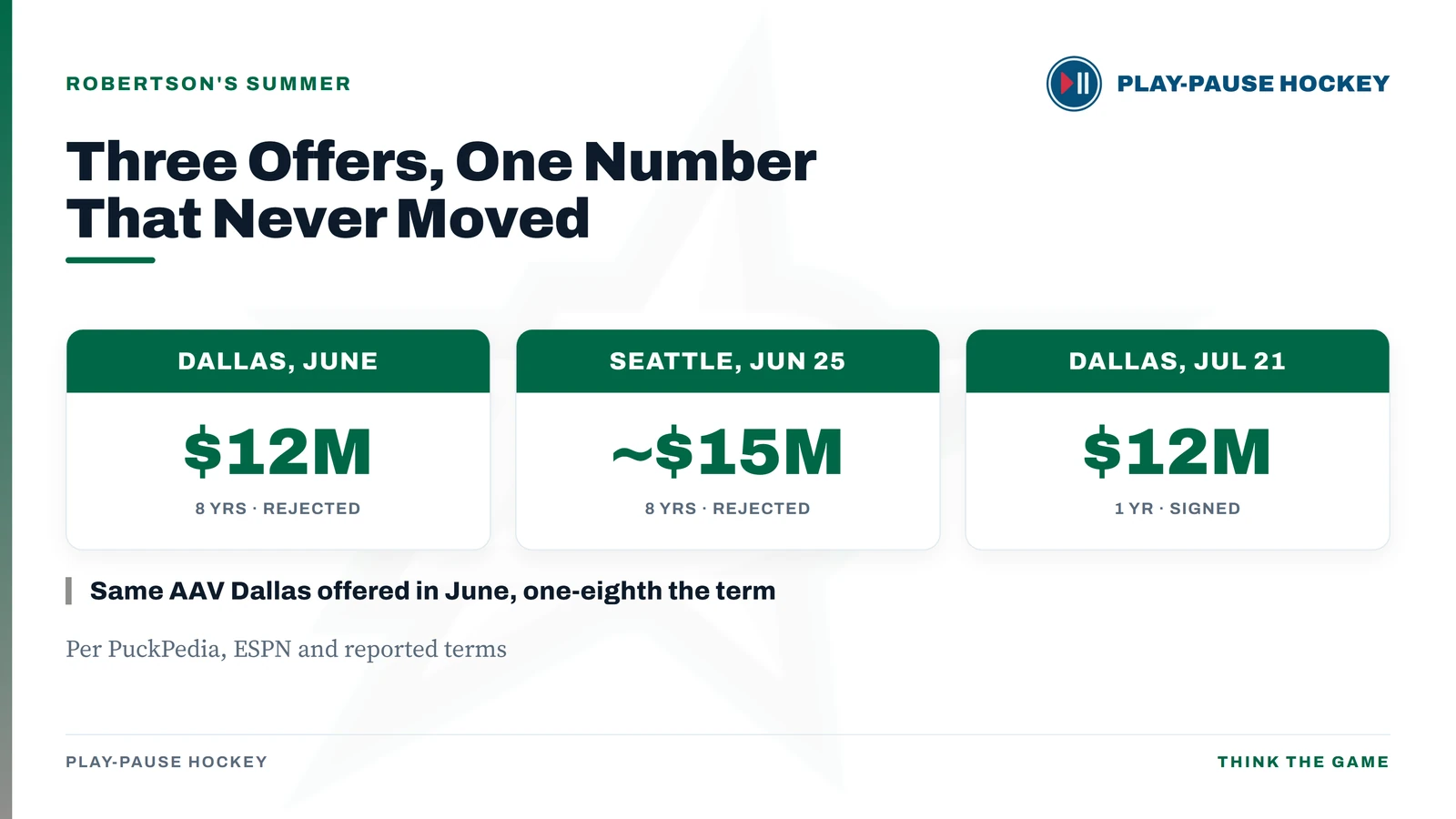
It is not the money. Robertson accepted Dallas’s own June number the moment it came without a decade attached to it. What he refused, twice, was locking his price in before the market moved. Eight years at $12 million is $96 million guaranteed. He took $12 million of it and left the other $84 million on the table for a year, which is either the most expensive act of self-belief of the summer or the cheapest option contract any player has written on himself.
Dallas Kept Him and Bought Itself Eleven Months
Jim Nill got the outcome that reads best in a press release. “Jason has been a cornerstone of our franchise since he was drafted in 2017,” the Stars GM said in the team’s announcement, and the production backs the word: 96 points in 82 games last season, 45 goals, his third 40-goal season.
He also got a problem with a date on it.
Nothing about that dynamic changed on July 21. It just acquired a countdown. Robertson can sign an extension on January 1, 2027, and becomes an unrestricted free agent on July 1, 2027, three weeks before his 28th birthday. The Stars have until then to either pay him on his terms or convert him into assets, and they will be doing that math while sitting roughly $1.36 million over the $104 million ceiling with the new deal on the books, per PuckPedia’s projection. The contract that resolved the summer created the compliance problem.
Nothing in This Contract Stops Dallas From Trading Him
Here is the part the wire coverage skipped, and it is the part that keeps Pittsburgh in the room.
No no-trade or no-movement protection has been reported in the deal, and more importantly, none comes with it automatically. Signing a contract to avoid an arbitration hearing confers no trade restriction of its own under the CBA. Do not confuse it with the offer-sheet rule that froze Barrett Hayton in Utah for a year after the Mammoth matched, which is a real one-year trade ban and applies only to a club that exercises its right of first refusal. Different mechanism, different consequence.
So Robertson is not untouchable. He is the most movable he has been all summer, on an expiring deal, at a price a contender can absorb for one playoff run without inheriting a decade.
That July 5 filing closed the offer-sheet door. It did not close the trade door, and Kyle Dubas spent the month leaning on it. The Penguins’ pursuit of Jason Robertson never produced a deal, but it also never formally ended, and Dallas’s cap position is now public knowledge.
The Case That He Just Took Less Than an Arbitrator Would Have Paid
The sharpest objection to all of this is not sentimental, it is arithmetic. If Robertson could have won $15 million or $16 million at a hearing, as Mark Madden argued via Yahoo Sports, then $12 million is not leverage. It is a discount, handed over with no term protection in return. Leo Carlsson’s $18 million AAV hangs behind every estimate in that range.
Take it seriously, because it is half right. Robertson almost certainly left single-season cash on the table.
But treat that figure as speculation rather than forecast. It estimates a hearing that never happened, and it sits well above the band arbitration has historically produced, because awards are backward-looking by construction, built on what a player already did. A hearing would also have delivered exactly what he spent the summer refusing: a price set by someone else. He was not optimizing next season’s paycheque. He was buying the right to set his own number in a market where the ceiling has moved.
That is the quiet math under the bet. Standing still costs $13.1 million. Anything he actually gains has to come on top of it.
What January 1 Decides
Watch the extension window, not the trade rumours. If Dallas and Robertson agree on term between January 1 and the deadline, the Stars keep a 45-goal winger and this one-year deal becomes a footnote. If January passes quietly, Nill is holding an expiring asset with a cap problem attached and a list of suitors who have already shown their hand.
Robertson did not win a negotiation in July. He postponed one, at full price, into a year when the money gets bigger. The next real deadline is not July 25. It is January 1.