
Grier Bought the Contract Shape, Not the Winger
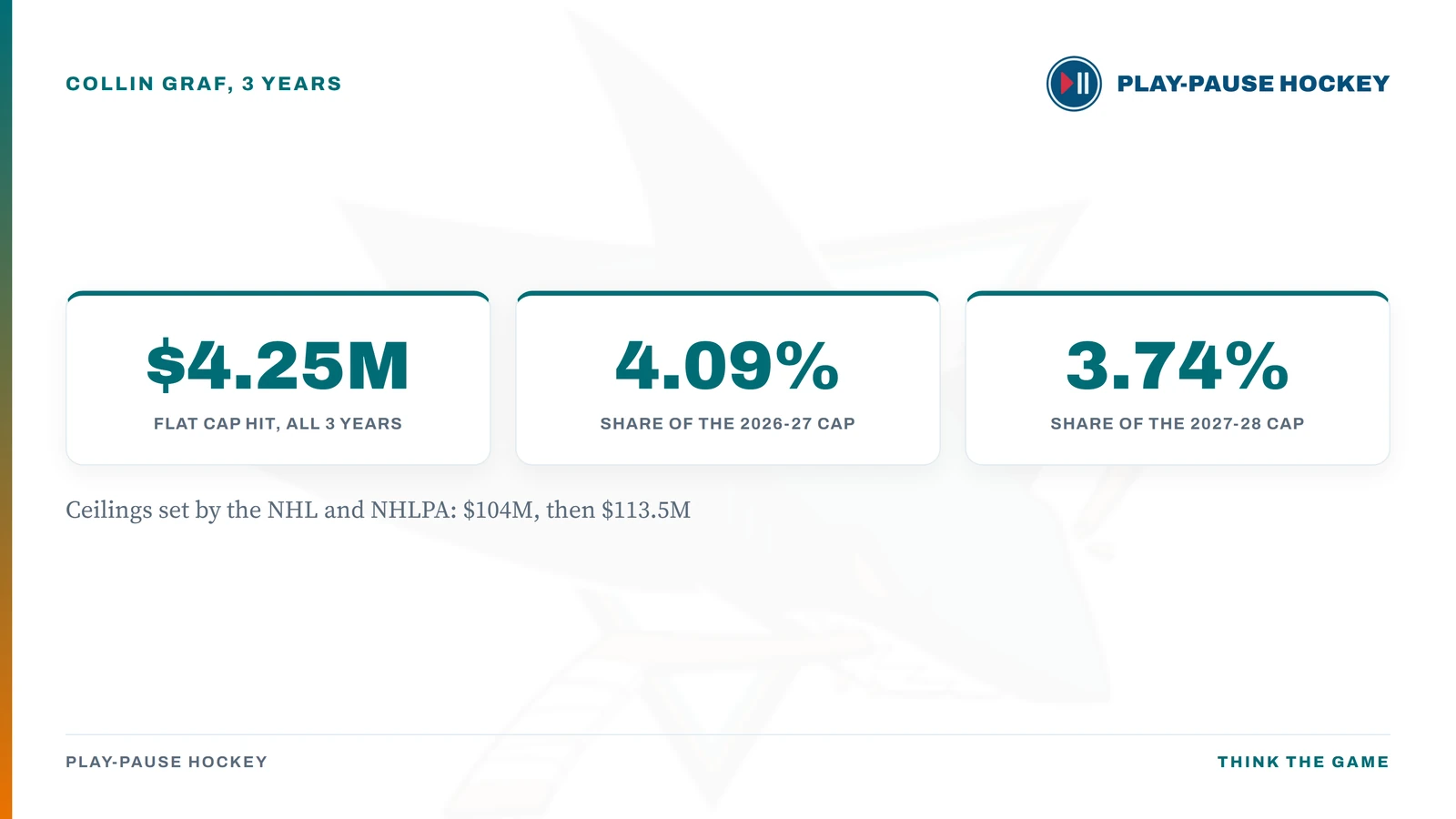
Mike Grier did not pay Collin Graf $4.25 million. He paid 4.09 percent of the salary cap, and then he bought two more years in which that number does nothing but fall.
San Jose re-signed the 23-year-old winger on Friday for three years and $12.75 million, a flat cap hit running through 2028-29. The wire read it as a modest bet on an undrafted breakout, which it is. It is also the cheapest and most deliberately shaped commitment the Sharks have made in a month of expensive ones, and the shape is the whole story.
Here is the part nobody put on the page. Graf’s cap hit never moves. The ceiling does. It sits at $104 million this season and $113.5 million next season, both figures announced jointly by the NHL and the NHLPA rather than estimated by an analyst. Same dollars, bigger denominator. That turns 4.09 percent into 3.74, and the contract sheds 8.4 percent of its cap value without Graf doing a single thing differently.
San Jose Doesn’t Have One Expensive Summer. It Has Two.
Start with the calendar, because the shorthand version of San Jose’s cap problem compresses two different summers into one.
The summer of 2027 is when the $18.8M cap hit from Celebrini’s record extension begins. It is also when Will Smith comes off his entry-level deal and when Yaroslav Askarov’s $2 million bridge expires. Two negotiations, arriving at the same moment as the largest cap hit in league history.
Then it happens again, twelve months later. Michael Misa, Sam Dickinson and Igor Chernyshov are all on entry-level contracts that run through 2027-28, which makes them 2028 business, not 2027 business. Collapse all five names into a single wave and you have invented a crisis a year before it can occur. Separate them and the real shape appears: two consecutive expensive summers, neither of them fatal on its own.
Three more years is the operative phrase in that post, and it is doing more work than a celebration lets on. Graf’s contract runs past both summers.
One name gets attached to San Jose’s cap problem and should not be. William Eklund is a Senator. The Sharks traded him to Ottawa on June 23 for the ninth pick in the 2026 draft, and the $5.6 million he carries through 2027-28 is Ottawa’s to carry.
Three Years Is the Decision. The Money Isn’t.
Term is where Grier actually made a choice.
Three years walks Graf to the summer of 2029, a full year past the second wave, at which point he turns 27 that September and San Jose still holds his rights as a restricted free agent rather than watching him reach the open market. The Sharks keep him through the expensive stretch, keep his rights after it, and never once negotiate with him in the same room where they are negotiating with Smith and Askarov, or a year later with Misa and Dickinson. A two-year deal would have dropped him straight into the first of those rooms. A five-year deal would have priced a 17.8 percent shooting season into 2031.
The price says the same thing. On July 28, San Jose Hockey Now modelled Graf into its projection of the 2028-29 books at five years and $30 million, a $6 million average. Three days later he signed for $4.25 million, on a deal that covers that exact season. Same player, same year, a $1.75 million gap, seventy-two hours apart.
We have run a cap-share cut on this roster once before, on Celebrini’s record extension, by holding the season constant and comparing two players. This is the mirror image: hold the player constant and let the seasons move. Both cuts exist because the raw AAV is the least informative number on a contract, which is the same reason what a cap hit hides was worth a piece of its own.
Yes, Every Flat Cap Hit Deflates. Term Is Why This One Counts.
The obvious objection lands immediately, and it is correct: every flat cap hit signed today deflates against a rising ceiling. That is arithmetic, not insight, and Nurse, Trouba and Marchment all do it too after San Jose’s free-agent spending on July 1.
Concede it, because conceding it sharpens the point. Deflation is available to everyone. Matching the deflation curve to the exact summer your roster gets expensive, on a player you can still control afterward, at a number below what the people covering you daily projected, is not. The generic version of this argument would praise any flat contract. The specific version explains why this one is three years and not five.
The real risk is not the cap sheet. It is the shooting.
Before last season, Graf had five NHL goals on 47 shots. Last season he scored 21 on 118, a 17.8 percent clip against a career mark of 15.75. Some of that comes back. And the production has an unusual shape underneath it: he scored zero power-play goals all season and registered exactly one power-play point, which means 45 of his 46 points arrived at even strength or shorthanded, the two states where scoring is hardest to manufacture.
Forty-five of 46 points, and not one of them came from the easiest minutes in hockey.
That cuts both ways, honestly. Pro Hockey Rumors noted he recorded the third-highest expected goals on the team from medium-danger positions, at 7.19, trailing only Macklin Celebrini and a since-traded William Eklund. Goals from those positions come from where a player goes, not from a hot stick. San Jose Hockey Now reported he led San Jose forwards in shorthanded ice time and ranked seventh among all NHL forwards in that category. A player generating that profile at $4.25 million is not a coin flip. He is just a player whose next 20-goal season will require more than 118 shots.
Contract terms per NHL.com and ESPN, July 31, 2026. Statistics via the NHL Stats API as of August 1, 2026.
Put Him on the Power Play and This Deal Gets Absurd
The verdict is straightforward. This is the best-value contract San Jose has signed this calendar year, and it is the only one that gets easier to carry.
What to watch is narrower than the cap sheet. Graf finished last season with a single power-play point, on a team that has just committed the largest cap hit in league history to the player who runs that unit. If Ryan Warsofsky finds him a second-unit role and the shooting regresses to something like his career rate, the raw point total may barely move, which will read as stagnation and will not be. If the shooting regresses and the power-play minutes never arrive, the market will decide Grier bought a 46-point season that happened once.
The contract survives either outcome. That was the point of building it this way.