


Don Waddell did not say no to Montreal because the offer was bad. He said no because he did not have to say anything else. On July 2 the Columbus general manager stood in front of reporters and closed the file in one sentence: he had spoken with Kirill Marchenko’s agent, and Marchenko would be a Blue Jacket when the season started. That is not the language of a man weighing a package. That is the language of a man who already knows he is keeping his player.
The read here is not that Kent Hughes got outbid. Every report describes Montreal’s offer as “huge,” and nobody who covers the Canadiens thinks Hughes was timid. The read is that the offer was never the variable. Marchenko is signed for one more year at a $3.85M cap hit, a 27-goal, 67-point winger on a bargain, with a qualifying number under $4M waiting next summer. A player that good and that cheap only moves when the team holding him needs the return more than it needs the player. Columbus decided it does not.
Montreal Keeps Winning Bids That Never Get Made
Start with what Hughes was actually offering, because it explains everything downstream. Montreal’s trade capital is deep, but it is the wrong kind of deep for this market: prospects who are still in the AHL, a stack of picks, futures that pay off in 2027 and beyond. That currency wins an auction on a whiteboard. It does not close a deal with a seller who wants to win now.
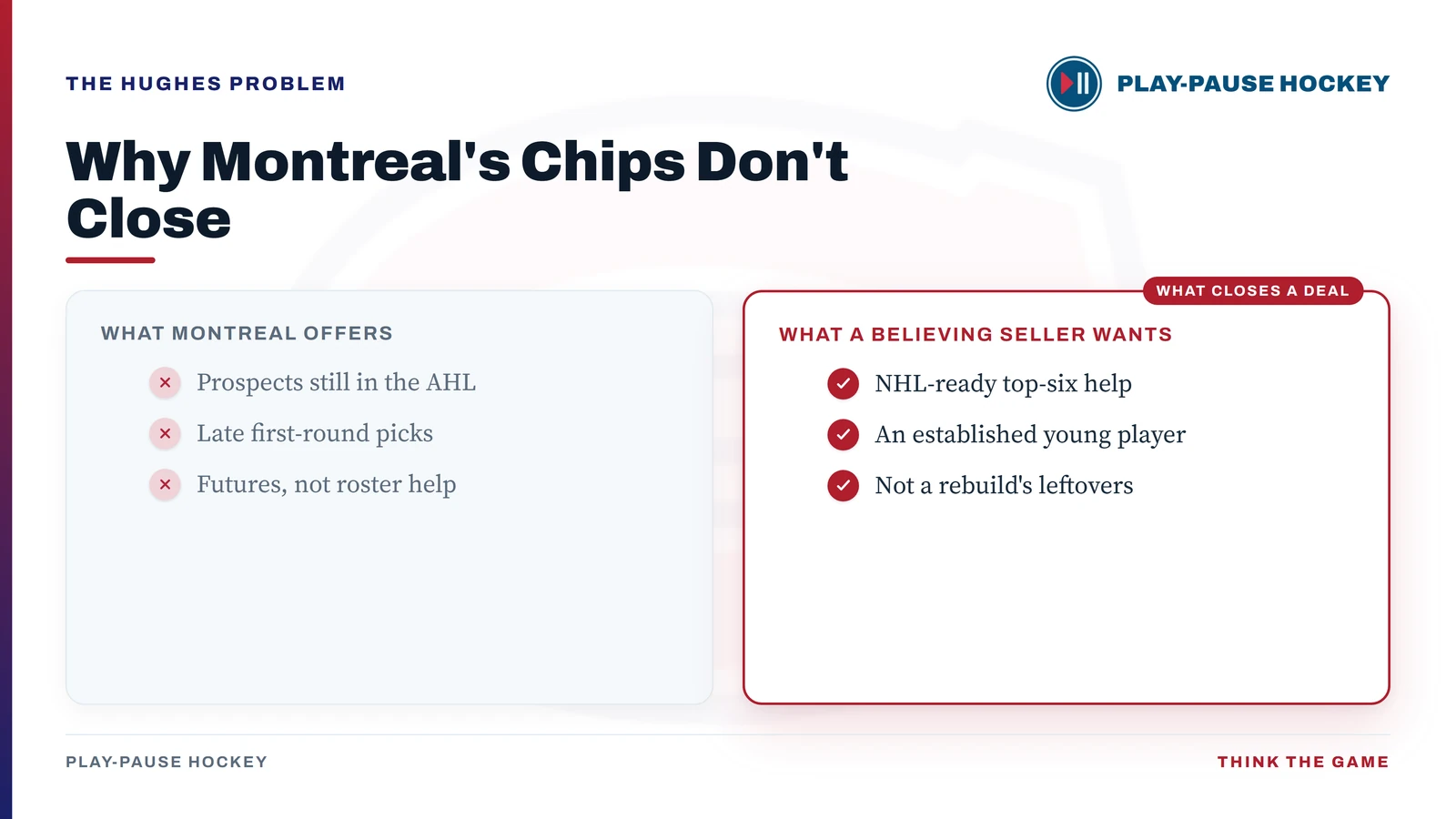
Per insider Marco D'Amico, the market itself has shifted: contenders chasing established talent now want NHL-ready players, not packages built around picks and prospects, and late first-round picks have lost value. Montreal's problem is that its second wave of prospects is not yet NHL-ready enough to headline a deal for a proven scorer.
That is the trap. The one asset that closes these trades, an established young player good enough to matter today, is exactly the asset a team on the rise refuses to trade. Montreal has plenty of tomorrow to sell. Contenders are done buying tomorrow.
Demidov’s $73 Million Just Started a Clock
Here is why this stops being an interesting failure and becomes an urgent one. On July 1, Montreal signed Ivan Demidov to an eight-year, $73.2M extension, a $9.15M annual commitment that runs through 2034-35. The franchise just bet the next decade on a 20-year-old winger. The move that finishes the bet, a right-shot scorer who can live on his flank, is still not on the roster.
Notice the number that is missing from that math: the money was never the obstacle. Marchenko would have slotted in at less than half of Demidov’s cap hit. Montreal has the space and the will to pay a top-six winger. What it does not have is the one thing that buys one, and every month Demidov’s deal is on the books, the empty seat next to him gets more expensive to leave empty.
Why Columbus Never Had to Say Yes
The other half of this is Columbus, and it matters that the Blue Jackets are not the tire fire they were two seasons ago. Waddell is not tearing down. He is, in D’Amico’s phrase, trying to stop the bleeding, because Columbus finally looks like it might reach the playoffs for the first time in a decade. Zach Werenski, the reigning Norris winner, anchors the blue line on a long-term deal. Adam Fantilli is the next extension looming. A team with that spine does not sell a 27-goal winger entering his prime for another club’s prospects, at any price a rebuild-adjacent buyer can offer.
That is the piece Montreal could not solve at the negotiating table, because it was never Montreal’s to solve. You cannot out-offer a team that isn’t selling.
The Case That This Is the Market, Not Hughes
Be fair to Hughes, because there is a real defense here. Marchenko is the third swing of the same summer. Elliotte Friedman, on 32 Thoughts, tied the pattern together: Montreal wanted a younger top-six forward and was willing to be aggressive, and it missed on Marchenko, on Matthew Knies in Toronto, and on Nico Hischier, who re-signed in New Jersey. Three targets, three teams that decided to keep their guy. If everyone is hoarding, the argument goes, this is a market problem, not a management one.
There is truth in that. But it is also the reassuring version, and the honest counter is sharper: a market where nobody sells young talent is precisely the market Montreal built its whole plan around beating. Hughes has spent three years accumulating the deepest prospect pool in the league on the theory that it converts into stars. The Marchenko summer is the first real test of that conversion, and the answer so far is that it doesn’t, not against sellers who have stopped selling. That is not fatal. It is a signal that the currency needs to change.
What Has to Change Before Next Summer
The fix is not a bigger offer. It is a different one. To land the player Demidov’s contract demands, Montreal will eventually have to do the thing it has resisted: put a real, roster-level young asset in the deal, the kind of player it has been protecting. The prospect-and-picks model got the Canadiens into every conversation this summer and closed none of them. Marchenko becomes a free agent to negotiate again in a year, this time with arbitration leverage and a camp that has already hinted at wanting out of Columbus long term. When that window opens, the question won’t be whether Hughes can make the call. It will be whether he is finally willing to trade something that hurts.