


The number everyone repeated on July 1 was $73 million. It’s the wrong number. The one that tells you what Montreal actually did is 8, as in the roughly eight percent of the salary cap that Ivan Demidov’s new extension will cost the Canadiens once it kicks in. For a 20-year-old who just outscored every rookie in the league, that isn’t a splurge. It’s the best value deal of the summer, and it is the exact inverse of the contract Anaheim spent last week sweating over on the other coast.
So before the sticker price starts doing your thinking for you, sit with that figure. Eight percent of the cap, for eight years, for a player who has already been one of the best 20-year-olds in hockey. Montreal didn’t overpay for a projection. It underpaid for one, and it did so on purpose.
Montreal Paid Its Best Young Forward Less Than It Pays Its Captain
Start with the terms, because they matter. The deal is eight years and $73 million at a $9.125 million average, and it does not begin until 2027-28, after the final season of Demidov’s entry-level contract. It carries $57.6 million in signing bonuses and a 10-team no-trade clause in the back three years. His agent, Dan Milstein, announced it himself.
Nine seasons of control is the headline for the fanbase. The cap math is the headline for everyone else. When it begins, $9.125 million will be roughly eight percent of the ceiling. Compare that to the contract Montreal already considers a bargain: Nick Suzuki’s $7.875 million ate 9.55 percent of the cap the year he signed it. Demidov, a player with a higher ceiling than his captain, will cost a smaller slice than Suzuki did. He won’t even be the highest-paid player on his own team; Noah Dobson’s $9.5 million sits above him. A number that reads like a max deal is, in context, a middle-of-the-roster percentage.
The Same Player Anaheim Is Paying $18 Million, Montreal Got for Half
Now put Demidov next to the deal that defined this offseason. Last week the Flyers made Leo Carlsson the highest-paid player in hockey with the Carlsson offer sheet, an $18 million cap hit that Anaheim has already committed to matching. Line the two young stars up side by side and the comparison does the arguing for you.
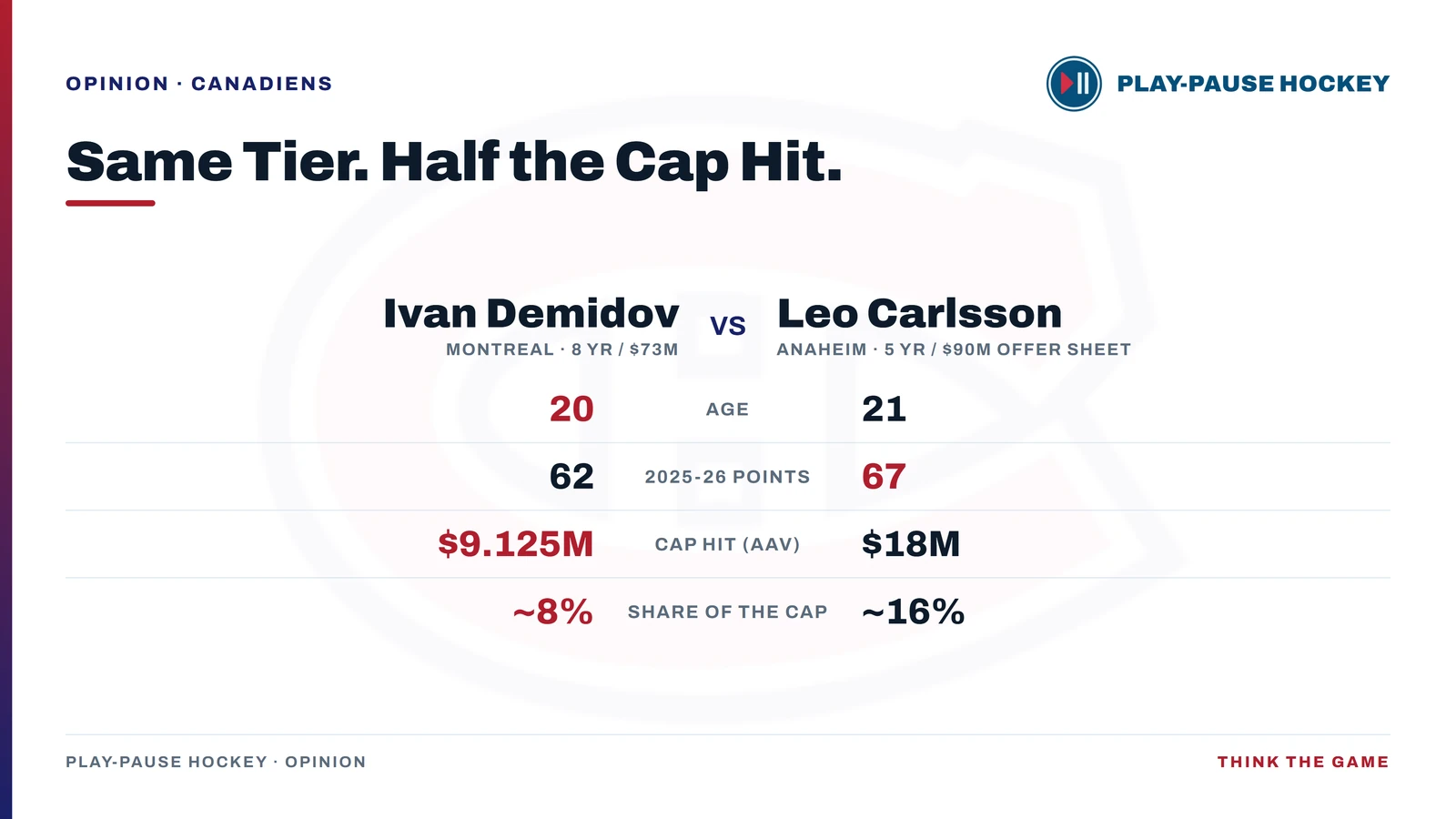
Carlsson scored five more points last season. That’s the honest part, and it’s the only column that runs his way. He is one year older, on a shorter deal, at double the cap hit and double the cap share. These are the same kind of player, at the same stage, projected off the same size of sample. One team is paying roughly eight percent of its cap for that projection. The other is paying sixteen. If you believe $18 million for a 21-year-old with one big season is a leap of faith, then $9.125 million for a 20-year-old with an almost identical one is the safest bet on the board.
The Bargain Isn’t That There’s No Risk. It’s That the Risk Is Priced to Survive.
Here is the fair objection, and it deserves a straight answer. Demidov has exactly one NHL season. Handing $73 million to a player off a single 62-point year is a projection, the same species of bet that made Nashville’s six-year term on Mavrik Bourque look shaky and made the Carlsson number look reckless. You can’t praise Montreal for projecting and roast everyone else for it.
So don’t. The distinction was never whether a team is betting on a young player. Every one of these deals is a bet. The distinction is the price of being wrong.
Overpay a projection at sixteen percent of the cap and a miss is a franchise problem you carry for five years. Underpay the same projection at eight percent and a miss is a rounding error the rising cap erases. Same wager. Completely different exposure.
That asymmetry is the entire case. And Montreal didn’t stumble into it, it engineered the timing. The Canadiens exercised an eight-year extension a full year before they had to, off the last season of an entry-level deal.
Because the new CBA limits a team to seven years on its own re-signings going forward, this summer was the final window in which Montreal could offer Demidov an eighth year. Signing early was the mechanism, not an accident.
Doing it now, before Demidov’s second NHL season could push his price toward Carlsson’s neighborhood, is what turned a good number into a great one. Wait a year, let him post 80 points, and this conversation starts with a one and a seven, not a nine.
A Contender’s Core, Signed a Year Early
Zoom out and the extension stops being one clever contract and becomes the last brick in something. Suzuki, Cole Caufield, Dobson, and now Demidov are all locked in below what the open market would charge for them, on a team that just reached the Eastern Conference Final. That is a contending core bought at a discount, with the cap rising underneath it to make every one of those deals look better each year.
The risk isn’t invisible. Demidov is a young Russian star with a no-trade clause coming and a long career of choices ahead of him, and eight years is a long time to promise anything in hockey. But that’s the cost of certainty, and certainty on a 20-year-old this good is the rarest thing a team can buy. The rest of the league spent this summer paying premium prices to project on youth. Montreal did the same projection, wrote a number half the size, and signed it a year before the market forced its hand. Call it what it is. This is how you’re supposed to do it.