


Montreal didn’t trade Brendan Gallagher to win the deal. They got future considerations and ate half his salary to send a 34-year-old home to British Columbia. The return isn’t the story. The timing is. The last veteran holdover from the team Montreal used to be just walked out the door, and that’s the day the rebuild quietly stopped being a project and became the roster.
Look at the mechanics and you can see it plainly. The Canadiens retained 50% of Gallagher’s $6.5 million cap hit and received nothing of substance in return, per NHL.com. Vancouver carries a $3.25 million number for one season before he reaches unrestricted free agency in 2027, per TSN. That is not a hockey trade in the usual sense, where one side is trying to get better. It is a favor with a cap figure attached.
The Last Player Left From the Team Montreal Used to Be
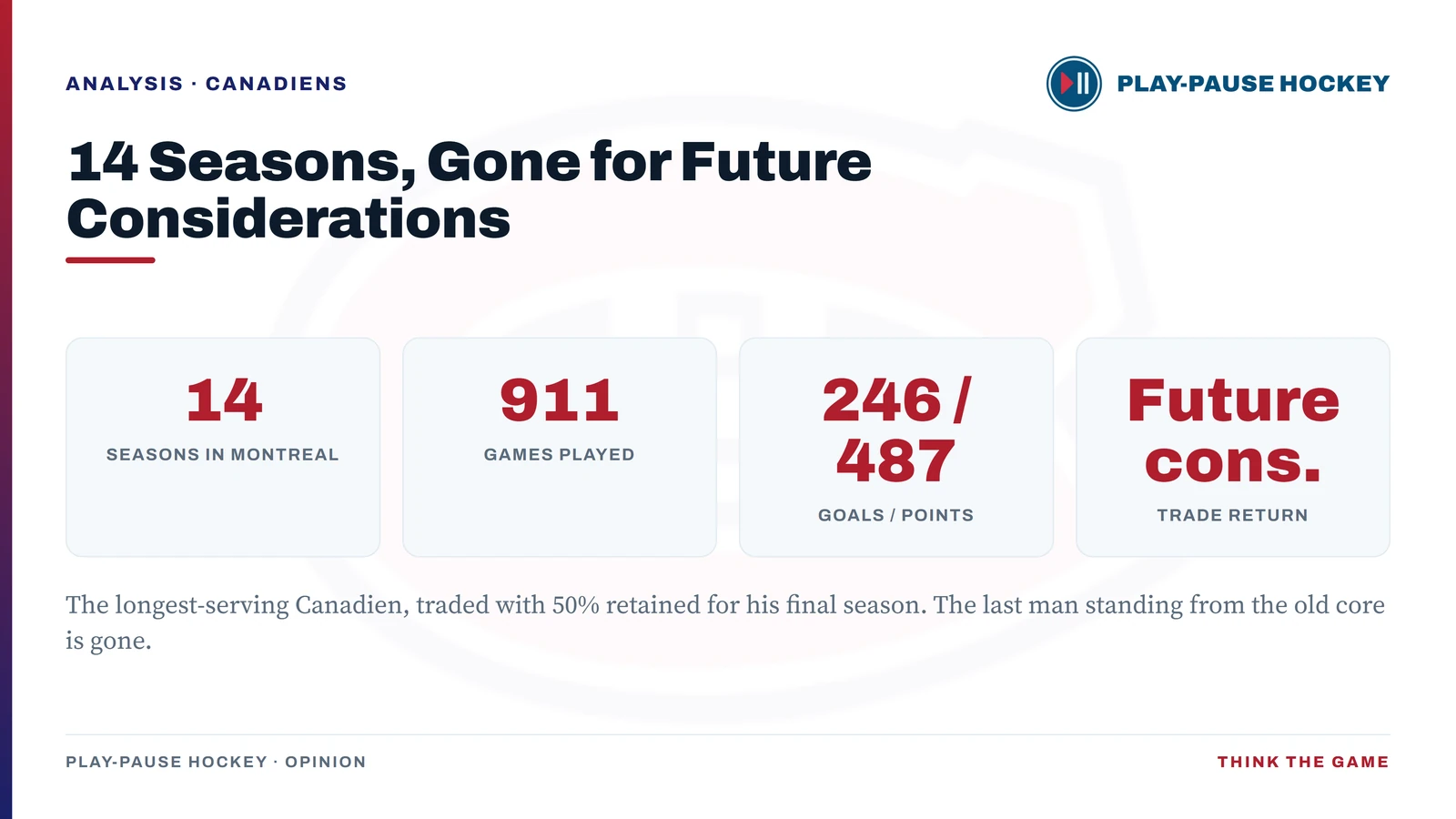
Gallagher leaves as the longest-serving Canadien, with 911 regular-season games, 246 goals and 487 points across 14 seasons since the team drafted him 147th overall in 2010, per NHL.com. Those are the numbers of a franchise fixture. What they don’t capture is the role he played in the building’s identity, which is the part Montreal is really losing here.
He was the bridge. When Kent Hughes started tearing the Canadiens down to studs, Gallagher was the last regular still standing from the version of the team that existed before the teardown, the Price-and-Weber Montreal that the franchise has spent four years moving on from. Nick Suzuki and Cole Caufield are the foundation of what comes next. Gallagher was the final everyday link to what came before.
The club’s own farewell gave the game away. The Canadiens called him a “warrior” and the “ultimate teammate,” thanking him “for everything you’ve done for this city, on and off the ice,” per the team’s public statement. You don’t write that about a player you’re swapping for assets. You write it about one you’re letting go.
“We would like to sincerely thank Brendan for everything he has brought to this team over the course of his remarkable 14-season career in Montreal.” (Kent Hughes)
His Ice Time in 2025-26 Already Wrote This Ending
The sentiment is real, and so is the reason the move made sense. Gallagher’s final Montreal season had already told you this was coming if you were watching the deployment rather than the highlights.
He put up 7 goals and 16 assists in 77 games, fine fourth-line production, while his average ice time fell to 12:21 a night, the lowest of his career, per NHL.com. Then came the tell that mattered more than any point total. On March 14, the Canadiens made Gallagher a healthy scratch for the first time since January 2013, back when he was a rookie. A player the organization once built its competitive identity around had become someone it could sit on a Tuesday. The on-ice case for moving on was made months before the paperwork.
Why Vancouver Wanted a 34-Year-Old Coming Off a Career Low
From Vancouver’s side, this is easier to read than it looks, and it isn’t really about the hockey either. Gallagher was born in Edmonton, raised in Delta, B.C., and played his junior hockey for the WHL’s Vancouver Giants. A rebuilding Canucks team gets a respected veteran with deep local roots on a one-year commitment, at a discounted $3.25 million, with no long-term risk.
Canucks general manager Ryan Johnson framed it around leadership, saying they “love the way he competes and leads by example” and that bringing in veterans like Gallagher would “help us set the standard for our younger guys to follow,” per the Canucks. Read that honestly and it’s a culture bet, not a needle-mover. That’s a perfectly reasonable thing to spend a one-year, half-retained contract on, as long as nobody pretends a 34-year-old coming off 12:21 a night is going to change Vancouver’s season.
Gallagher, who called the move a "best-case scenario" and "maybe the worst-kept secret" given his B.C. roots, gets the homecoming he wanted, per NHL.com.
What Gallagher’s Exit Clears for Montreal’s Young Core
So strip away the tribute and ask what Montreal actually accomplished, because that’s where the real value sits. The Canadiens didn’t get an asset. They got room. A roster spot and a block of forward minutes that used to belong to a declining veteran are now open for the players the rebuild was built around, the Caufield and Slafkovský wing depth and the arrival of Ivan Demidov, with Lane Hutson already anchoring the back end.
That’s the quiet logic of a goodbye like this one. The return was never the point. The point was closing the last chapter of the old team so the new one has the room to be exactly what it is. Watch what Hughes does with the cleared spot over the summer, because that, not the future considerations, is the trade’s real outcome. Gallagher got to go home. Montreal got to stop being a team in transition and start being the one it has been building toward all along.