

Grade the Mavrik Bourque contract by its cap hit and it looks like a steal. Six years, $33 million, a $5.5 million annual number for a 24-year-old center who just posted a career-high 41 points and is slotted to run Nashville’s second line. Read it that way and the reviews write themselves: cost-controlled, upside, a bargain in a rising-cap league.
That read isn’t wrong. It’s just answering the easy question. The dollars were always going to be fine. The number Nashville should have to defend isn’t $5.5 million. It’s six.
The Dollars Fit. That Was Never the Hard Part.
Start by conceding the easy argument, because it’s real. The salary cap climbs to $104 million in 2026-27, an $8.5 million jump, and that inflation reprices everything below the stars. In that market, $5.5 million is middle-six money. If Bourque is a genuine second-line center, the cap hit is not just fine, it’s a slight discount, and it ages well as the cap keeps rising against a flat number.
The fit is real too. Nashville plans to drop him between Filip Forsberg and Jonathan Marchessault, a spot that manufactures points for whoever fills it. He was a 2020 first-round pick, 30th overall, and one year removed from the NHL he was the AHL’s most valuable player, the youngest ever to win the Les Cunningham Award, leading the league with 77 points at 22. Nobody is arguing Bourque can’t play. The talent was never the question.
So if you only look at the AAV, you’ll conclude Nashville did something smart and move on. The problem is that the AAV is the part of this deal carrying the least risk.
Six Years Is a Bet on the AHL MVP, Not the NHL Résumé
Here is the number that should give a general manager pause. Bourque has exactly one NHL season above 25 points. One. Last year’s 41 was a career high and a real step forward, but the year before it he put up 25 points in 73 games as a rookie. Nashville didn’t sign the three-year sample. It signed six more years on top of a two-year NHL body of work that reads 25, then 41.
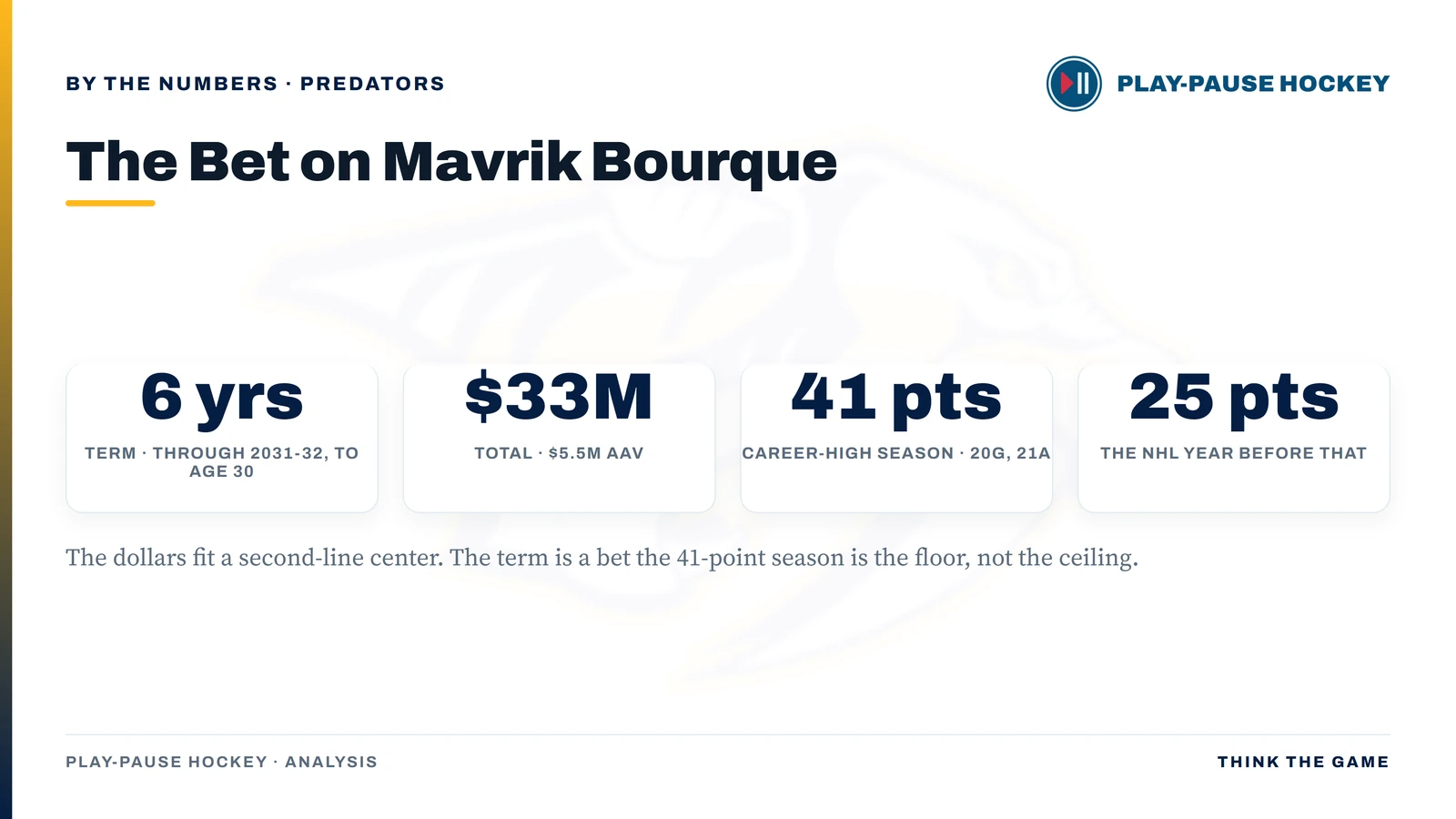
That’s the tell. A contract’s term is a team’s confidence interval made public, and six years says Nashville is treating 41 points as Bourque’s floor rather than his ceiling. Maybe it is. The AHL pedigree is the reason to believe the trend line keeps climbing. But a bridge deal, two or three years, lets a player prove that before the club commits to it. Nashville skipped the proving and paid for the projection, locking the bet in through 2031-32 and Bourque’s age-30 season.
The dollars are a bet a rising cap can absorb. The term is a bet on a player becoming someone he has been for exactly one year.
There’s a reason bridge deals exist for players in precisely this spot: real pedigree, thin NHL sample, one good year. They protect the team from paying a career high as if it were a baseline. Nashville had that option and passed on it.
The Honest Case Is That Bourque Is Still Climbing
The counter-argument is legitimate, so let’s make it properly. Bourque’s arrow points up. Twenty-five points, then 41, is the trajectory of a young center figuring out the league, and the underlying pedigree, first-round talent and a dominant AHL season, suggests the 41 is a waypoint, not a peak. Buy the term now and you buy it before a genuine breakout reprices him. If he’s a 55-point player in two years, $5.5 million on six years looks like theft, and the bridge deal everyone’s recommending would have handed him the leverage to make Nashville pay full freight in 2028.
That’s the bull case, and it’s coherent. Locking in ascending players early is how smart teams beat the cap. The Predators are betting the AHL MVP is the truer signal and the modest NHL counting stats are just a young player’s runway.
But that case rests entirely on projection, and projection is exactly what a six-year term removes the escape hatch from. If Bourque settles in as a 40-point middle-six center, which is a perfectly plausible outcome for a player who has been a 40-point middle-six center, the deal isn’t a disaster, but it isn’t the bargain the reviews promised either. It’s a fair contract for an average player, signed for six years, by a team that can’t afford many of those.
A Franchise That Still Can’t Say What It’s Building
Which is the part that nags. This is a young man’s contract, six years to age 30, signed by an old team. Nashville has missed the playoffs two straight seasons around a veteran core, Steven Stamkos, Marchessault, Ryan O’Reilly, Roman Josi, that will be gone or greatly diminished long before 2031-32. Bourque is the sixth move new general manager Chris MacFarland has made since June, and it’s genuinely unclear whether it’s a rebuild brick or a contention patch.
Per reporting from Elliotte Friedman, the deal drops Nashville's cap space to roughly $8.25 million, and Bourque cost a 2027 second and a 2028 third to acquire from Dallas alongside Ilya Lyubushkin.
Read one way, the Bourque term is the smartest thing here: the one long-term asset on a roster full of expiring veterans, the piece you build the next Nashville team around. Read another, it’s a six-year commitment made by a front office spending like it hasn’t decided whether the next Nashville team starts in 2027 or 2029. The contract itself is fine. What it can’t answer is the question Nashville keeps refusing to: which team is this for? Bet six years on that uncertainty and you’d better be right about the player, because the term leaves no room to be wrong.