
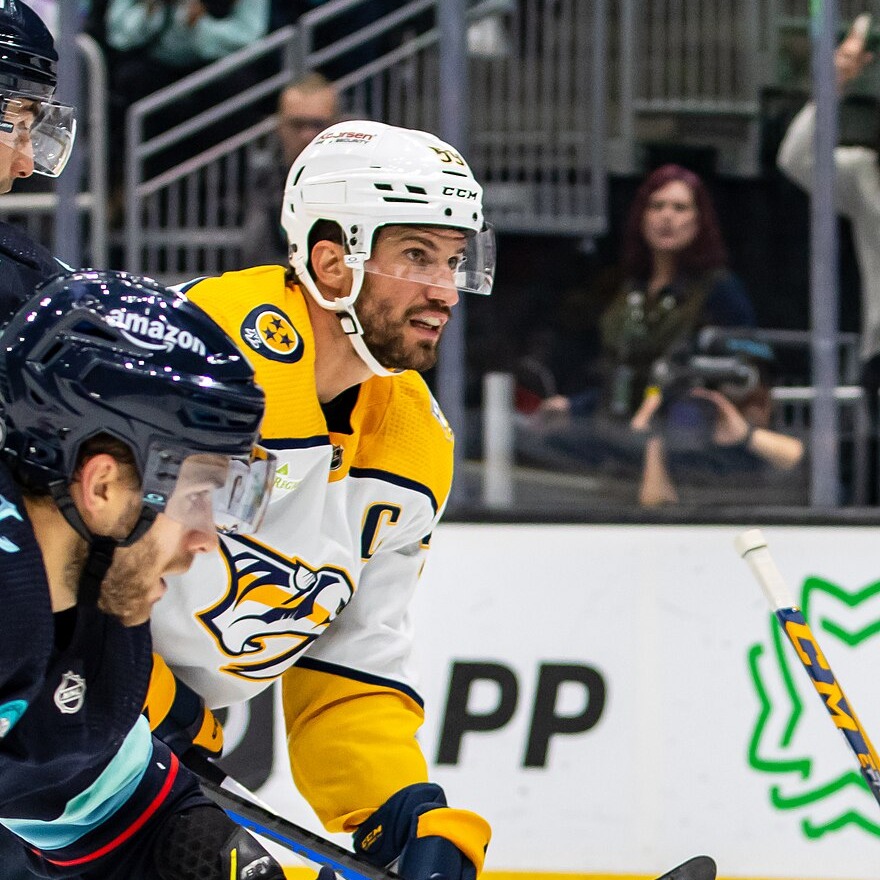
Alex Daugherty’s case for trading Roman Josi rests on an anniversary. Ten years ago the Predators shocked the league by moving their captain, the franchise survived it, and so they should do it again. It is a real argument and Nashville’s front office should hear it. What the column never does is check whether the 2016 move is still available to the 2026 Predators, and it is not. Put the two contracts side by side and the parallel dies on a single row. None of the coverage carrying the pitch this week does that: not the column’s own framing, not Pro Hockey Rumors’ Predators notes, not the aggregators recycling both.
One caution before any of it, because the coverage has blurred this: what is circulating is a columnist’s recommendation, not a report that Nashville is shopping anybody. The one piece of actual insider reporting we could find on Josi is five months old.
The Weber Trade Needed One Yes. This One Needs Two.
On June 29, 2016, Nashville sent Shea Weber to Montreal for P.K. Subban, one for one, no retention, no third team. Weber found out he was a Canadien the way everyone else did. That was legal, and it was the whole shape of the deal, because Weber had no say in where he played. Not a weakened say. None.
Josi does. His extension carries a full no-movement clause, and a full NMC is not a preference the club weighs against a good offer. It is a contractual veto. Nashville cannot trade him, cannot place him on waivers, and cannot move him in a deal he has not agreed to. The column asks the Predators to repeat a transaction whose defining feature was that only one party had to say yes.
Why a Second Missed Spring Put the Captain Back on the Table
The context is real, and it is why this pitch has legs at all. Nashville missed the playoffs for a second straight year, and the franchise has since changed hands at the top: Chris MacFarland arrived from Colorado on June 2 as president of hockey operations and general manager, replacing Barry Trotz. He has been public about wanting more puck skill on the blue line and about setting the bar above a wild-card berth.
That is the tension worth writing about. The one defenseman in Nashville who already supplies puck skill is the one the column wants traded. And he is not supplying less of it than he used to.
Two months ago, days before he turned 36, Josi was named the best player at a World Championship. He was the only defenseman in the tournament to reach double figures in points, and Switzerland lost the gold-medal game 1-0. Age is the strongest available argument for moving him, and right now it is doing less work than it looks.
Per Pro Hockey Rumors, MacFarland has identified puck-moving defense as a need and framed Nashville's ambitions above a wild-card berth. Nashville's blue line behind Josi skews defensive.
Weber’s Contract Never Had the Clause. Josi’s Runs to the End.
Here is the row the anniversary framing skips, and it is sharper than the shorthand suggests. The 14-year, $110 million offer sheet Nashville matched in July 2012 contained no no-trade clause and no no-movement clause at all. What kept Weber in place for a year was not his contract. It was a CBA rule that bars a team from trading a player whose offer sheet it just matched, a restriction on the club rather than a right held by the player, and it expired in the summer of 2013 with nothing behind it. Three years before the trade, Weber’s ability to refuse was already zero.
Josi’s clause is the other thing entirely. It is his, it is written into the deal, and it runs to the contract’s expiry after 2027-28, which is to say it outlives the trade window completely.
On the terms: On the Forecheck reported when Weber's matched contract was finalized that it contained neither a no-trade nor a no-movement clause. Josi's full no-movement clause appears in Puckpedia's entry for the 2019 extension and in the NHLPA's announcement of the deal. Daugherty's column sits behind the Tennessean's paywall; this piece works from its headline framing and from secondary coverage of it, and quotes none of its text.
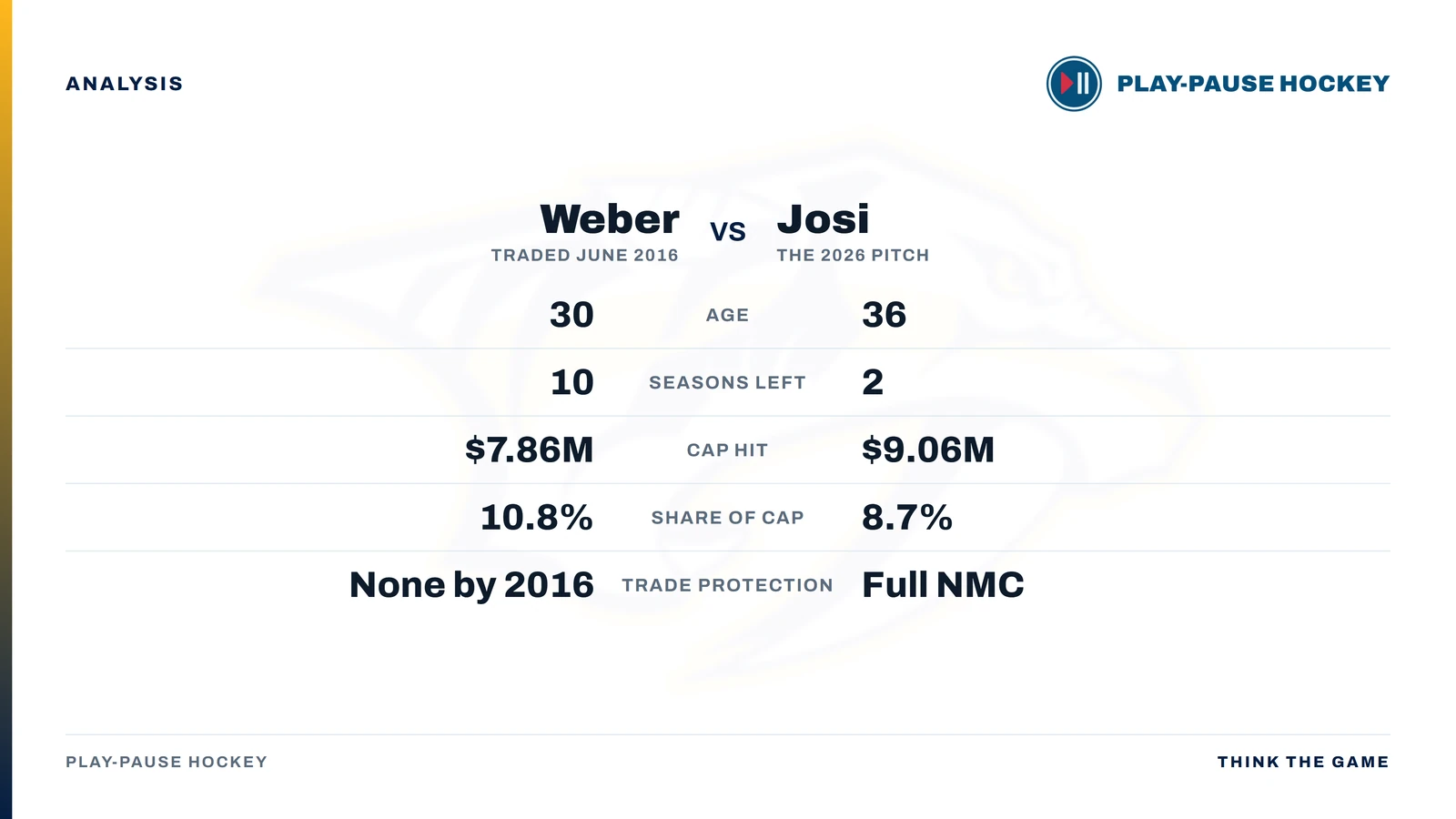
Read down that card and the trade reverses direction. Weber was 30 and came with ten years of term, so Montreal bought a decade that day. Nashville took back six remaining years of Subban and shed term in the process. Either way, 2016 was a franchise moving contracts by the decade. Josi is 36 with two years left. Moving him is not the same category of transaction; it is a shorter, smaller, later thing wearing the same headline.
The money says so too. Weber’s $7.857 million counted for 10.8 percent of the $73 million cap in the season after the trade. Josi’s $9.059 million is 8.7 percent of this season’s $104 million ceiling. The bigger number is the lighter burden. Whatever case exists for moving Josi, cap pressure is not it.
Weber had a rule that expired. Josi has a clause that does not.
Players Do Waive. That Still Isn’t the Same as Being Shopped.
The fair objection: no-movement clauses get waived all the time. Veterans on going-nowhere teams agree to move every March. Treating the clause as a wall overstates it.
Correct, and it matters. A full NMC is not a guarantee Josi finishes his contract in Nashville. What it changes is who opens the conversation. A club with an unprotected player can canvass the league quietly, build a market, and present the player with a completed deal. A club with a full-NMC player cannot do any of that without the player’s consent to be discussed at all. The market has to be built with him in the room. That is not a speed bump on the way to the 2016 trade; it is a different process with a different owner.
This is not the first time this summer the same clause has decided a story. Rielly’s no-movement clause set the terms in Toronto. Hellebuyck’s no-move clause set them in Winnipeg. An Elias Pettersson trade to Pittsburgh ran into one and stopped. The pattern is not a coincidence. The long extensions that bought these players’ primes also handed them the one clause that decides where those primes finish.
The one piece of real reporting here belongs to Pierre LeBrun of The Athletic, who wrote on March 10 that a Josi move had "more of a chance of happening than one might imagine" (as summarized by ClutchPoints). Read the condition he attached, though: if two or three of Ryan O'Reilly, Steven Stamkos and Jonathan Marchessault were moved, LeBrun expected Josi and his agent to seek a conversation with the club about its direction. Even the reporting has the player opening the door. That was five months and one general manager ago.
What MacFarland Has to Do Before Any of This Is Real
Nashville’s new GM does not start this process by calling thirty teams. He starts it by asking his captain a question, and the answer to that question determines whether there is a story at all. Everything downstream, the return, the retention, the destination list, exists only after Josi says the word.
So watch for the tell, and it will not be a price. It will be Josi or his agent acknowledging that a conversation is happening, or a report that Nashville has been given permission to talk. Until one of those lands, a column arguing the Predators should trade their captain is an argument delivered to the wrong address.
The 2016 comparison has one last thing to say, and it cuts against the nostalgia it runs on. Neither Weber nor Subban finished that contract with the team that acquired him. Nashville did not buy a decade of anything that day. It got three seasons of Subban and a story people are still telling ten years later, which is precisely what makes a franchise want to do it again.