

Free agency opens Wednesday at noon, and the best unrestricted player you can sign is a 37-year-old Patrick Kane. That is not a buyer complaining about a thin year. It is the system working exactly the way the new salary cap was built to make it work, and it is not going back. The names that move a season are already gone. What is left on July 1 is a clearance rack, and the league has quietly reorganized its entire calendar to make sure it stays that way.
Read the July 1 List: Patrick Kane Is the Headliner
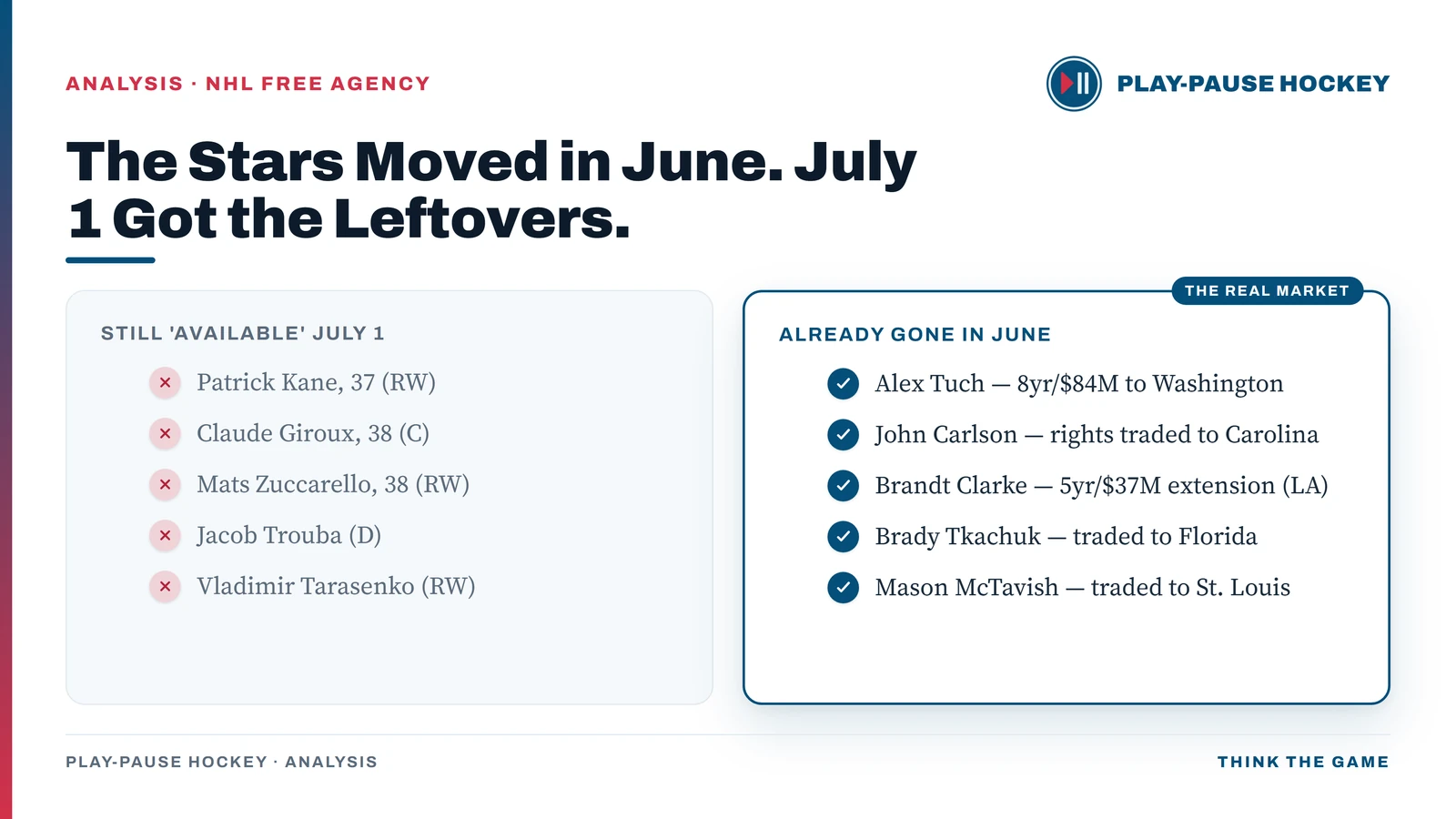
Start with the menu, because the menu is the whole argument. The top of the 2026 unrestricted class reads like an alumni night: Kane at 37, Claude Giroux at 38, Mats Zuccarello at 38, Jacob Trouba on his third team in two years, Vladimir Tarasenko looking for his fourth. These are useful players. None of them is the player a contender clears a roster spot to chase, and not one of them changes a playoff series.
The class was described before the draft as one of the weakest in years, and the reason is not a coincidence of birth dates. Connor McDavid, Jack Eichel, and Kirill Kaprizov all signed extensions before last season ever started. The stars did not get to the market. They were never allowed near it.
An $8.5 Million Cap Jump Rewrote Every GM’s Math
Here is the engine. The salary cap climbs to $104 million for 2026-27, an $8.5 million jump, and then to $113.5 million the following year, up another $9.5 million.
A cap that rises this fast does something specific to behavior. It makes the player you already have cheaper to keep than to replace, because next year’s ceiling absorbs the raise you give him today. So you extend early. You buy the years before the player can shop them, and you do it while the number on the deal still looks reasonable against a cap that will have grown by the time it kicks in. Multiply that logic across 32 front offices and the market does not thin out by accident. It empties on purpose, one early extension at a time.
The Real Market Already Closed on Draft Weekend
If the stars are not in free agency, they have to be somewhere, and they are. They are in the trade column, and the trade column ran for a week straight. Florida pried Brady Tkachuk out of Ottawa. St. Louis paid two first-round picks for Mason McTavish. Chicago spent the No. 4 overall pick on Bowen Byram. The actual business of changing rosters happened across draft weekend, in deals, while the free-agent tracker sat empty waiting for a noon that would not deliver.
The cleanest proof is the man who was supposed to headline July 1. Alex Tuch was the consensus No. 1 unrestricted free agent, and he will not sign with anyone on Wednesday. He already signed, eight years and $84 million, in a sign-and-trade to Washington, before the market he was meant to lead ever opened.
Tuch went to Washington on an eight-year, $84 million deal, with Buffalo receiving David Kampf and a 2027 third-round pick. John Carlson, another of the winter's notional top free agents, had his negotiating rights traded to Carolina during the draft, per ESPN's free agency preview.
When the No. 1 free agent is pre-sold and the No. 3 has his rights dealt mid-draft, free agency is not a market anymore. It is a receipt.
This Isn’t a Down Year. It’s the New Calendar.
The easy read is that 2026 is just a weak class and next summer will be different. It will not be, and the reason is in the math above. The cap is not spiking once. It is on a locked-in escalator, $8.5 million this year, $9.5 million next, with more agreed beyond. Every one of those steps hands teams the same incentive to extend their own before someone else can bid, which means the pipeline that would normally feed July 1 gets drained twelve months early, every year, by design.
Be fair to the other side of it. There is still room for a July surprise. Pittsburgh is sitting on better than $45 million in cap space and could decide to be aggressive, and the offer sheet remains the one weapon that can pull a star off another team’s books against its will. But notice that even those exceptions prove the point. The splashy money is concentrated in a few cap-rich teams, and the offer sheet is a trade mechanism in a free-agent costume. The open market, the one where 32 teams bid on the same available star, is the part that has quietly died.
A Ceremonial July 1 Hits Small-Market Teams Hardest
This is not a neutral change, and it is worth being honest about who it hurts. For two decades, July 1 was the day a smaller-budget team with cap space could simply outbid the field for a player it could not otherwise acquire. Cash was the equalizer. That door is closing. If the talent now moves only by trade and early extension, then the currency is no longer money. It is assets and readiness, and the teams with the deepest prospect pools and the most expensive cores are the ones holding both.
So when noon hits on Wednesday and the tracker stays quiet, do not read it as a slow news day. Read it as the new shape of the sport. The real market opened in June, did its business, and closed before most fans thought it had started. July 1 is the ceremony now. The deals were the week before.