

Leon Draisaitl is getting an extra $910,000 for a season that ended in June. Almost every account of that payment, including the headline on the report that broke it, calls it a rebate. It is not a rebate. Nothing was withheld from Draisaitl’s cheques in 2025-26, because the NHL switched escrow off in January 2025 and never switched it back on. There is no pot of his own money coming back to him.
That is not a quibble about vocabulary. It decides who in this league should actually be pleased.
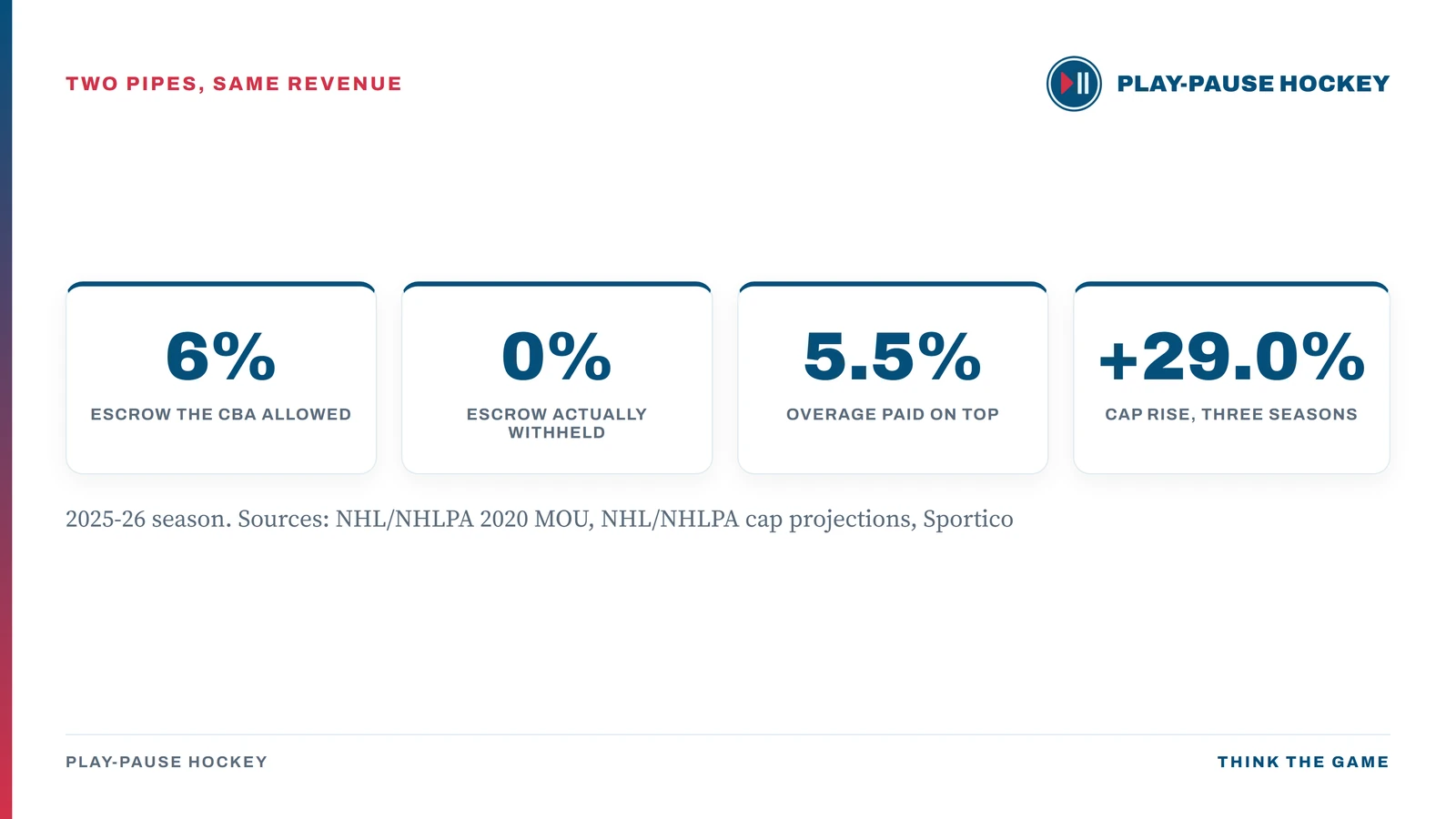
Per Sportico’s Kurt Badenhausen, on July 13, NHL players are on track for roughly $170 million above their 2025-26 salaries, about 5.5% each, on league revenue of around $6.8 billion. One caveat, stated plainly rather than buried: Sportico is the only outlet to have published that figure, and everything else circulating is downstream aggregation of it. So treat the number as one outlet’s reporting. What follows is not an argument that the figure is certain. It is an argument about the machine that produced it, and that machine is fully documented.
Here is the part you will not get from the wire. The $170 million and the salary cap are the same revenue arriving through two different pipes on two different clocks, and which pipe you are standing under is decided entirely by when you last signed a contract.
The League Did Not Give the Money Back. It Never Took It.
Escrow is the mechanism that enforces the 50/50 split of hockey-related revenue. Money is held back from every cheque during the season, and once the books close, whichever side overshot settles up. For most of the last decade it ran one way: players handed a slice back every year.
That was eighteen months ago, and the tap has stayed shut since. So read the 2025-26 payout for what it structurally is: not a refund, but a cash top-up on salary that was paid in full, because the players’ contracted share came in below half of what the league actually earned.
The scale of that reversal is easy to miss because nobody quotes the contract. The 2020 Memorandum of Understanding between the NHL and the NHLPA lists a maximum escrow percentage for every league year of the deal: 20% in 2020-21, 14% to 18% in 2021-22, 10% in 2022-23, then 6% in each of the last three, 2025-26 included. Six percent was the ceiling players signed up for this season. They were charged nothing and paid 5.5% on top.
Draisaitl’s $910,000 Is the Part Everyone Can See
The 5.5% is flat and proportional, which makes it the least interesting money in the story. It scales with the cheque you already have. Draisaitl leads the league because his salary does. A $3 million forward on the same percentage collects $165,000. Nobody’s contract changes, nobody’s leverage changes, and it lands once.
It is also, by the standards of this system, genuinely historic. Sportico puts the previous notable overage at 4.6%, in 2005-06, the first season of the salary cap era. Twenty seasons later the league has beaten it.
But a one-time 5.5% is not what has reshaped this offseason.
The Cap Is Up 29 Percent. The Payout Happens Once.
Put those against the $88 million upper limit of 2024-25 and the second pipe becomes visible. From $88 million to $113.5 million is a 29.0% rise across three seasons, and unlike the overage it does not land once. It resets the ceiling every future contract is measured against.
That is the money that has actually been moving this summer. Macklin Celebrini’s $18.8 million average annual value, the largest cap hit in league history, is a number that only exists inside a $113.5 million world. So are the second contracts Connor Bedard and Leo Carlsson signed. None of those players negotiated for a share of the $170 million. They negotiated for a share of the ceiling, which is worth vastly more and lasts for years.
Now hold the two side by side for a player in the middle of a long deal. Nathan MacKinnon signed eight years at $12.6 million in September 2022 and was, that afternoon, the highest-paid player in hockey. The deal runs through 2030-31. Against the $83.5 million ceiling of its first season it consumed 15.1% of a roster. Against the projected $113.5 million of 2027-28 it consumes 11.1%. Four points of cap share evaporated without a syllable of his contract changing, and Celebrini now clears him by $6.2 million a year.
A 5.5% cheque does not close that gap, and neither does anything else available to him. An NHL contract cannot be reopened and renegotiated, and an extension cannot be signed until the final year of the deal. The rising salary cap is the raise, and it is reserved for whoever happens to be negotiating when it arrives.
Gary Bettman, quoted by Sportico, is not hiding the trajectory: “Every platform, every source of revenue is growing. It’s going to be even better next year because the new media deal in Canada kicks in.” He is describing the pipe, not the puddle.
Salary Is Not Cap Hit, and That Objection Lands
The sharpest pushback is that the comparison cheats. The 5.5% applies to salary actually paid, while $88 million and $113.5 million are cap-hit ceilings, and salary and cap hit diverge constantly through signing bonuses and front-loaded structures. That is correct, and it diverges most on exactly the long-term contracts named above.
The concession sharpens the point rather than killing it. The argument was never that 5.5% and 29.0% share a denominator. It is that one is a percentage applied to money already promised, and the other is an expansion of what money can be promised at all. A player cannot convert the overage into term, into a no-move clause, or into a bigger AAV. He can convert the cap into all three, if his contract happens to expire at the right moment.
The fair counter is that this evens out, since everyone signs again eventually. It does, over a full career. It does not over a specific one. Careers are short, the cap is compounding at roughly 9% a year, and a player whose next negotiation is in 2029 is not made whole by a cheque in 2026.
What Changes If Escrow Ever Comes Back
Escrow was not abolished. It was set to zero, and the mechanism is symmetric: if salaries ever catch up to revenue again, withholding resumes. Sportico reports it is not expected back for 2026-27, which is a projection, not a guarantee, and the new collective agreement that takes effect on September 16, 2026 keeps the 50/50 split that makes escrow necessary in the first place.
So the verdict is narrower than the headline number suggests. The $170 million is real, it is the largest overage of the cap era, and it belongs to the players. It is also the smaller half of what this revenue boom is paying out, and it is being distributed on the opposite principle from the larger half: the overage rewards the size of the contract you already have, the cap rewards the timing of the next one.
Watch two things this season. Whether withholding stays at zero once Canada’s national NHL rights start producing at the new price, and how the flat-cap contracts behave as they come due. Their holders cannot reopen them. They can only reach the end of them, and a player reaching the end in a $113.5 million world will be paid on a different scale from the one who signed in an $83.5 million one.