

Anaheim won. That is the official story: the Ducks matched Philadelphia’s five-year, $90 million offer sheet on July 9 and kept Leo Carlsson. Utah won too, matching New Jersey’s one-year, $4.775 million sheet for Barrett Hayton the day before. Two attacks, two matches, zero players moved. And if you stop reading there, you will miss what actually happened this month: the offer sheet stopped being a failed poaching tool and became the mechanism that sets restricted free agent prices in this league. Rival general managers just wrote Anaheim’s payroll and Utah’s, and neither team had a real choice about it.
Two Matched Offer Sheets in Eight Days Rewrote the Weapon’s Job
The old test for an offer sheet was simple: did the player move? By that test the weapon almost never worked, which is why front offices treated it as a nuclear option that mostly embarrassed the team firing it. The new test is different: who set the number on the contract? In July 2026 the answer, twice in eight days, was somebody else’s GM.
Philadelphia set Carlsson’s number at $18 million a season, the richest cap hit in NHL history for a 21-year-old who has never scored 30 goals or cracked 70 points. New Jersey set Hayton’s at $4.775 million. Both teams matched because the alternative was worse, and both now live with a contract they did not write. Matching kept the player. It did not keep control.
Read that announcement again, because the structure is the weapon. Four first-round picks sounds like an enormous price. It is a price Philadelphia never paid. The moment Anaheim matched, every one of those picks went back in the drawer, and the Flyers walked away having cost a Western Conference team $90 million for free. And not a friendly $90 million: per ESPN, $83.5 million of it is paid out in buyout-proof signing bonuses, a poison-pill structure designed to hurt whoever ends up holding the contract.
Anaheim Kept Carlsson and Lost Its Summer Anyway
Here is the bill for “winning.” Carlsson’s $18 million cap hit eats about 17 percent of Anaheim’s ceiling, and the team is left with roughly $9 million in space to sign Cutter Gauthier, a 22-year-old coming off a 41-goal, 69-point season. Gauthier is not even eligible for an offer sheet, which means he has no leverage weapon of his own, and his team has no room to pay him what the market says wingers like him now cost. Anaheim already rushed a five-year, $36 million deal to Pavel Mintyukov on July 6 specifically because a second sheet was pending, with Carolina and Montreal both circling.
One rival GM’s aggression did all of that. Pat Verbeek spent years grinding his young players down: Jamie Drysdale, Mason McTavish and Trevor Zegras all went through it, and all three are now former Ducks. The market finally graded the strategy.
Twelve Sheets in Nineteen Years, Then Five in One Week
The scale shift is the story the box scores miss. When St. Louis signed Philip Broberg and Dylan Holloway away from Edmonton in 2024, they were the 11th and 12th offer-sheeted players of the entire salary cap era, per Daily Faceoff. Then came the first week of July 2026.
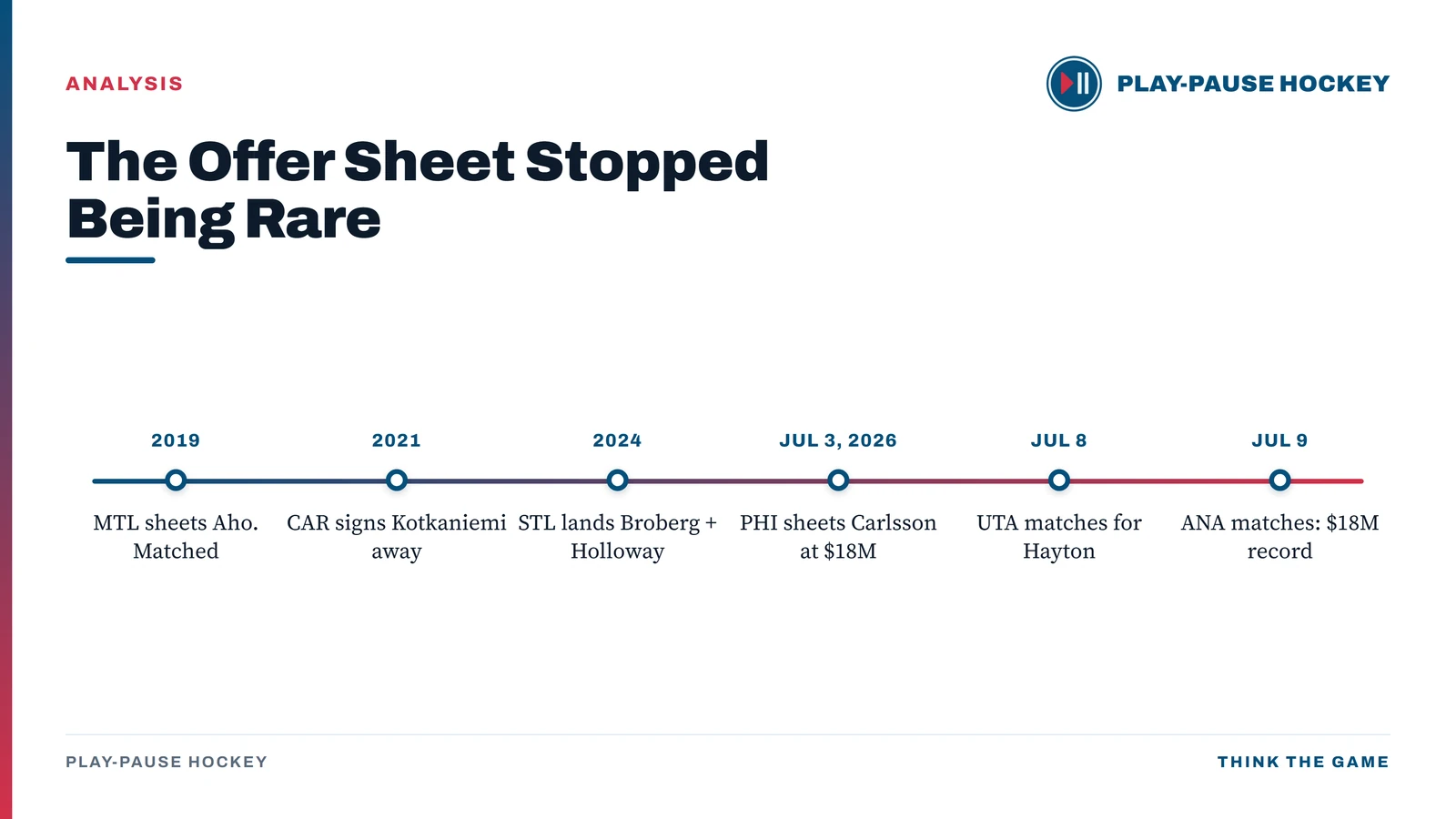
Four teams presented offer sheets to one player. Add New Jersey’s sheet for Hayton and five were put on the table in a single week, nearly half the cap era’s two-decade total, and that counts only the sheets we know reached paper. Dreger’s agents are telling you the rest out loud: this juices the market. The people who set prices for a living have noticed that the league’s most efficient price-setting tool just went mainstream.
There is a clock on all of it. The new CBA takes effect September 16, 2026, cutting maximum contract terms from eight years to seven for a player’s own team and six for anyone else. Meanwhile the cap ceiling keeps climbing, to $104 million this season and $113.5 million the next, which drains the UFA pool because teams extend their stars before they ever reach the open market. Put those two facts together and the RFA class becomes the only aisle in the store with anything on the shelf, and this summer is the last chance to shop it under the old rules.
The “They All Got Matched” Crowd Is Reading the Wrong Scoreboard
The obvious objection: Sebastian Aho got a sheet from Montreal in 2019, Carolina matched in a heartbeat, pundits declared a new era, and nothing happened for two years. Every 2026 sheet got matched too. If the players never move, how is this a machine and not a fire drill?
Because presenting is nearly free and matching is not. The bidder risks draft picks only if the player actually changes teams; a matched sheet returns every pick and costs nothing but a news cycle. The target team, meanwhile, eats the contract, and the side effects are written into the CBA: a team that matches cannot trade the player for one full year, which is why Hayton, due to hit unrestricted free agency next July, is now untradeable through a walk year Utah did not plan. That asymmetry is why “it got matched” is a defeat dressed as a victory. Verbeek said it himself after the match, in back-to-back breaths: “It was forced on us,” and then the confession that should scare every GM with an unsigned RFA.
"The increased cap space has led to different circumstances. We're going to have to do business in a different manner going forward," Verbeek acknowledged after matching, per ESPN's winners-and-losers breakdown of the saga.
That is the sound of a front office admitting the negotiation now starts from the rival bid, not from its own comparables. And yes, 2019 was one sheet that led nowhere. July 2026 was five sheets, two signings, two matches and at least three more RFAs under active threat, with a rule-change deadline behind it that 2019 never had.
Fantilli, Leonard and Bedard Are the Next Prices Somebody Else Sets
Watch how the next three negotiations run, because they are already running differently. Columbus is racing to extend Adam Fantilli before a rival puts a number on him first, with Don Waddell publicly prepared to match. Washington is bracing for a sheet on Ryan Leonard, who happens to be represented by the same Keator agency that ran the Carlsson play. And Chicago sits in the most exposed spot of all: Connor Bedard is an unsigned RFA reportedly seeking Kaprizov-tier money around $17 million while the team opened in the $10 to $12 million range, and he now has Carlsson’s $18 million as a public comparable he did not have two weeks ago. Awkward detail for Chicago: Bedard has outproduced Carlsson, 203 points to 141 since they entered the league, per ESPN. The comparable does not just exist. It argues for him.
None of those three may ever sign a sheet. It will not matter. The threat now does the negotiating, which is exactly what a price-setting mechanism looks like: prices move without the weapon ever firing. The offer sheet did not fail this month because nobody moved. It graduated. The proof will come by September 16, in every RFA deal that closes fast, pays full market, and gets announced by a GM insisting he was not rushed.