


Kyle Dubas spent two years teaching Pittsburgh to be patient. Now he is shopping like a team that has run out of it.
The Penguins general manager has quietly built a deep bank of prospects and draft picks, a war chest designed to pay off at the back end of the decade. Yet the same front office spent the first week of free agency chasing scoring help to prop up a core whose best player turns 39 in August. Both instincts are defensible on their own. Stacked on top of each other, they describe a team trying to win in two different years at the same time.
Kyle Dubas Is Betting on Two Timelines That Can’t Both Win
Start with the numbers, because they do not agree with each other. Dubas is sitting on roughly 25 draft picks across the next three drafts and has kept all three of his own first-rounders, the most deliberate stockpiling of his tenure. A first-rounder taken in 2027 does not play a meaningful NHL role until 2029-30 at the earliest, and the class as a whole does not mature into everyday players until the back half of the decade.
Sidney Crosby is signed through 2026-27 at an $8.7M cap hit, with a full no-movement clause and, by his own account, a wait-and-see attitude about anything past that. So the rebuild currency and the win-now core are pointed at different calendars. One is built to matter in 2029. The other has to matter now.
Why Crosby’s Final Guaranteed Year Forces the Choice
This is not a rebuild that gets to take its time, because the reason to hurry is still the best player they have. Crosby put up 74 points in 68 games last season, a point-per-game pace at 38, and Pittsburgh rode him back into the playoffs for the first time since 2021-22, finishing second in the Metropolitan at 98 points before a six-game first-round loss to Philadelphia that went to overtime in the clincher.
That playoff cameo is the trap. A team that just proved it can still make noise around Crosby has every emotional reason to push chips in for one more run. Evgeni Malkin, who turns 40 this month and is sliding to the wing after a 19-goal, 42-assist season in 56 games, sharpens the urgency: the window where both legends are still contributing is measured in months, not years. The problem is that pushing in for 2027 means spending the very assets that are supposed to build 2030.
The Pick Hoard Says Rebuild. The Star Chase Says Win Now.
Look at what the desk did in free agency and the split personality is right there on the transactions page.
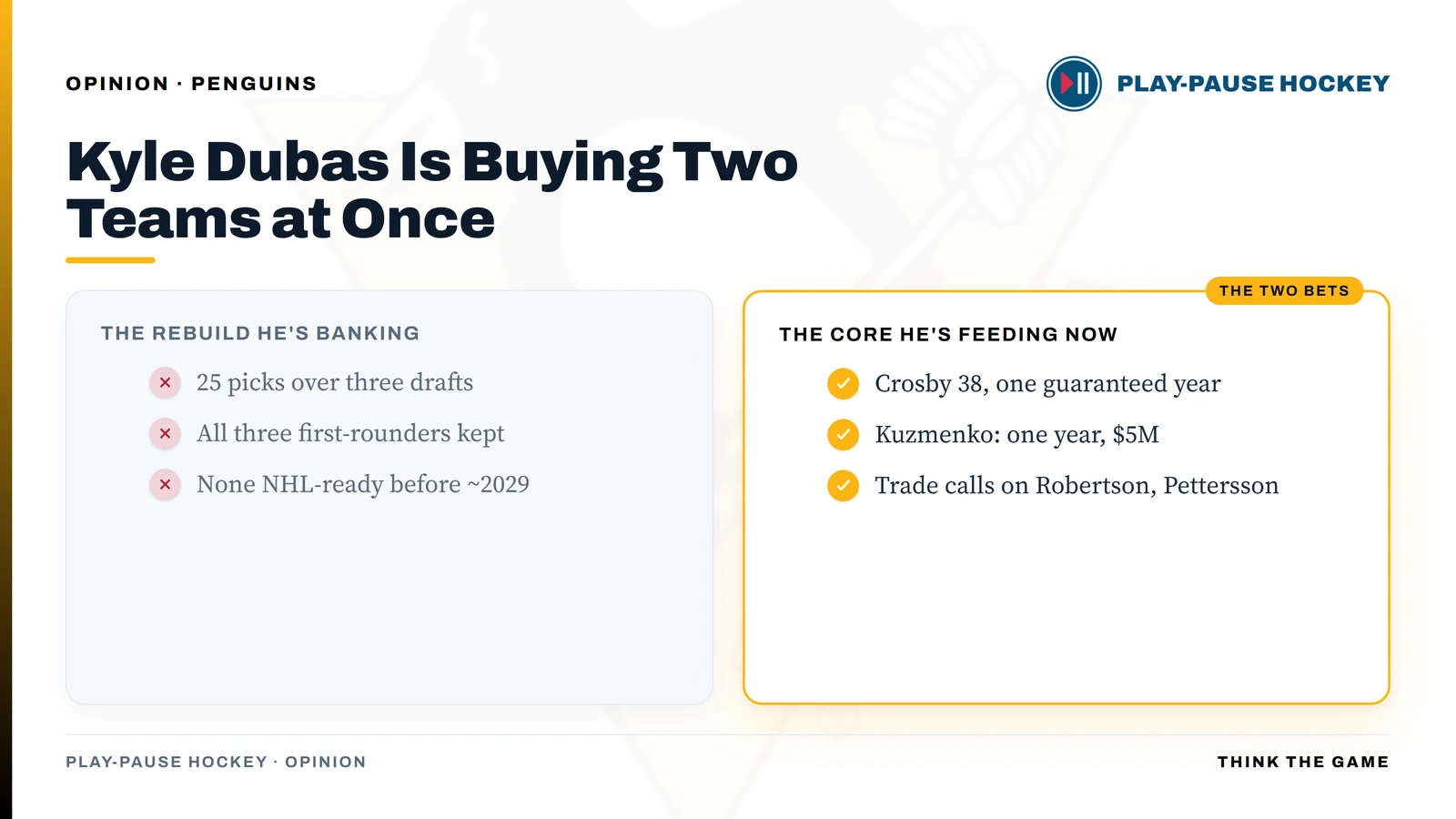
On one side, the patience: draft picks banked, young reclamation forwards added on cheap, short terms. Andrei Kuzmenko came in on a one-year, $5M deal. Nick Robertson, a 24-year-old former high pick, arrived from Toronto for a 2028 fourth. Trevor van Riemsdyk stabilized the blue line on a modest two-year term. None of those moves mortgages anything.
On the other side, the ambition. Pittsburgh has been the loudest name attached to Dallas winger Jason Robertson, and it circled back on Vancouver’s Elias Pettersson after an earlier framework fell through. There is an irony buried in that pairing. The Penguins’ actual hole is at center behind Crosby, yet their noisiest pursuit is a winger, and the one true center they chased already told them no once.
Per Elliotte Friedman on the 32 Thoughts podcast, Dubas had a deal in place to reunite Pettersson with new Penguin Andrei Kuzmenko under a new coaching staff, and Pettersson said no. The Athletic's Josh Yohe has reported Pittsburgh keeps circling Robertson, whose brother Nick the Penguins just acquired.
Those are not depth pieces. Robertson is a 45-goal talent seeking something close to $14M a year; Pettersson carries a full no-movement clause and $11.6M against the cap through 2031-32. Landing either one, in the shape these talks have taken, means paying a real trade price. And the only currency Pittsburgh has stacked high enough to pay it with is the pick hoard.
The Case That Dubas Is Threading It, Not Straddling It
Here is the strongest version of the counterargument, and it is not a bad one. Dubas is not stuck between two timelines, the optimist says; he is bridging them. The picks are insurance for the post-Crosby era. A Robertson (26) or a Pettersson (27) is young enough to still be a core piece when those picks graduate. Add a controllable star in his mid-20s and you serve both the 2027 push and the 2030 team in a single move. That is not indecision. That is having it both ways on purpose.
It holds together only if the young star is actually ascending, controllable, and affordable. Neither candidate clears all three bars. Robertson is one year from unrestricted free agency, filed for arbitration in Dallas, cannot be offer-sheeted, and wants a number the Stars themselves are balking at, so acquiring him is a bet he re-signs at a premium rather than walking in 2027. Pettersson is coming off a down season, holds all the leverage of a full no-move, and already told Pittsburgh no once. Spending three straight banked first-rounders to rent one contract year of a 26-year-old, or gambling $11.6M on a 27-year-old reclamation, is not bridging two timelines. It is cashing in the future one to buy a lottery ticket on the present.
What the Pettersson Answer Will Tell Us About Pittsburgh
The move to watch is not who Pittsburgh signs. It is what Pittsburgh is willing to trade.
If Dubas holds his first-rounders and lets Kuzmenko, Nick Robertson, and a cheap veteran or two be the extent of the retool, the plan stays coherent: compete honestly around Crosby with low-cost swings, and keep the war chest sealed for the rebuild it was assembled to fund. If instead he ships a first plus prospects for a Pettersson or a Robertson, he will have told you which timeline actually governs this front office, and it is not the one his own draft board has been building toward.
Two years of discipline bought Dubas a genuine choice. The next trade is where he finally has to make it.