
San Jose Paid the Record, Not the Discount
Two weeks ago Macklin Celebrini told ESPN he would “100%” take a below-market deal to help the Sharks win. On July 29 he signed for five years and $94 million, an $18.8 million cap hit beginning in 2027-28. It is the largest average annual value in the history of the league, and it arrived roughly three weeks after Leo Carlsson’s $18 million set the previous mark.
So where did the discount go?
Nowhere, is the honest answer. Not into the dollars, and not into the cap share either. That matters because our own read on Celebrini’s hometown discount two weeks ago accepted the premise and asked only whether San Jose was positioned to spend the savings. The savings do not exist.
Why $18.8M Reads Differently Off a Non-Playoff Season
The pledge was never just goodwill. A cornerstone signing under his market value is a real team-building instrument, and the deals now cited as bargains were struck by teams already close enough to convert the room into wins. Crosby in Pittsburgh, Point in Tampa, Barkov in Florida. All contenders when the contract was written.
San Jose missed the playoffs in 2025-26. It is spending its record share of the cap while the roster around Celebrini is still being assembled, and San Jose’s free-agent spending on July 1 committed term to Jacob Trouba and Mason Marchment, on top of the four years left on Darnell Nurse’s contract, acquired by trade from Edmonton the same day. Will Smith, on the last year of his entry-level deal, is unsigned and wants an extension of his own.
None of that makes the contract bad. It does mean the contract has to be good, because there is no discount underwriting the rest of the build.
Hold the Year Constant and Carlsson Is the Cheaper Contract
Here is the number the wire coverage skipped.
The tempting comparison is Celebrini’s 16.56 percent of the 2027-28 ceiling against Carlsson’s 17.31 percent of this season’s. That looks like restraint. It is not a real comparison, because it runs two different denominators across a $9.5 million jump in the cap.
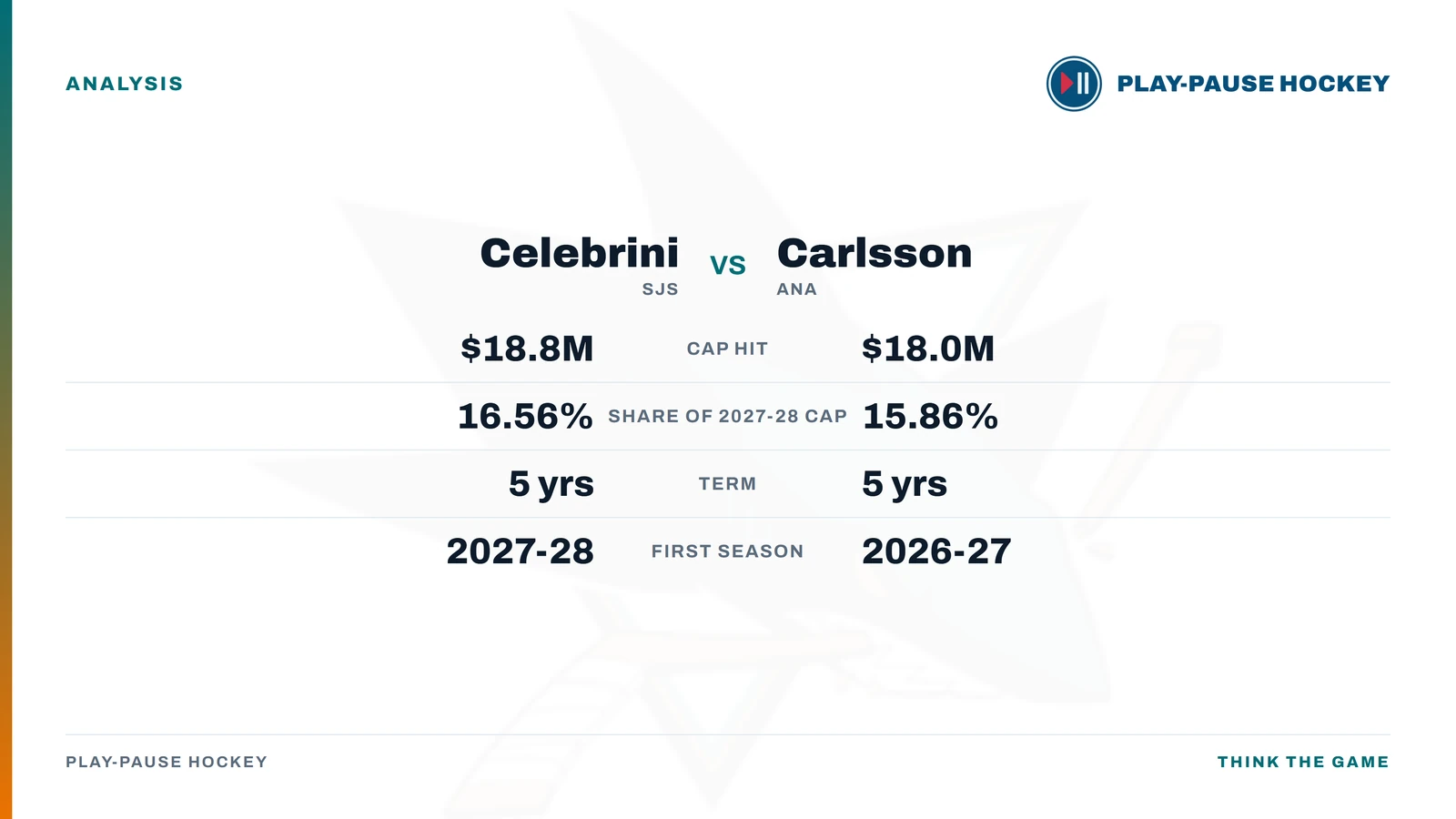
Run both contracts in a season where both are active. In 2027-28, with the ceiling locked at $113.5 million, Celebrini’s $18.8 million is 16.56 percent and Carlsson’s $18 million is 15.86 percent. Celebrini is the more expensive player in dollars and in cap share at the same time.
The projections tell the same story. Sheng Peng of NBC Sports Bay Area, citing agents, modelled roughly $15 million in May. David Pagnotta said on Daily Faceoff that “the $15-million range wouldn’t entirely shock me.” AFP Analytics ran seven years at $17 million. Celebrini beat the top of that range by more than 10 percent and the bottom by a quarter.
Even Elliotte Friedman, hours from the announcement, did not have the shape of it:
That uncertainty is the point. Nobody with access expected this number, which is what makes calling it a discount untenable.
Where the pledge did show up is term. Five years, not the eight San Jose could still have offered before the new CBA cuts the maximum on September 16. That is the same structure as Bedard’s five-year deal, and it should not be mistaken for generosity: it expires in the summer of 2032, the summer Celebrini turns 26, handing him a second trip to the market in his prime against a still-climbing cap. Short term is the player’s bet, not the team’s saving.
The Case That Celebrini Is Underpaid Anyway
The sharpest reply is that this misreads the market. Carlsson got $18 million off a far thinner résumé, via an offer sheet Anaheim had to match. Celebrini just put up 45 goals and 115 points in 82 games and finished fourth in Hart voting. Against that comp, $800,000 more is close to a bargain, and the projections were simply low.
Half of that lands. The Carlsson number was set by an offer sheet, which is a distorted price mechanism rather than a market clearing, and by production Celebrini has already lapped. If you think a centre who scored 115 points at 19 is worth more than 16.56 percent of a cap, you are probably right.
But being worth more is not the same as taking less. A discount is measured against what a player could have signed for, and there is no evidence Celebrini left anything on the table. He beat every public model. One place a discount could still be hiding is structure: Carlsson’s $90 million is roughly $85.3 million in signing bonuses, which is worth materially more than the same figure in salary. San Jose has not disclosed how Celebrini’s $94 million is paid out. Until it does, that question stays open, and it is the only one still open.
The Two Seasons That Decide Whether This Was a Bargain
The extension does not start until 2027-28, which gives Mike Grier one more season of Celebrini at entry-level money to convert into a roster.
Watch three things. Whether Will Smith signs before the leverage shifts. Whether the Nurse and Trouba contracts age into a competitive blue line or a pair of anchors. And whether San Jose is a playoff team by 2028-29, while the cap keeps climbing and 16.56 percent quietly becomes 15, then 14.
If the Sharks contend inside this deal, the record price stops mattering and the discount question turns academic. If they do not, San Jose will have paid the highest cap share in hockey to be the best player on a team going nowhere, which is precisely the outcome a real hometown discount was supposed to prevent.