


Every Leafs blog in the country is running the same headline this week: Toronto is chasing Patrick Kane. It is technically true, and it is going almost nowhere. The tell is not in the rumor. It’s in who is spreading it, and how fast they are walking it back.
Insider David Pagnotta named four clubs circling the future Hall of Famer, Toronto among them, then described the Leafs’ involvement in the flattest possible terms: some conversations, “very loose.” On TSN’s Insider Trading, Chris Johnston had already said the quiet part out loud, that a Kane-to-Toronto marriage doesn’t “seem to be like that’s actually something that’s likely to materialize.” When the two reporters carrying the story are also the two throwing cold water on it, that is the story.
Reporting via David Pagnotta (The Fourth Period) and Chris Johnston (TSN Insider Trading).
Toronto Isn’t Signing Patrick Kane, and the Insiders Who Started It Already Know
Start with what Kane still is, because it’s real. At 37, he put up 57 points in 67 games for Detroit last season on a one-year, $3 million deal, 16 goals and 41 assists, fifth on the Red Wings in scoring. He is not a passenger. He is a legitimate top-six winger who will help a playoff team, and he will sign somewhere that matters.
That is exactly why the “loose” language from Pagnotta is doing more work than the four-team list. A player of Kane’s pedigree draws polite check-in calls from half the league; that is not the same as a fit. The gap between “Toronto called” and “Toronto is a threat to sign him” is the entire article, and it is measured in dollars.
What a Team Already Over the Ceiling Can Offer a Free Agent
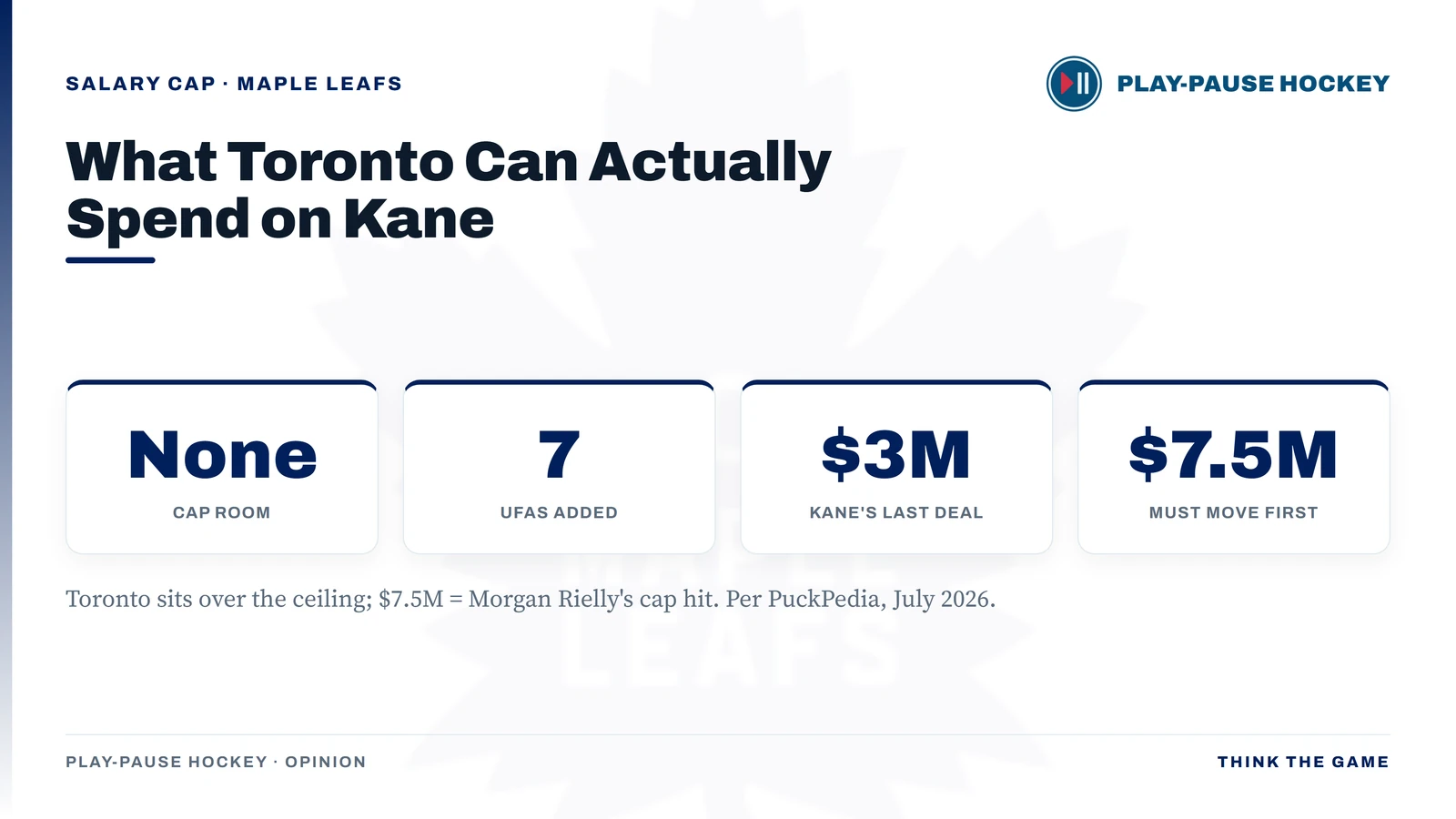
Here is the part the rumor blogs skip. Toronto is over the salary cap. Not tight against it, over it, after a spending summer that has already added seven free agents, led by the three-year, $21 million contract handed to goaltender Sergei Bobrovsky. By PuckPedia’s accounting the Leafs sit roughly $2.75 million above the upper limit as of mid-July, and even the friendlier estimates have them over on a full roster. Either way, the number that matters for Kane is the same one.
That is not a haggling position. A team over the cap cannot add a contract, veteran-minimum or otherwise, without first subtracting one. To create even a bargain slot for Kane, Toronto has to move a real salary, and the name that keeps surfacing is Morgan Rielly and his $7.5 million cap hit, a defenseman with a full no-movement clause who is not walking out the door in July to make room for a 37-year-old winger.
Now layer the fit on top of the finances. Kane is a finesse scorer whose game has always lived on skill, not weight. Toronto’s playoff exits have never been about a shortage of top-end offense; the Leafs keep losing in the spring for the opposite reasons. Their real needs this summer are a top-four defenseman and heavier, harder-to-play-against forwards. Kane is neither. Paying a premium in cap gymnastics to add the thing you already have too much of is how bad summers happen.
The LTIR Relief Leafs Fans Are Counting On Doesn’t Arrive Until Winter
The sharpest pushback from the Toronto side is a good one, so let’s take it seriously: Max Domi is a candidate to open the year on long-term injured reserve, and LTIR is how cap-strapped teams manufacture room. Doesn’t that solve it?
Not in July, it doesn’t. LTIR is in-season relief. It lets a team exceed the cap during the season by the injured player’s hit, but it does not hand you offseason spending money, and it does not exempt you from being cap-compliant on opening night. A club can carry up to 10 percent over the ceiling through the summer for bookkeeping, but the roster still has to fit under the limit when the puck drops in October. So even in the rosiest Domi scenario, Toronto’s path to Kane runs through the same toll booth: trade out salary first. The relief that fans are banking on is a winter mechanism, not a summer loophole, and it is precisely why Pagnotta reached for the word “loose.”
The Honest Case for Kane in Blue and White
There is a version where this happens, and fairness demands naming it. Kane could decide a contender at the veteran minimum is worth more than dollars, the way aging stars sometimes do. Gavin McKenna, Toronto’s new No. 1 pick, has spoken about Kane as a childhood idol, a soft gravitational pull that’s real if not decisive. And if the Leafs find a taker for Rielly or move a Matthew Knies-sized number, the math loosens in a hurry.
But notice that every one of those paths starts with a subtraction Toronto has not yet made, on a roster whose glaring holes Kane doesn’t address. “Possible if several other things happen first” is not the same as “likely,” and the reporting reflects exactly that hierarchy.
Where Patrick Kane Actually Signs
Follow the fit and the money, and two names stand out. Buffalo is Kane’s hometown, a Sabres team short on proven scoring and unburdened by Toronto’s cap knot. Chicago is where his number will one day hang in the rafters, with a chance to mentor 20-year-old Connor Bedard on the way. Both have the room. Both have the reason. Colorado lurks as the contender wildcard for a minimum-deal flyer.
None of that is Toronto. The Leafs made their big swing in net with Bobrovsky and spent their flexibility doing it. Kane is a good player having his market read correctly by the only people close to it. The buzz will keep climbing in the aggregation feeds; the two insiders who started it already told you where it lands, and it isn’t on Yonge Street.