

Toronto does not have a Morgan Rielly trade problem. It has a Morgan Rielly stalemate, which is a different and worse thing. For months the reporting has called a deal a matter of when, not if, and for months nothing has moved. That is not a coincidence or a slow market. The three forces that are supposed to produce a trade here, a player who has accepted a move, a team that needs the cap space, and a league full of teams that always want a top-four defenseman, are the same three forces jamming the door shut.
When, Not If, and Nobody Knows When
The framing has been consistent since spring. Back in April, Daily Faceoff’s David Pagnotta reported that Rielly had “kind of accepted” he might be one of the changes coming in Toronto. By July, Pagnotta’s language had hardened into something that sounds like inevitability and functions like a shrug.
“I was told it’s a matter of when, not if. Now, the problem with the when not if is nobody really knows when. It could be this week. It could be next week. It could be next month. It could be into the season.”
That is not a countdown. That is a description of a negotiation with no forcing clock, dressed up as one. A “when, not if” that stretches from July into the regular season is just an “if” that nobody wants to say out loud. The interesting question is not when Toronto trades Rielly. It is why a deal everyone claims is coming keeps not arriving.
The List That Runs the Whole Saga
Start with the clause, because everything else bends around it. Rielly carries a full no-movement clause, which means he cannot be traded, waived, or sent anywhere without his say-so. Toronto is not shopping him. It is asking his permission, and he has answered with a very short guest list.
Four teams, all in the West, out of a possible thirty-one. Dreger notes the list can grow if the fit is right, and that caveat matters, but read it the way a rival GM does. The pool of buyers is capped before the phone rings, and the player controls the cap. A GM who wants Rielly cannot simply out-bid the field. He has to be one of the four names Rielly has already blessed, and then he has to clear the other two hurdles below. Player empowerment is real, but it does not come free. Every door the clause closes to Rielly it also closes to Toronto. It is a gentler version of the box that has frozen Shane Wright’s trade request in Seattle, where naming a single preferred destination handed all the leverage to the seller; Rielly has simply drawn his box a little wider, at four teams instead of one.
The Decline That Sets the Price
Now the part that makes those four doors even harder to walk through. This is not 2018 Rielly, the 72-point offensive engine a contender would mortgage a prospect to add.
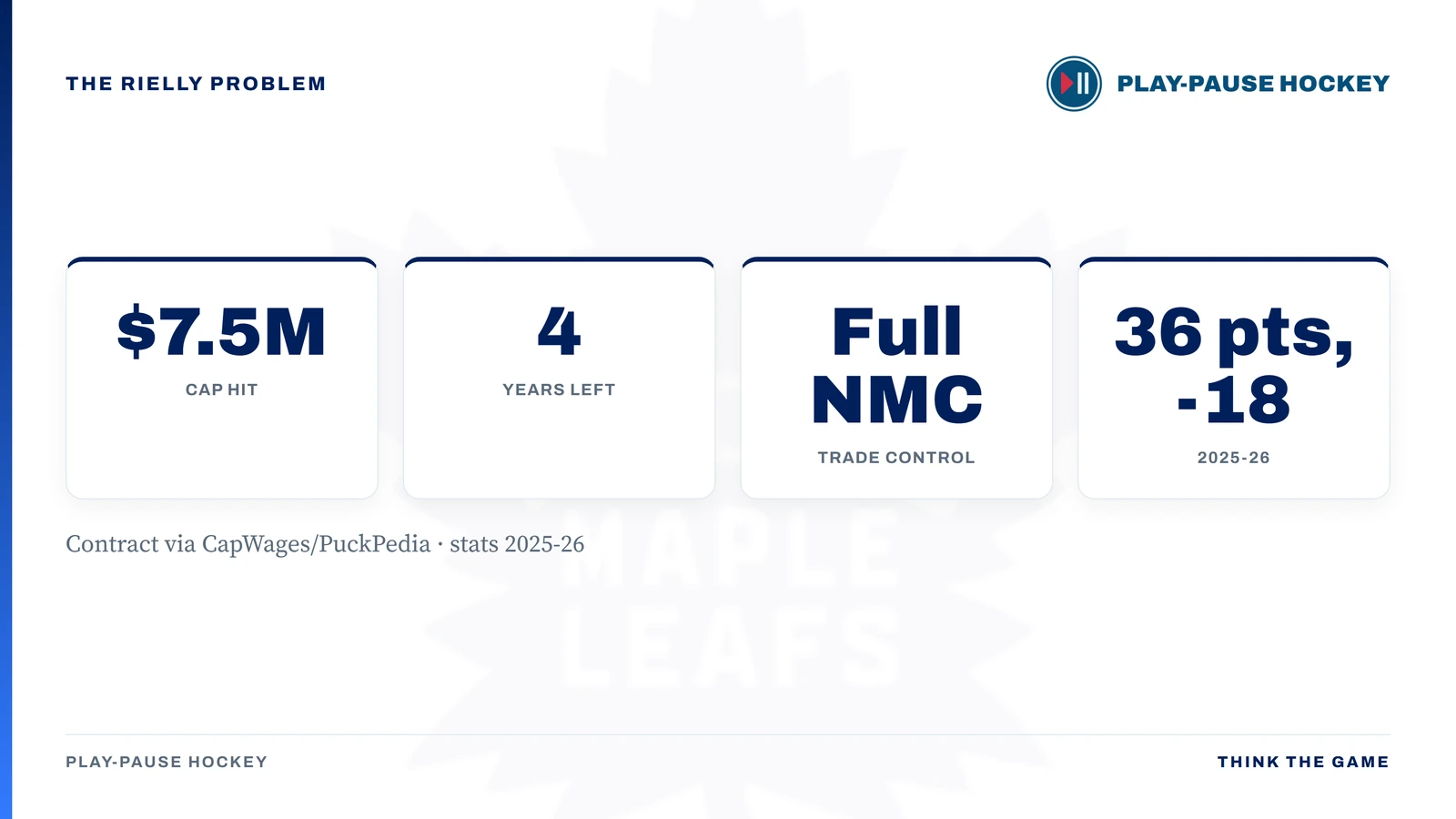
Rielly finished 2025-26 with 36 points and a minus-18 in 78 games, his first season under 40 points in five years and a clear step down from the four straight 40-plus campaigns before it. Set that next to the contract, $7.5M against the cap with four years still to run, and the mismatch is the whole valuation problem. A buyer is not being asked to pay for what Rielly did last year. He is being asked to pay $7.5M through 2029-30 for a 32-year-old defenseman coming off the worst season of his last five years, and to give up an asset for the privilege. That is a tough number to move even before anyone gets to the clause.
Chayka’s Floor: No Retention, No Sweetener
Here is where the seller closes the last door himself. The obvious way to make an aging, expensive contract move is to grease it, retain a slice of the salary or staple a pick to it. GM John Chayka has reportedly refused to do either, the same unsentimental streak that drove Chayka’s Leafs front-office purge earlier this month. Toronto’s position is that quality veteran defensemen have been fetching real returns lately, so it will wait for a fair one rather than subsidize a rival’s blue line.
Philadelphia, per Pagnotta, kicked the tires and wanted salary retained, and the Flyers are not on Rielly’s four-team list anyway. So a real inquiry died on both counts at once: the wrong destination and the wrong terms. That is the market in miniature. The clause filters out most teams, the price filters out most of the rest, and Toronto’s refusal to sweeten the deal filters out the few that remain. Each rule is defensible on its own. Stacked together, they leave almost no legal move on the board.
Vancouver, and the Exit That Isn’t There
Which brings us to the one name that keeps recurring, and the reason it does not actually solve anything. Vancouver, Rielly’s home province, has been floated as a fit, and unlike most suitors the Canucks can genuinely afford him. They enter 2026-27 with among the most projected cap space in the league, north of $17M, more than enough to absorb a $7.5M cap hit without a single corresponding move. If money were the wall, this deal would already be done. It is not, and the sourcing tells you why.
The reporting is in tension: some accounts put Vancouver among the interested clubs as a hometown fit, while Pagnotta has separately indicated Rielly does not want Vancouver or Seattle. Both cannot be fully true, and neither has been resolved as of late July 2026.
That contradiction is the tell. The one team with the cap room and the hometown pull still cannot get to yes, which means the obstacle was never Vancouver’s ability to pay. It is whether Rielly will actually go there, and what Toronto gets back if he does. Chayka is not retaining salary to send a declining defenseman home at a discount, and Vancouver, mid-retool itself, has little reason to pay a premium for a 32-year-old coming off a minus-18. The suitor that can most easily afford him is stuck on the very same walls as everyone else. And this is the pressure Toronto cannot escape, because Toronto’s cap crunch is the one clock in this saga that actually ticks.
That is the trap in one figure. The cap says the money must go. The clause, the price, and Chayka’s floor say it cannot go, at least not for anything Toronto is willing to accept. The honest counter is that none of these walls is permanent. Rielly’s list can expand, a contender’s injury in October can manufacture a bidder overnight, and Toronto has quietly signaled it is fine opening camp with him still on the roster if the return is not there. A patient seller with a useful player is not in crisis.
But patience does not pay the cap bill, and the strongest objection cuts the other way too. Someone will argue this is Toronto’s own doing, that handing a declining defenseman a full no-move clause created the box, so calling it a “stalemate” lets the front office off easy. Fair. The clause is Toronto’s mistake to own. It is also, right now, the mechanism doing the trapping, not a loophole around it. Until a fourth wall cracks, a second bidder, a softened ask, or Rielly widening his list, the likeliest outcome is the least dramatic one. Morgan Rielly opens next season exactly where he has spent the last thirteen, and the “when, not if” rolls forward one more month.