

Vancouver’s summer has a number attached to it now, and the number is smaller than the contract everyone is arguing about. Patrick Johnston of The Province reported this month that Canucks ownership has told its hockey department it wants player payroll down by as much as $20 million. Almost every version of the Elias Pettersson trade conversation since has used that order as the explanation for why he is available. Do the subtraction and it doesn’t hold. Vancouver is about $9.3 million above the salary floor. Pettersson’s cap hit is $11.6 million. The order does not reach him, and moving him does not satisfy it. It blows through it.
One flag before the arithmetic, because it matters. This is a single reporter’s sourcing. Johnston’s number has been republished up and down the aggregators, but a pickup is not a second source, and the Canucks have not confirmed a figure. Treat the mandate as reported rather than as fact. The useful question was never whether the number is exactly $20 million. It is what a number like that can and cannot buy.
The Order Is About $8 Million. Pettersson Is $11.6 Million.
Start with the two figures that are not in dispute. The 2026-27 upper limit is $104 million and the lower limit is $76.9 million, set by the NHL and NHLPA when they published payroll ranges for three seasons. Vancouver’s projected cap payroll is $86,185,833, per PuckPedia as of July 27, which leaves $17.8 million of room under the ceiling and this much above the minimum:
Johnston’s reporting fills in the rest. The Canucks are already down roughly $12 million from where their payroll finished last season, leaving something like $8 million still to find, and hitting the full target would land them just over $78 million. Those two accountings sit on different bases, which is worth saying out loud: an end-of-season payroll carries deadline additions and in-season bonuses that a 23-man summer projection does not. The gap between $98 million and $86 million is mostly that. The arithmetic below runs off the projection, because that is the number the front office is actually managing against today.
An Ownership Budget Is Now the Constraint, Not the Roster Plan
This is a new front office working under an old problem. Patrik Allvin was fired on April 17 after a 25-49-8 season. Daniel and Henrik Sedin were named co-presidents of hockey operations on May 14, with Ryan Johnson promoted from the AGM chair to general manager. Johnson has been in the job since mid-May, and the first hard boundary on his summer is a budget he did not write.
The direction is what makes it strange. The league just added $8.5 million of ceiling, from $95.5 million to $104 million, the largest single jump in the cap era. Every other team’s ceiling went up. Vancouver got an instruction to spend less.
None of which is new here. The Canucks traded Quinn Hughes, their captain and best defenseman, to Minnesota on December 12, and in July they declined to meet the Kraken’s asking price for Wright rather than part with a young defenseman. This roster has been getting cheaper for seven months.
Every Path Where Pettersson Leaves Ends With Vancouver Spending Again
Here is the part nobody has run.
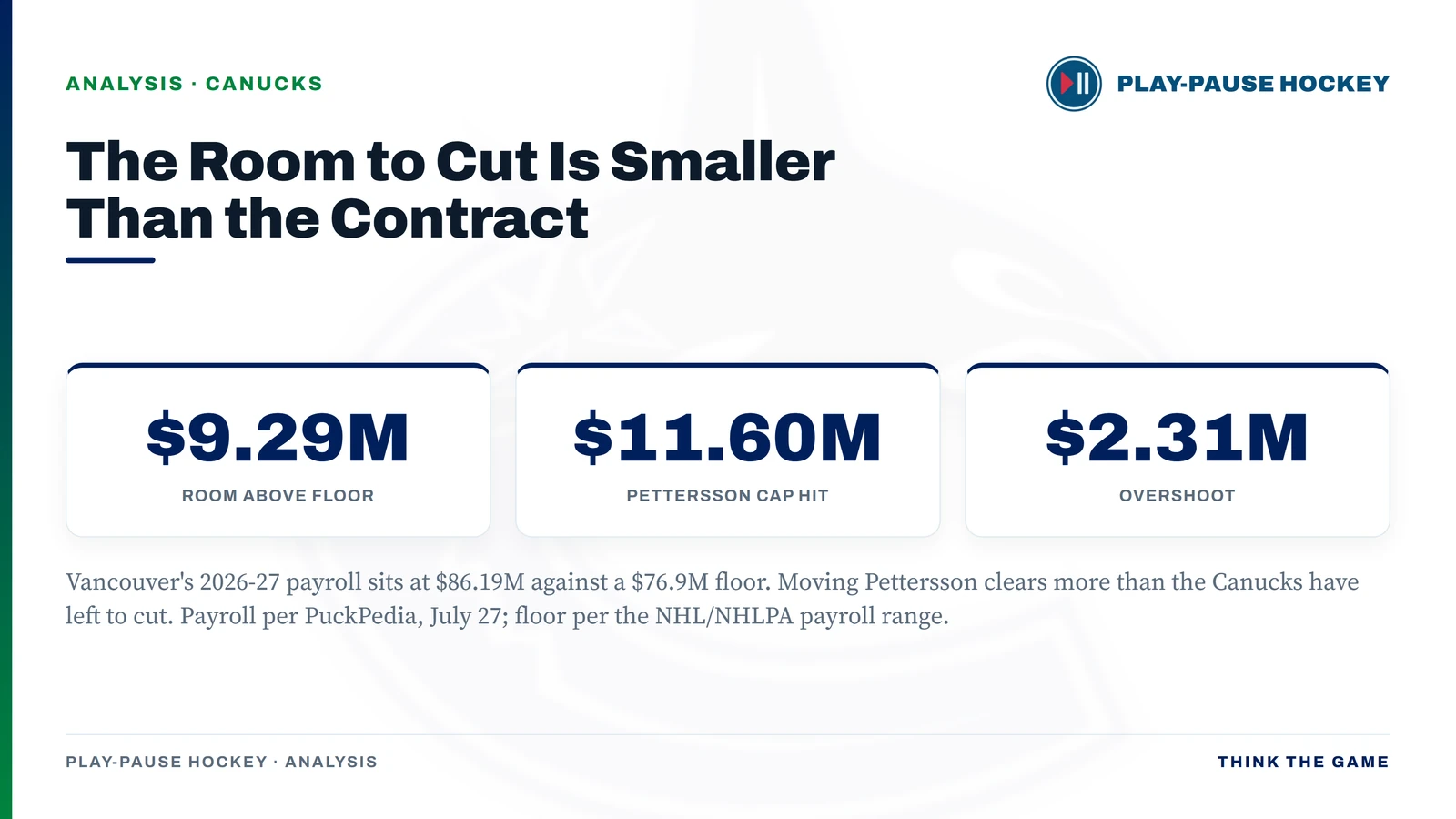
Take Pettersson’s $11.6 million off $86,185,833 and Vancouver lands at $74,585,833. The floor is $76.9 million. They are not near the minimum at that point, they are $2.31 million underneath it, and a team below the lower limit is not compliant. It has to add salary back.
So the trade has to bring money with it. And that inverts the market the rumor mill has been building. TSN’s off-season watch has Detroit and Los Angeles as the suitors and floats young pieces like Nate Danielson and Marco Kasper as the return. Those are entry-level contracts. A package of cheap kids and picks is the version of an Elias Pettersson trade that leaves Vancouver furthest offside, because it removes $11.6 million and replaces it with roughly $1.8 million. Under a payroll order, the teams that fit best are the ones sending real cap hits back, which is the opposite of a rebuild return.
You can size that return, in fact, and the window is tighter than it looks. To stay legal Vancouver has to take back at least $2.31 million in cap hits. To still land near the roughly $78 million the order points at, it cannot take back much more than $3.6 million. Call it $2.3 to $3.6 million of real salary coming the other way. That is a veteran on a mid-priced contract, not a prospect pool, and it is a very specific kind of trade partner.
Yes, That $9.29M Is a Projection. It Survives Anyway.
The obvious objection is that $9.29 million is an artifact, and it is a fair one. That figure counts 23 players out of 42 under contract, PuckPedia’s projected roster rather than the one that opens in Edmonton, and a different 23 gives a different cushion. If Vancouver signs $4 million of depth tomorrow, the room above the floor grows past Pettersson’s cap hit and the whole objection above evaporates.
Except that raising the cushion means raising the payroll, and the payroll is the thing under the order. You cannot spend your way into room to make the cut that the spending limit demanded. Whatever roster you project, the two constraints bite in opposite directions, and Pettersson’s number sits on the wrong side of both.
The contract has its own veto anyway, and it is a longer one than the trade chatter assumes. The Pettersson no-move clause kicked in on July 1, 2025 and runs to the end of the deal he signed in March 2024, through 2031-32. There is no later window where Vancouver gets to move him without his consent. Nobody has asked him to lift it yet either.
Read that next to the payroll math and the two say the same thing from opposite ends. The budget does not require this trade, and the player has not been asked to enable it. We made the same point in July when the market decided Pettersson to Pittsburgh was inevitable and the only person who could veto it had already done so once.
Watch What Comes Back, Not Who Leaves
The verdict is narrow on purpose. The payroll order is real as reported, and it explains a great deal about Vancouver’s summer, including the veterans on expiring deals who will be quietly shopped between now and the deadline. It does not explain Pettersson. Moving him is a separate decision that would need a separate rationale, and anyone selling it as budget compliance is selling arithmetic that does not close.
So when a deal does surface, skip the prospect rankings and go straight to the cap hits coming back to Vancouver. If the return is entry-level contracts, the Canucks just created an $11.6 million hole they are obligated to refill, and this was never a payroll move.
Payroll figures per PuckPedia as of July 27, 2026. Upper and lower limits per the NHL and NHLPA payroll ranges. Payroll-reduction reporting by Patrick Johnston, The Province.