

For once, a team that spends every spring on the outside looking in did something genuinely shrewd: Columbus found a great trade. Over the last week of June the Blue Jackets agreed to send Zach Werenski to Dallas in a package built around Thomas Harley, a 24-year-old top-pair defenseman the Stars had just signed through 2033-34. Read the two contracts side by side and it’s a rebuild dream. Columbus was about to swap two years of a 28-year-old for eight years of a 24-year-old, and pick up additional pieces on top.
Then Werenski used his no-move clause, the deal died, and the Blue Jackets spent the next 24 hours framing that as a victory. That’s the part worth pausing on. Strip away the “he’s staying” glow and what actually happened is that Columbus ran a full trade process on its best asset, surfaced the strongest return it’s seen in years, and had no power to complete it. The commitment is real. So is the vulnerability it papers over.
Columbus Actually Found a Great Werenski Trade
Give the front office its due, because the deal it built was smart. Werenski is a terrific player and a bad long-term bet for a team that isn’t winning now. He turns 29 this month, he’s signed only through 2027-28, and he is coming off a career year that maximized his trade value. A Harley-centered return cashes that value at its peak: a younger cornerstone locked in for the better part of a decade, at an $10.59M cap hit that a rising cap swallows more easily every season.
That is exactly the trade a non-contender is supposed to make. You don’t hold a soon-to-be-30 defenseman with two years of control if you’re not close. You convert him into the guy who’s still a top-pair fixture when your next good team arrives. General manager Don Waddell found a team willing to give up that guy. The plan was sound. The execution was never his to control.
The No-Move Clause Did Exactly What It Was Built to Do
Here is where the contract structure becomes the whole story. Werenski holds a full no-movement clause through 2026-27, which means he doesn’t just get consulted on a trade, he gets a veto over every one. On June 30 he used it, blocking the Dallas deal. His preference, per multiple reports, was to stay in the Eastern Conference, which narrowed any workable trade to Toronto or Tampa Bay.
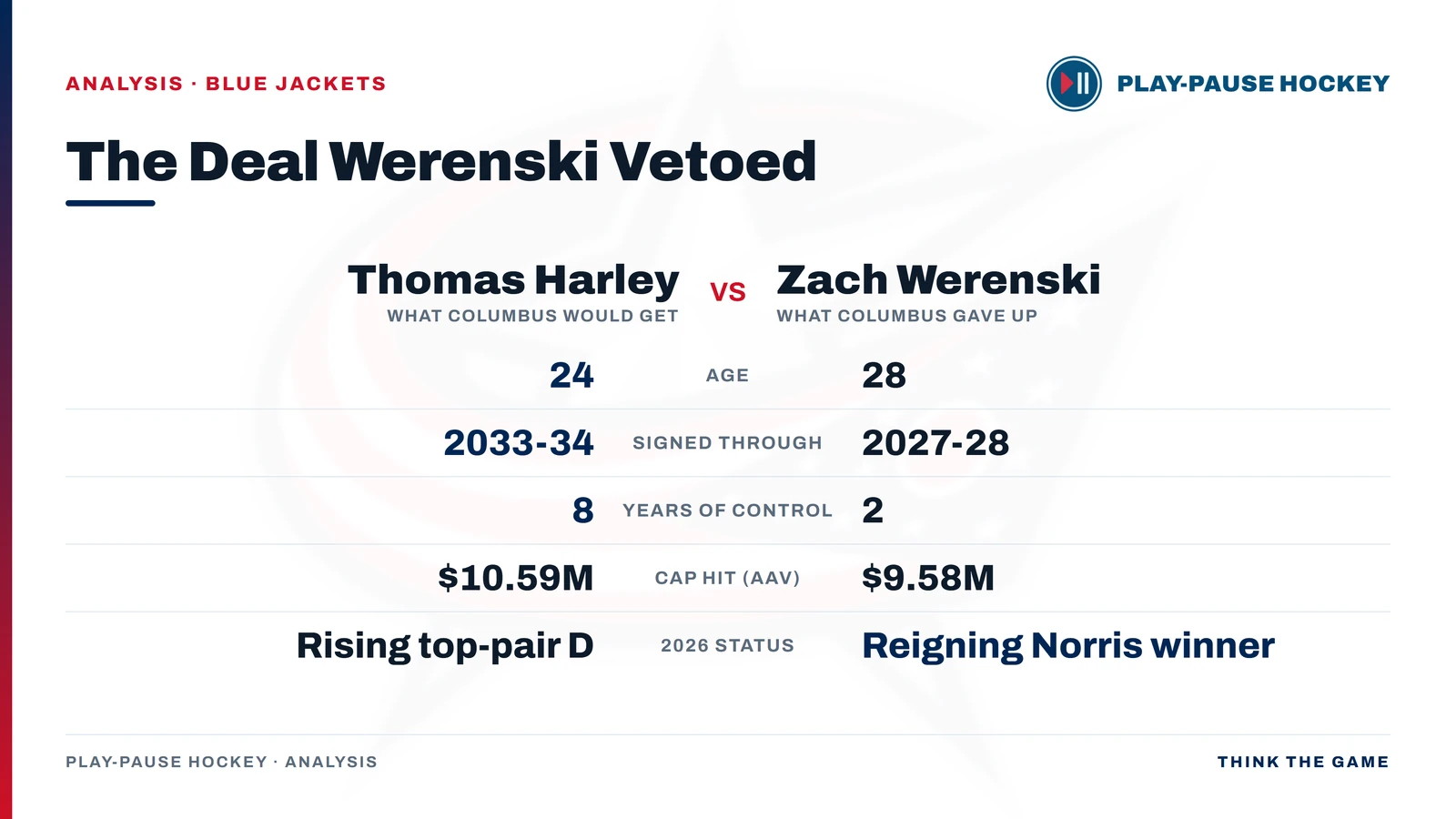
And that’s the trap. Once the market shrinks to two teams the player approves, the return craters, because those two teams know they’re the only bidders. Chris Johnston laid it out plainly: Columbus “never liked either of whatever those teams could put on the table,” because “they didn’t have something like Thomas Harley to offer up.” Toronto’s headline asset was Matthew Knies. Good player, not a 24-year-old top-pair defenseman signed to 2034. The clause didn’t just kill one trade. It defined the only deals left on the board and guaranteed they’d be worse.
A no-move clause on a star doesn’t slow a rebuild down. It hands the player a veto over whether the rebuild happens at all.
The Feel-Good Statement Buries the Real Admission
The joint statement Waddell and Werenski put out on July 1 is a small masterpiece of reframing. Werenski said he wants to win in Columbus, praised “the best fans in the NHL,” and stressed that he and Waddell are “completely aligned.” Everybody applauded. But read Waddell’s own words: Werenski “indicated that he wasn’t sure what the future would hold with regards to staying with the club or possibly moving on.” That is not the language of a happy franchise cornerstone. That’s a GM confirming his best player asked to explore the exits, agreed to be shopped, and then changed his mind after his agent and the front office had already found a buyer.
Per ESPN's reporting on the joint statement, Werenski's agent Judd Moldaver spoke with Waddell on July 1 about the collapsed Dallas trade before both sides released their commitment statements.
“Aligned” is doing a lot of work in that statement. A week earlier they were aligned on trading him.
Ten Years of Werenski Haven’t Gotten Columbus Anywhere
Now the honest counter-case, because there is a real one. Trading a reigning Norris winner who genuinely wants to be there is not a move most teams should make, whatever the return. Werenski just posted 81 points in 75 games, logged the second-most ice time in the NHL, and won a gold medal. A player that good, that bought-in, is a foundation you build on, not a chip you cash. A disgruntled star forced out for future assets can sink a room. Keeping a great one who chose you is defensible on its own terms, and plenty of smart people will call this the right outcome.
The problem is that the last decade is the rebuttal to its own happy ending. Werenski has been Columbus’s best player for ten years, and in that time the Blue Jackets have collected exactly one playoff series win. The reason a Harley package was so tempting is that the front office clearly knows a Werenski-led core has already been tried, at length, and hasn’t cleared the bar. “We want to win here” is a lovely sentiment. It is also, almost word for word, the thing this team has been saying and failing to do for Werenski’s entire prime.
The Clause, Not the Commitment, Is What Columbus Lives With Now
So where does this leave the Blue Jackets? With a fragile promise and a shrinking window. Werenski’s full no-move clause runs through 2026-27; only in 2027-28, his contract’s final year, does it soften to a 10-team no-trade list that would finally give Columbus a real say in any move. That is the one moment the leverage tilts back toward the team, and it arrives the same season Werenski can walk to unrestricted free agency for nothing.
Read the whole sequence and the takeaway isn’t “Werenski loves Columbus.” It’s that a full no-move clause on a star inverts the entire power structure of a rebuild. The team can do everything right, find the perfect buyer, agree on the perfect return, and still be told no by the one person the deal is built around. Columbus just lived that. The commitment statement is the consolation prize. The clause is what it actually has to plan around, and the clock on it runs out at the worst possible time.