

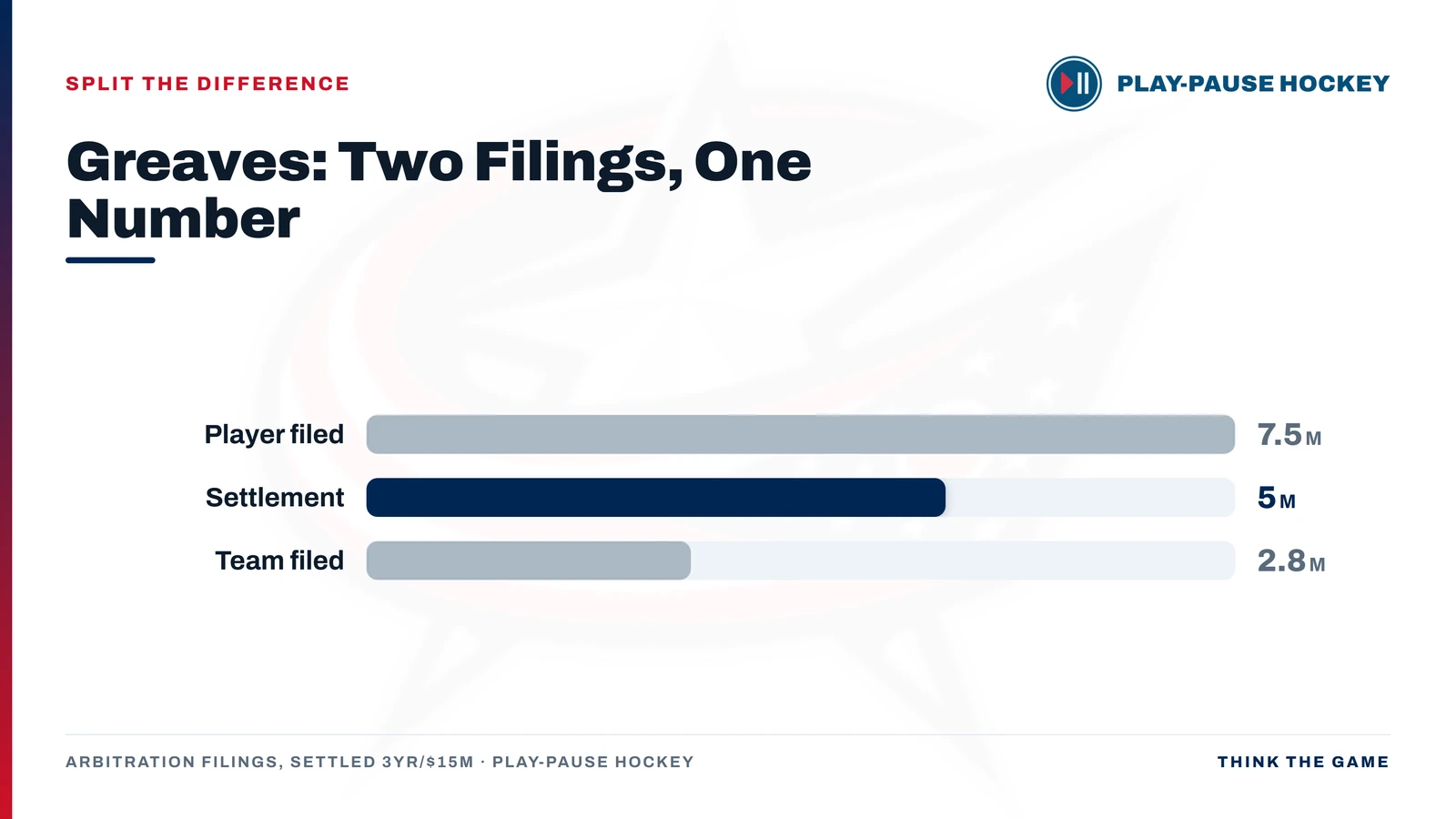
Columbus had two numbers on the table and a hearing on the calendar. Jet Greaves filed for $7.5 million, the franchise-goalie number. The Blue Jackets filed for $2.8 million, the backup number. The deal they signed hours before that hearing, three years at $5 million a season, lands almost exactly on the line between the two, and that is not a rounding accident. It is the most honest thing anyone in this negotiation said about who Greaves actually is.
Call it a calculated bet, not a scared overpay. Columbus is paying starter money for a goalie with one full starter season, and the exact price it settled on tells you the front office knows precisely how thin that evidence still is.
The Deal That Beat the Clock
Greaves and the Blue Jackets settled Thursday morning, a few hours before a salary arbitration hearing that, once it formally opened, would have shut the door on any further negotiation. The terms were three years and $15 million, a $5 million cap hit through 2028-29, per Elliotte Friedman.
Beating the clock was the point. An arbitration hearing is a blunt instrument: it hands out a one-year award, it forces each side to argue in a room why the other’s goalie is worth less, and it tends to leave a mark that lingers into the next negotiation. A three-year number closes the file instead. For Greaves, 25 and coming off a two-way deal that paid him $812,500, this is a roughly sixfold raise and the first real security of his career. Both sides had reasons to want it done before the numbers turned adversarial.
Why $2.8M and $7.5M Were Both Right
The gap between the filings was the real story of the week, and it was wide even by the standards of a process built on strategic extremes.
Here is why neither number was crazy. Columbus reportedly built its $2.8 million case around Arturs Silovs, a young, unproven goalie on a one-year, backup-tier deal, the argument being that Greaves is a recent breakout with a short track record. Greaves’s camp reached for Dustin Wolf, whose seven-year extension carries a $7.5 million cap hit and pays a goalie who has already established himself as a number one. Both comparables were defensible, which is exactly the problem. Greaves is neither Silovs nor Wolf, he is the unresolved case in between, and the settlement priced him there.
The Number Under the Number
If this were only a wins-and-losses bet, the skepticism would be fair. It is not. Greaves went 26-19-9 with a 2.60 goals-against average and a .908 save percentage across 55 games, and the underlying model liked him more than the raw line does.
Ninth in goals saved above expected among the goalies who carried a starter’s workload is not a fluke of a good team in front of him, it is a measure of stopping pucks he was not supposed to stop. Stack on the sliver of 2024-25 that preceded it, 11 games at a .938 save percentage, and a summer at the World Championship where he posted a shutout against the United States, and the shape of a legitimate starter starts to fill in. Columbus is not paying for a hunch. It is paying for a signal that has shown up in three different settings.
The wins can be inflated by the team in front of a goalie. Goals saved above expected cannot. That is the number Columbus actually bought.
The Sample Nobody Can Ignore
Now the honest part. That signal, real as it is, sits on top of roughly 66 starter-caliber games, and 55 of them came in a single season that was itself a career-high jump in workload from the 11 he played the year before. Goalies who post one great year and then regress are not a rare species, and the ones who get worn down by a first heavy starter’s load are not either. Three years is not a reckless term, but it is a real one on a thin base.
Then there is the objection a Columbus fan will type first, and it is a good one: Elvis Merzlikins is still on the books at $5.4 million for one more season, so the Blue Jackets are about to carry roughly $10.4 million in goaltending for 2026-27. That is a real claim on Columbus cap space at a moment the front office is already guarding it, and the argument goes that this is not a bet on Greaves at all, it is a cap crunch they built themselves.
It is true for exactly one year. Merzlikins is a pending unrestricted free agent in 2026-27, so the overlap is a bridge, not a standing cost. Read the Greaves term against that expiry and the sequence is deliberate: hand the net to Greaves through 2028-29, let Merzlikins play out his walk year as an expensive insurance policy, and clear the room the season after. Columbus did not trap itself. It set a timer.
A Fair Price on an Open Question
Put the deal back in the market it was signed into. After the cap jump, $5 million a year is what a mid-tier starter costs: below Wolf at $7.5 million and Logan Thompson at $5.85 million, comfortably above the Silovs backup tier. Columbus paid the going rate for a goalie it believes is a starter, no discount for the thin sample and no premium for the upside. That is not the price of conviction, and it is not the price of panic. It is the price of an open question, which is precisely what Greaves still is.
The bet is fair. Whether it pays off comes down to one thing the model cannot yet answer: can he do it twice? If Greaves carries a starter’s workload again in 2026-27 and the goals-saved number holds, Columbus will have found its goalie for the price of a good one, not a great one. If the sample was the ceiling rather than the floor, the Blue Jackets have two more years to find out, with Merzlikins already gone. They split the difference on the way in. The next two seasons decide which side of it Greaves was really on.