

Don Waddell has spent two weeks telling anyone with a microphone that Columbus can match. He is probably right. It is probably not for the reason he keeps giving.
The Cap Space Waddell Keeps Quoting Is the Weakest Part of His Case
The Blue Jackets general manager has built his summer around one sentence, delivered on TSN1050’s First Up in mid-July: “You never want to put yourself in position where you don’t have enough cap space if you ever did get an offer sheet.” It is a clean piece of logic, and it is the correct instinct. Pat Verbeek had the same instinct in Anaheim, and when Philadelphia handed Leo Carlsson a five-year, $90M offer sheet on July 3, the Ducks matched it inside a week. Ducks ownership said so out loud: Verbeek “intelligently left enough cap space to give us the ability to retain Leo.”
So Waddell is running the Verbeek playbook. The trouble is what he said next, in the same interview.
“You say we have $25 million in cap space,” he went on, “but with Fantilli and the two arbitration cases, that money can go very quickly.” That is the general manager pricing his own deterrent and finding it thinner than the headline. It is also a different figure from the one the Columbus Dispatch reported days earlier, more than $23M in open room. Nobody has reconciled the two, and we are not going to pretend to. Either way it is a gross number, and Columbus has two bills to pay before a dollar of it reaches Adam Fantilli.
Fantilli Is Exposed Because He’s the One Who Can’t File
Cole Sillinger and goaltender Jet Greaves both filed for salary arbitration this month. That filing is not just a pay dispute. It is a shield: a player who files cannot be signed to an offer sheet.
Fantilli did not file, because he cannot. He has three accrued professional seasons on an entry-level deal signed at 19, which makes him a Group 2 restricted free agent with offer-sheet exposure and no arbitration rights. Read that back slowly. The two Blue Jackets who are eating Waddell’s cap space are the two nobody can touch. The one player a rival can actually take is the one whose price is still an open question.
Portzline, who covers this team for The Athletic, was not being cute. He posted those two career lines within hours of the Carlsson offer sheet because they are almost the same line. One point apart, twelve games apart, one draft slot apart. If the market has decided that profile is worth $18M, Columbus does not get to argue that its version of it is worth $9M.
The Wall Is About $14M Tall. The Comparable Is $18M.
Here is where Waddell’s sentence stops covering him.
AFP Analytics projects the Sillinger and Greaves awards could combine for $8M to $9M. Take the friendlier end of Waddell’s own cap figure, subtract that, and you land near $14M of usable room for Fantilli. That is the number that matters, and it is roughly $4M below the only comparable anyone has.
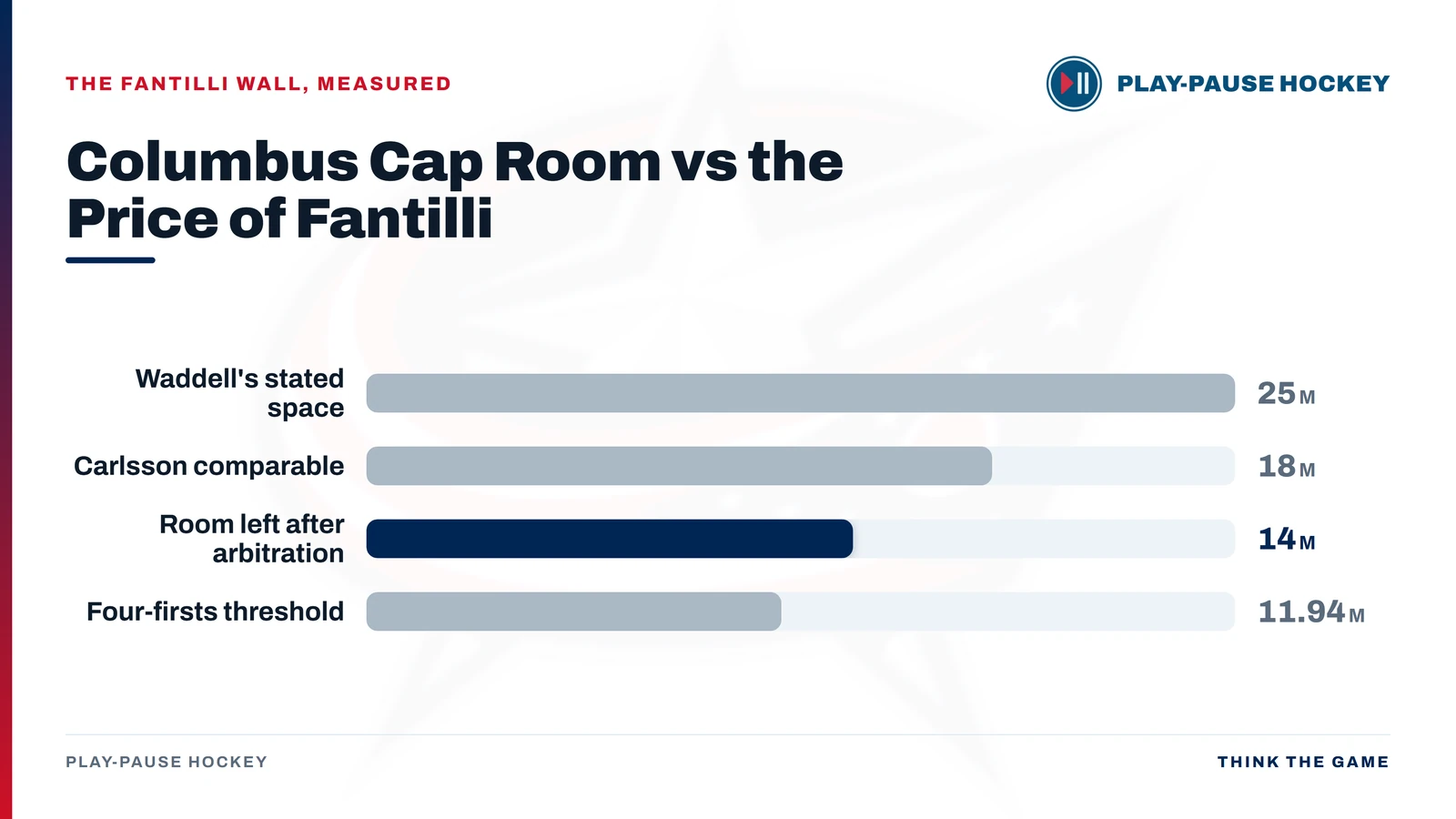
Now put the compensation tiers next to it. Under the schedule that applies to 2026-27 signings, an offer above $11,939,166 costs the signing team four consecutive first-round picks, 2027 through 2030. An offer between $9.55M and $11.94M costs a 2028 first plus a 2027 first, second and third.
Follow the arithmetic all the way down. A rival that wants Fantilli badly enough to punch through a $14M wall has to bid above $14M. Every dollar figure above $14M is already past the $11,939,166 line by at least $2,060,834. There is no window where an offer is large enough to beat Columbus’s cap sheet and small enough to avoid the most expensive compensation in hockey.
That is the actual deterrent. Not the cap space. The tier.
The Honest Problem With Our Own Math
Start with the objection this argument has to survive: $14M is a projection, not a fact, and that is fair. Arbitration awards are not handed down until the hearings run, Sillinger and Greaves could settle low, and if those two come in at $6M combined then Waddell’s wall is suddenly $18M or $19M tall and this entire calculation collapses.
We will concede it, because conceding it makes the point sharper rather than weaker. If the height of the wall is set by what Columbus pays Sillinger and Greaves, then Waddell’s offer-sheet defense is not a negotiation with Philadelphia or anyone else. It is a negotiation with his own restricted free agents, conducted in a room where the other side has no idea it is participating in a defense at all. Every dollar he saves on those two hearings is a dollar of Fantilli protection. That is a more interesting summer than “we have cap space.”
There is a second objection worth naming: a team cannot tender what it cannot fit, and the most obvious suitor already spent. Philadelphia committed to Trevor Zegras at $9.125M and Jamie Drysdale at $6.5M this month. The Flyers are not an unlimited threat.
What Would Actually Turn This Into an Offer Sheet
Two tenders in July, two matches. Anaheim kept Carlsson. Utah matched New Jersey on Barrett Hayton and, as the price of doing it, cannot trade him for a year. The 2026 offer sheet has so far been a device for setting other teams’ payrolls, not for taking their players.
Philadelphia was the obvious next name, and briefly the awkward one. The Flyers were floated as a Fantilli suitor if the Carlsson tender came back matched, which it did, and Danny Briere’s son Cam works on the Columbus staff as a video coach. Then Philadelphia spent that money elsewhere. The tidiest villain in this story wrote himself out of it.
Flyers-to-Fantilli speculation and the Briere detail per Aaron Portzline, The Athletic, July 6, 2026.
So watch three things, in this order. Whether Sillinger and Greaves settle before their hearings, because that sets the height of the wall. Whether Waddell converts his “good-faith negotiation” language into an actual Fantilli term sheet before September 16, when the new CBA drops the maximum term for a player re-signing with his own club from eight years to seven. And whether any club with real space decides that four first-round picks is a survivable price for a 21-year-old center with 140 points in 213 games.
Nobody has paid that price yet. Waddell’s cap space is not the reason.