

Utah handed a defenseman with four goals an eight-year contract on Tuesday, and the reflex around the league was to file it under term risk. That reading misses what the Mammoth actually bought. John Marino’s extension is not a bet on Marino the individual scorer, and it is not a team talking itself into a No. 4 defenseman. It is the last brick in a blue line Utah has spent two years quietly building to outlast its own forward core.
Here is what the transaction wire will not tell you. Stack this deal on top of the two that came before it and Utah has assembled about as cost-certain a long-term defense as there is in the league, on purpose, while every marquee blueliner elsewhere is resetting the market north of $15 million. The Mammoth zigged.
What Utah Actually Signed
Marino’s extension is eight years and $54 million, a $6.75 million cap hit that runs through 2034-35, per terms reported by Elliotte Friedman and confirmed in the team’s release. It does not start yet. One year and a $4.4 million cap hit remain on his current deal, so the new term kicks in for 2027-28. Marino was scheduled to reach unrestricted free agency next summer, and Utah bought him out of that market a full year early.
Terms per TSN and Elliotte Friedman (Sportsnet), July 21, 2026. Marino carries a full no-movement clause in 2027-28, a full no-trade clause from 2028-29 through 2030-31, then a modified no-trade clause for the final four years.
He earned the raise. Marino, a 29-year-old right shot, just posted the best season of his career: 80 games, 36 points, and a plus-42 that led the Mammoth, at better than 20 minutes a night with heavy penalty-kill work, per the Daily Faceoff report card. Bill Armstrong called him “a foundational piece of our future,” and for once the boilerplate matches the paperwork.
The Trio Utah Was Quietly Assembling
Now widen the frame, because Marino’s deal only makes sense inside it.
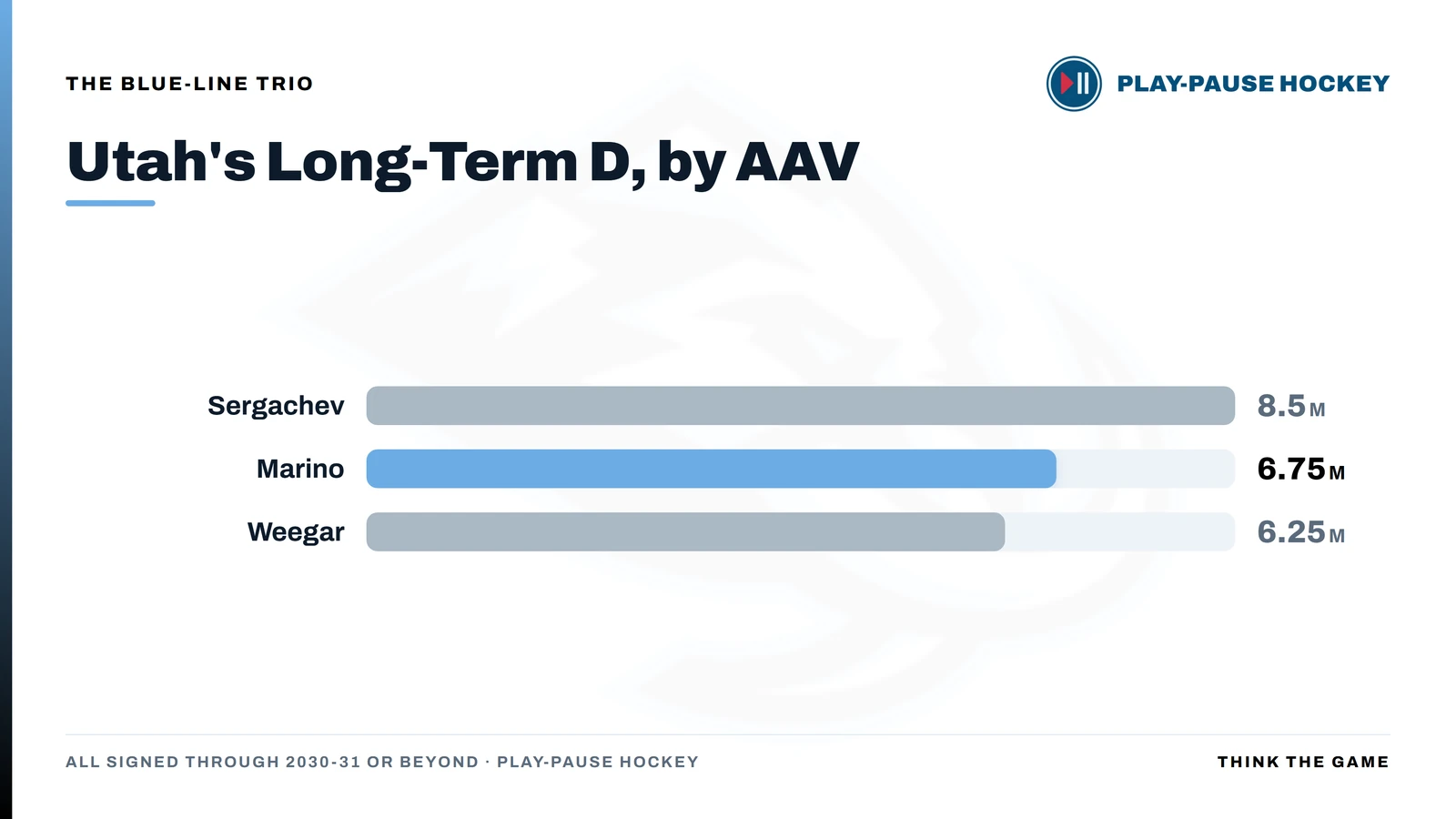
Mikhail Sergachev is signed at $8.5 million through 2030-31. MacKenzie Weegar, acquired from Calgary in a March trade to balance a left-heavy corps, sits at $6.25 million through the same season. Marino now slots between them at $6.75 million, and further out than either. That is three top-four defensemen, two right shots and a left, all locked past the point where most of this roster’s contract questions get answered. Utah did not build that by accident. It traded two second-round picks for Marino in 2024, another package for Weegar this spring, and paid a premium to pry Sergachev out of Tampa. The blue line was the plan all along.
Cost Certainty Is the Whole Point
Look at the three numbers again and notice what is missing from all of them: offense. Sergachev is the puck-mover, and even he tops out well short of the money elite defensemen are now commanding. Marino and Weegar are shutdown pieces who will never headline a highlight package. Utah is paying $21.5 million total for a defense whose ceiling is reliability, and that is the whole idea.
The contrast writes itself. Around the league, the defenseman market reset is dragging the number toward $15-20 million a year, led by Cale Makar and Quinn Hughes. Utah looked at that number and opted out of it entirely. Rather than pay one star and hope to fill the rest cheaply, the Mammoth spread three predictable, below-market deals across their top four and bought a floor instead of a ceiling. It is not the flashy way to build a blue line. It might be the most sustainable one in a rising-cap era, where the teams that get squeezed are usually the ones with a single immovable defense contract, not three movable ones.
The Term Risk Is Real. Here’s Utah’s Out.
None of that erases the obvious objection, and the sharpest version of it is worth stating plainly: $6.75 million for a defenseman with 36 points is fine, but eight years of term that runs to Marino’s age-37 season is exactly the kind of contract that ages into a buyout. Fair. Marino is not a difference-maker on his own, and his gaudy plus-minus owes something to Nate Schmidt and to a team defense that improved around him. Strip out the partner effect and you are paying star-adjacent term for a very good complementary piece.
Two things blunt the risk. The first is price: at $6.75 million, Utah is paying Marino like the complementary piece he is, not like the star the term length implies. The second is the exit. The no-trade protection softens in the back half, dropping to a modified list where Marino must leave teams open, which gives Utah a real mechanism to move the deal if his early-30s decline comes fast.
The term is the scary part. The dollar figure and the escape hatch are what make it survivable.
What the Deal Says About Utah’s Clock
Which is the real tell here. A team bracing for a short win-now window does not sign 29-year-olds through their late 30s. It rents. Utah is doing the opposite, and it is doing it three months after the franchise’s first-ever playoff appearance, a first-round loss to Vegas that announced the Mammoth as real without pretending they were finished.
The forward core is already accounted for. Logan Cooley, the franchise center, is locked at $10 million a year through 2033-34, an extension Utah made its priority and closed back in October, and Dylan Guenther and Nick Schmaltz are signed alongside him for years. Read the Marino deal as the last piece of that same sequence and it stops looking like an overpay for a depth defenseman. It looks like a front office deciding that the spine is finished, forwards and defense both, that the core money is fixed and predictable, so what comes next is depth and timing rather than another franchise-altering bet. Utah is not building for 2026. It is making sure the whole thing is still standing when it matters.