

Pro Hockey Rumors published its cheapest-cost-per-point defensemen of 2025-26 on Thursday, and the fifth name on the list is Brent Burns at $29,000 a point. That figure is arithmetically correct. It is also off by a factor of four.
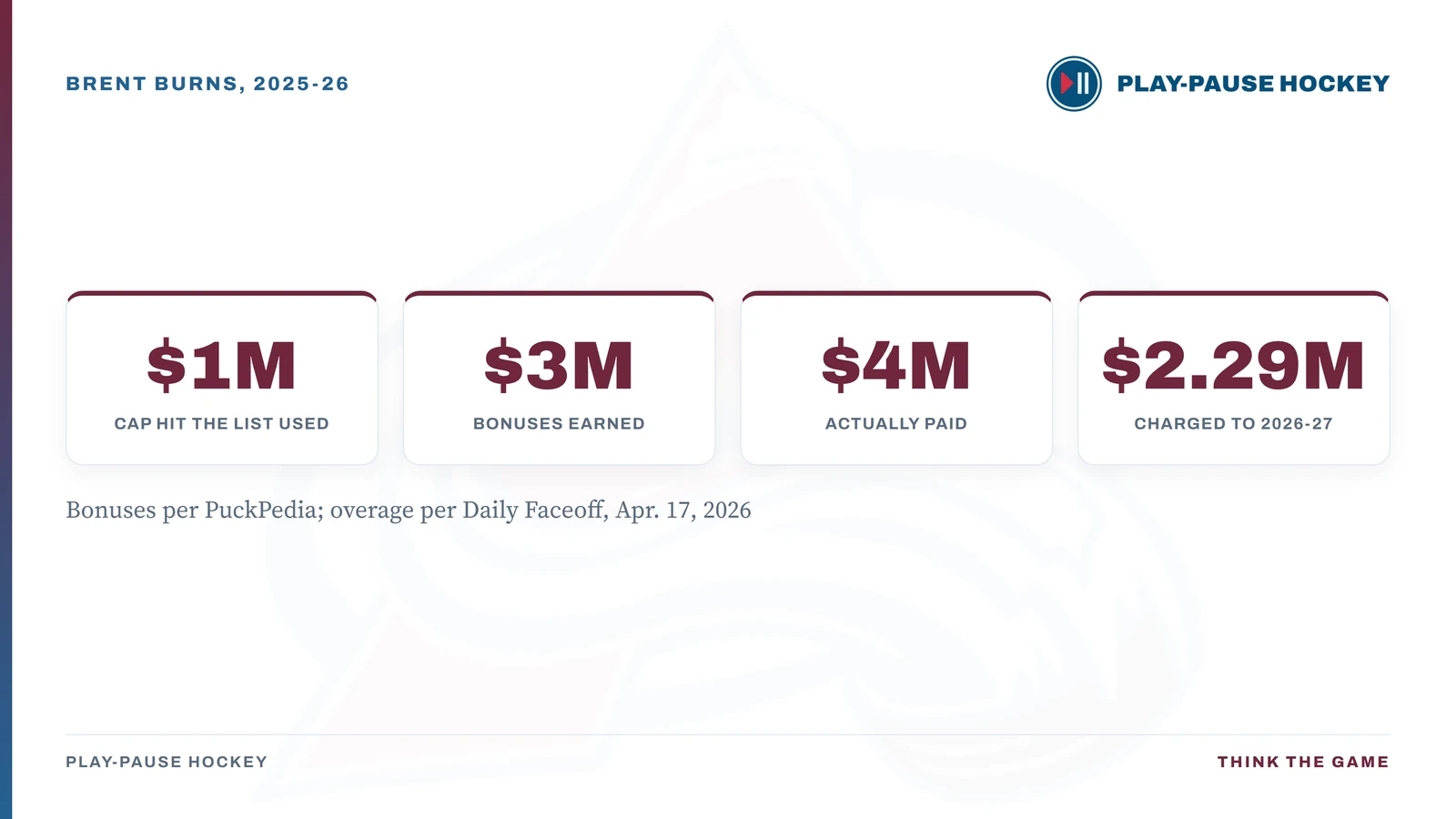
Colorado did not pay Burns $1 million last season. It paid him $4 million, and the Avalanche are still paying, because $2,291,841 of that bill landed on their 2026-27 cap sheet. Nobody has run the list against the money that actually changed hands. Do it on the one name where the structure is public and the exercise stops measuring value and starts measuring accounting.
The Bonus That Cashed in the Third Week of October
Burns signed a one-year deal in Colorado in July 2025, at 40, which under the CBA puts him in the small class of players permitted to carry performance bonuses on a standard contract. That permission is the whole story. His salary was $1 million. His bonus schedule was $4 million more.
Read the trigger on the first bonus. Three million dollars at 10 games played. Not 10 good games, not a points threshold, not a playoff round. Ten appearances, which for a healthy top-four defenseman is the third week of October. Burns played 82. Per Daily Faceoff, he earned $3 million of the possible $4 million, missing only the piece tied to averaging 23 minutes a night, and he averaged closer to 19.
So the money is settled and it is not in dispute: $1 million in salary, $3 million in bonuses, $4 million out the door for 35 points. That is $114,286 per point. The list has him at $29,000, in fifth place. At the real number he is not fifth on a bargain list. He is the most expensive point in the group by a distance, more than double the last name on it.
That comparison is not strictly like for like, and it is worth saying so out loud: every other player on the list is still being measured by cap hit, and some of them may carry structure of their own. Burns is just the one whose structure is public. That is the point rather than a caveat to it. The metric is only as honest as the contracts nobody bothered to open.
Colorado Is Still Paying for a Season That Is Over
The overage is where this stops being a rounding argument. Bonuses do not float free of the cap. Teams carry a Performance Bonus Cushion worth 7.5% of the upper limit, $7.8 million for 2026-27, and bonuses can be paid against it during the year. What does not fit when the season closes becomes a charge against the following season.
Overage figures per Daily Faceoff, April 17, 2026, citing PuckPedia. Colorado is one of at least eight teams carrying one, alongside the Islanders ($3.5M), Dallas ($2.08M) and New Jersey ($1.25M).
That number is worth sitting with. The overage alone is 2.3 times the cap hit the bargain list credited Burns with. Colorado will spend next season paying for points scored last season, in the years when the rising salary cap is supposed to be handing everyone room. Calling that a bargain requires closing the ledger before the last invoice arrives.
Raddysh Shows the Same Gap on a Longer Clock
Burns is the clean case because his structure is published. The list’s top name shows the identical flaw stretched across seasons.
Darren Raddysh led it at $14,000 a point: 70 points, a $975,000 cap hit. Real numbers, real season. What they describe is the expiring year of a two-year contract Tampa Bay signed in August 2023, before Raddysh became a 70-point defenseman. The cheapness was the calendar.
The market said so out loud. On June 19, six weeks before the list ran, Raddysh signed an eight-year, $68 million contract with an $8.5 million cap hit and was sign-and-traded to Toronto for a fifth-round pick. Same player, same production, roughly nine times the annual number, and now part of Toronto’s cap crunch rather than anybody’s bargain column.
A defenseman does not become cheap by being good. He becomes cheap by being good in the last year before somebody prices it.
That is not a knock on the research. It is what happens when the numerator is a contract instead of a valuation.
The Cushion Objection Is the Right One
Here is the sharpest version of the pushback, and it deserves a straight answer rather than a strawman: the cap hit is the constraint a general manager actually manages. Bonuses live in the cushion. For the purpose of building a roster inside a hard ceiling in 2025-26, Burns cost Colorado $1 million of usable space, full stop, and the $2.29 million belongs to a different season’s ledger.
For roster construction, that is correct, and it is why cap hit is the right unit in most cap analysis. The problem is the tense. This is a retrospective list, a judgment on what 2025-26 was worth after the fact, and a retrospective verdict cannot be settled while part of the invoice is still outstanding. The cushion does not forgive the money. It defers it, which is the entire appeal of a 35-plus bonus contract and exactly why Colorado structured it this way.
Cost per point has one job it does well: flagging cheap offense from the blue line quickly. Pro Hockey Rumors says as much itself, calling it “a blunt measure for defensemen, who are paid to do far more than score” and asking readers to treat the piece as a breakdown rather than a ranking. That disclaimer is honest. It is also the first thing lost when a list gets shared.
What to Price Instead
Two fixes, and neither is exotic.
Use money paid, not cap hit charged. For 35-plus deals and bonus-laden contracts they are different numbers, and the gap is public. That alone reorders the list.
Then look at the denominator. The 42-game minimum is a sensible guard against small samples. It also removes the best counterexample to the whole exercise.
Jaccob Slavin put up eight points in 39 games last season on a $6.4 million cap hit. On a points screen that reads like one of the worst contracts in the sport. It is nothing of the kind, and the models say so.
Daily Faceoff, working from Evolving Hockey in January, found the defense-first group grading ahead of the offense-first group on combined two-way impact, 0.171 to 0.099, while getting paid roughly $5.35 million a year against $8.07 million. Better total play, $2.7 million a year cheaper.
Analytics per Daily Faceoff, January 21, 2026, citing Evolving Hockey 5-on-5 RAPM. Exact figures: the 13-player defense-first group averages $5,349,697 over 5.31 years and ranks 21st league-wide on average in 5-on-5 RAPM expected goals against per 60; the 15-player offense-first group averages $8,073,657 over 6.8 years. The gap is $2,723,960. Slavin's 2025-26 line per NHL statistics; his $6,396,062 cap hit per PuckPedia.
Which is the uncomfortable part. A defenseman-value screen built on points cannot see the market inefficiency that actually exists, because the underpriced players are underpriced precisely for not scoring. Teams already know this. It is what Utah’s cost-certainty model on defense is buying, and it is why the money being negotiated toward the Makar and Hughes extensions, neither of them signed as this publishes, reads less like the market’s verdict on defensemen than like its verdict on the two who score.
The bargains are real. They are just not on the list, and the one that is sitting in fifth place is still being paid for.