

The $17 Million Was Never the Hard Part
Bill Guerin and Quinn Hughes have effectively agreed on the scariest-looking number in this negotiation. The extension will pay Hughes something north of $17 million a year, and almost nobody in Minnesota is arguing about it. The fight that actually decides who wins this deal is the one hardly anyone is pricing: three years, or five.
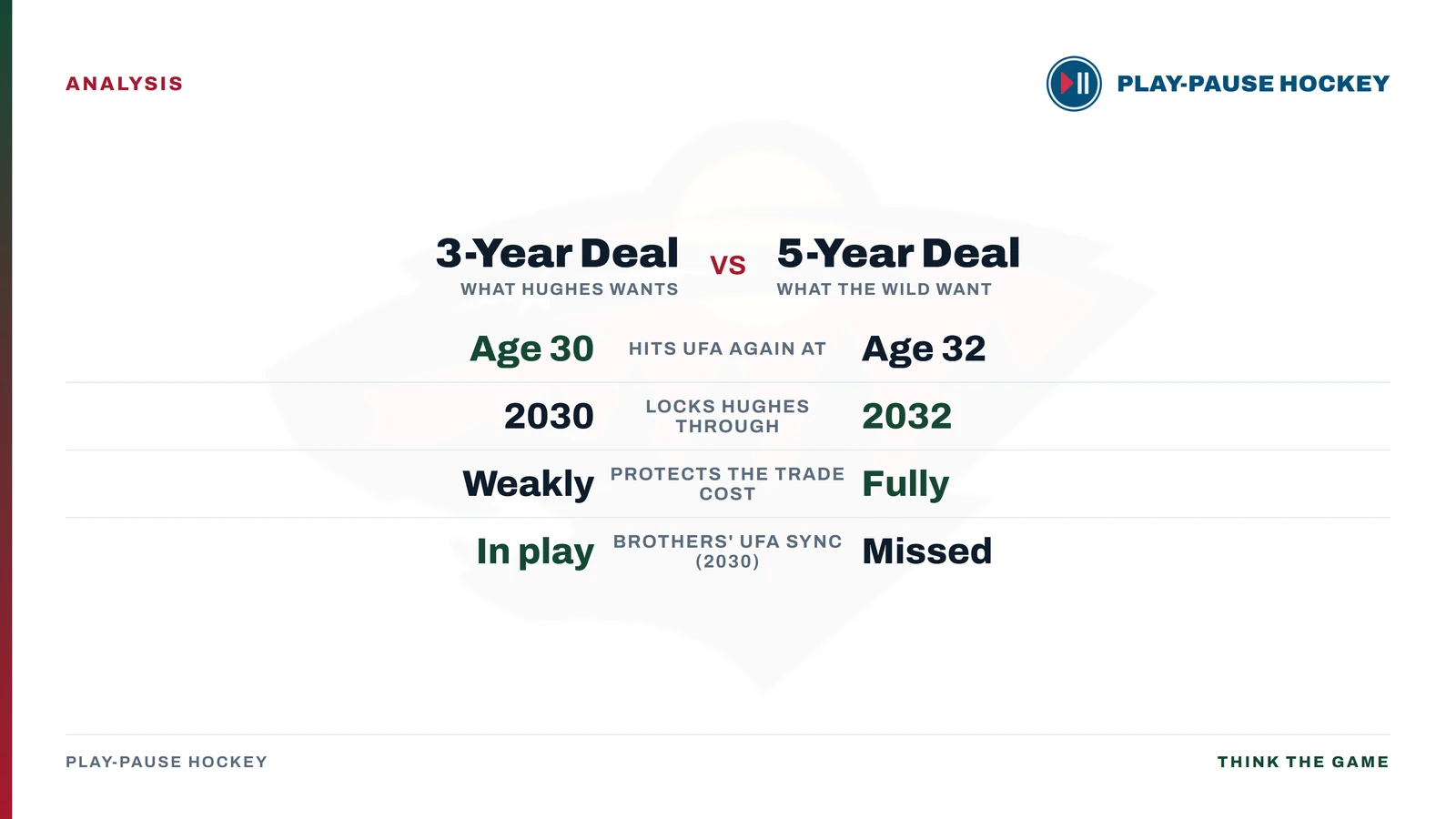
That gap sounds like a rounding error next to a $17 million cap hit. It isn’t. At 26, Hughes is choosing whether to reach unrestricted free agency again at 30 or at 32, and a franchise that surrendered a small mountain of assets to acquire him is choosing how long it actually controls the player it paid for. Everyone else is running the AAV math. The term is where this gets won or lost.
Here is what you get nowhere else on this story. A three-year extension does not just mean a shorter commitment. It hands Hughes a second bite at free agency the same summer his brother Jack becomes a UFA in New Jersey, and it does it while the salary cap is climbing fast enough to make his next contract dwarf this one. That is not a compromise the Wild are quietly winning. It is the outcome they should be fighting hardest to avoid.
Leipold Said the Quiet Part Out Loud
Most owners bury this kind of thing in cliché. Craig Leipold didn’t. Asked in late June about the coming Hughes negotiation, Minnesota’s owner laid the whole tension on the table:
“We had to give up a lot to get him in this past year. We are going to re-sign him. The question will be for how long. We would like to go as long as we could. He will probably want it to be a little shorter, shorter being maybe three years. We hopefully will end up at five, I don’t know.”
Read that again, because it is the entire story. The team wants five. The player wants three. And the owner, unprompted, admitted he isn’t sure which way it breaks. That is not the posture of a front office holding the leverage. It is the posture of one that already spent its leverage in December and is now hoping the player is generous with the years.
Why Three Years Is a Win for Hughes, Not a Compromise
A three-year deal usually gets framed as the player betting on himself. For Hughes, it is closer to a heist.
Start with the cap. Hughes at $17 million is already about 16% of next season’s ceiling, and that ceiling is not standing still. The cap climbs to roughly $104 million in 2026-27 and is projected to keep rising past $113 million the year after. Sign for three years and Hughes is back on the market in the summer of 2030, at 30 years old, with the cap higher still and a fresh Norris-caliber résumé behind him. The percentage he can command then is almost certainly larger than the one he is signing for now.
Per David Pagnotta (The Fourth Period), the sides are "getting there" at $17M or higher. The open question is length, not dollars.
A five-year deal erases that runway. It carries Hughes to 32, buys out his most valuable UFA years, and locks Minnesota’s price in before the next cap surge reprices the entire defense market. Same AAV, wildly different bet. Three years keeps the leverage in the player’s pocket. Five years moves it to the team. That is why the length is the fight, and why calling three years a “middle ground” reads the negotiation exactly backwards.
Minnesota Already Paid Too Much to Get the Term Wrong
This is where the Wild’s December bill comes due.
To land Hughes, Minnesota sent Vancouver a package headlined by Marco Rossi, Liam Ohgren and Zeev Buium, plus a 2026 first-round pick. Buium alone, the 12th selection in 2024, already projects as a future top-pair defenseman. The Wild didn’t rent Hughes. They mortgaged a chunk of their young core for him, and that is precisely why term is not a luxury for this front office. It is the reason the trade existed at all.
One rebuttal writes itself: a three-year deal at $17 million is still 16% of the cap, so what does Minnesota actually save by holding out for five? Nothing on the AAV. The savings live entirely in walk-away risk. A five-year term is what protects the assets the Wild already spent. Three years hands the leverage back to Hughes around 2029, right as the cap spikes, and dares Minnesota to either overpay again or watch a player it traded three roster pieces and a first-rounder for leave for nothing. When you pay that much to acquire someone, term is not a detail of the negotiation. It is the whole reason you are negotiating.
The Clock Hughes Is Really Watching Runs in New Jersey
There is one more reason three years is not arbitrary, and it wears a different sweater.
Jack Hughes, Quinn’s younger brother, is signed in New Jersey through 2029-30. A three-year Quinn extension expires the same summer. Sign it, and both Hughes brothers reach unrestricted free agency in 2030, at the peak of their earning power, each free to choose a team, or a team, together. You don’t have to believe a reunion is the plan to see that a three-year term keeps the door open and a five-year term nails it shut. Minnesota’s push for the longer deal isn’t only about cost certainty. It is about running out a clock the player very much wants to keep ticking.
So here is the verdict. The Wild will get their man, and they will pay roughly what everyone expects. But if this ends at three years, don’t read it as a friendly compromise. Read it as Quinn Hughes winning the only number that mattered, and Minnesota learning that the leverage it needed was gone the day it made the trade. Watch the years, not the dollars. The years are the whole game.