

Connor McDavid just signed for $12.5 million a year and called it a bargain. That number is about 12 percent of the salary cap, and McDavid, who is the best hockey player alive, chose it on purpose to give Edmonton room to finally win. The same summer, two defensemen are about to make him look underpaid.
Cale Makar and Quinn Hughes are each a year from unrestricted free agency. The number the market keeps whispering for their next deals is $15 to $20 million. A week after an $18 million forward became real in Anaheim, the blue line is lining up right behind him. Run that against a cap that is climbing fast and you get a share of the payroll bigger than the one McDavid takes, in some versions bigger than any share he has ever taken. The sticker number is loud. The percentage is the story.
Bowen Byram’s $12.5 Million Was the Floor, Not the Ceiling
Here is the tell everyone skated past. When Chicago signed Bowen Byram to six years at $12.5 million on July 1, the headline was that he had become the highest-paid defenseman in the league. Read the fine print and the deal is more interesting than that. It does not even start until 2027-28. Byram plays this coming season on his old $6.25 million bridge, and the raise lands a year later.
So the record contract for a defenseman is a number that is not on the books yet, signed by a very good top-pair guy rather than a franchise pillar. If Byram is worth $12.5 million on a deal that begins in 2027, what is Cale Makar worth on one that begins the same year? That is the floor of this market, and the floor already sits above the current ceiling. The highest active cap hit among defensemen next season belongs to Erik Karlsson at $11.5 million. Byram’s future deal clears it before Makar and Hughes have signed a thing.
What a $104 Million Cap Does to the Word “Overpaid”
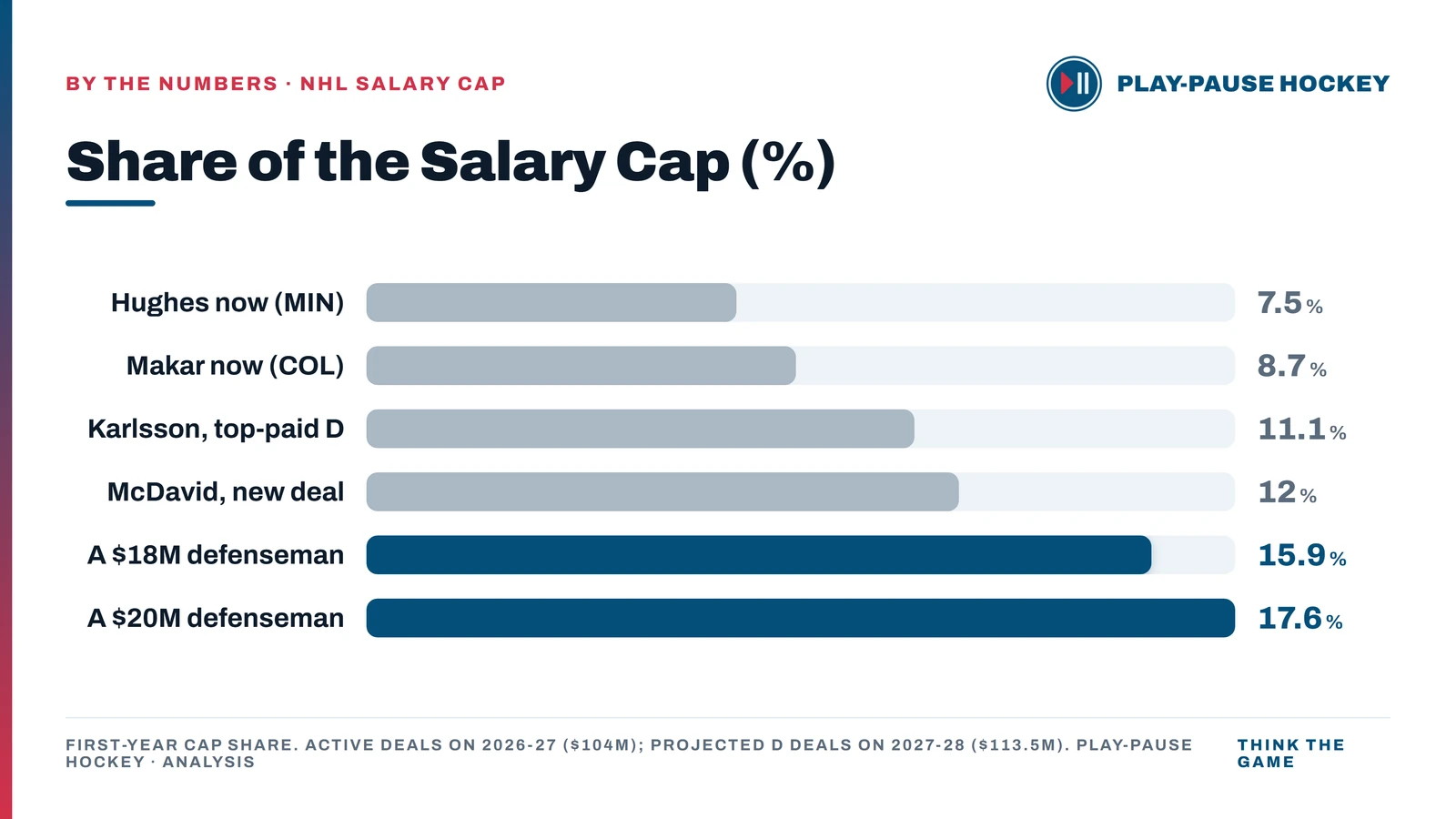
The cap is the engine here, and it is not idling. It sits at $104 million for 2026-27, up from $81.5 million just five seasons ago, and it climbs again to $113.5 million the year after. That is one of the steepest climbs the league has seen, and it quietly rewrites what a big contract means.
When the cap rises, the honest way to measure a salary is not in dollars but in the slice of the payroll it eats. Makar makes $9 million today, 8.7 percent of this year’s cap. Hughes makes $7.85 million in Minnesota, about 7.5 percent. Those are the deals of stars who signed when the cap was $81.5 million and are now, frankly, underpaid. Their extensions replace them at the top of a market that has moved twice over: the players got better and the cap got bigger. Both arrows point up.
A $20 Million Defenseman Would Out-Share Connor McDavid
Now put the projection in cap terms, because that is where it stops sounding like a typo. An $18 million defenseman on the 2027-28 cap is 15.9 percent of the payroll. A $20 million one is 17.6 percent. McDavid’s new deal is 12 percent. Even the biggest share McDavid ever carried, the $12.5 million contract that kicked in for 2018-19 when the cap was $79.5 million, was 15.7 percent.
So the market is telling you, out loud, that Makar and Hughes will command a bigger share of their team’s cap than the best forward of his generation takes for himself. Not close to it. Past it.
The number that matters was never $18 million. It is 16 percent of the cap for a defenseman, in a league where no blueliner on the books today reaches even 12. That is not a raise. It is a repricing of what a No. 1 defenseman is worth.
Per ESPN, an agent pegged the range for the next elite-defenseman deal at "anywhere between $15 and $20 million a year, depending upon the term."
The case for it is real. Makar is the best skater in the world and drove a Cup in 2022 the way a forward drives one. Hughes is a possession machine who pulled a middling Minnesota roster into the playoffs the moment he arrived. Elite No. 1 defensemen touch the puck on every shift, smother the other team’s best players, and quarterback the power play. There are maybe three of them on the planet, and two are about to come free. Scarcity sets prices.
The One Number That Could Keep This Under McDavid
Then again, maybe it does not get there, and the reason is the same one that keeps McDavid’s own number low: term.
The loudest objection an informed fan will post is also the right one. A defenseman does not put the puck in the net like McDavid, so paying him a bigger slice of the cap is not a bargain, it is positional inflation. Fair. But there is a live escape hatch built into one of these two situations. Hughes has said he is open to a shorter extension in Minnesota, a three-year window rather than a max-term deal. A bridge like that trades years for a lower AAV. It could land closer to $15 million than $20 million and keep him under McDavid’s historical peak. Makar, in Colorado, has more reason to take the eight-year max and the security that comes with it, which pushes his number the other way.
So the range is not noise. It is the distance between a bridge and a max deal, and it is why the two best defensemen in the world could sign for numbers $5 million apart in the same summer.
What Makar and Hughes Actually Sign For
Here is the call. Makar signs at something like $18 million over eight years, and it becomes the most expensive defenseman contract in history the day it is announced. Hughes lands a hair under, either because he takes the shorter term he has hinted at or because his camp lets Makar set the comp and then matches the structure rather than the total. Both clear Byram. Both clear Karlsson. Both, measured the only way that matters on a rising cap, clear Connor McDavid.
Watch the order. Whoever signs second is not really negotiating against his team. He is negotiating against the first deal, because in a two-player market the first number becomes the floor for the second. That is the standoff worth watching this offseason, and it is why neither camp is in a rush. Each team wants the other star to sign first and set a lower bar. So does the other team. Nobody blinks, until somebody does, and the day one of them does, the blue line has a new ceiling and every contender has a new problem on its cap sheet.
McDavid took 12 percent to chase a Cup. The blue line is about to ask for more. The only question left is whether a defenseman, however great, is worth a number the best player in the world just turned down.