

Twenty-One More Days to Play Two More Games
The NHL released its 2026-27 schedule on July 16, and the reaction wrote itself: 84 games, the first expanded season since 1993-94, more hockey squeezed into the same calendar, more wear on the same bodies. That reaction is understandable. It is also wrong, and the schedule the league actually published proves it.
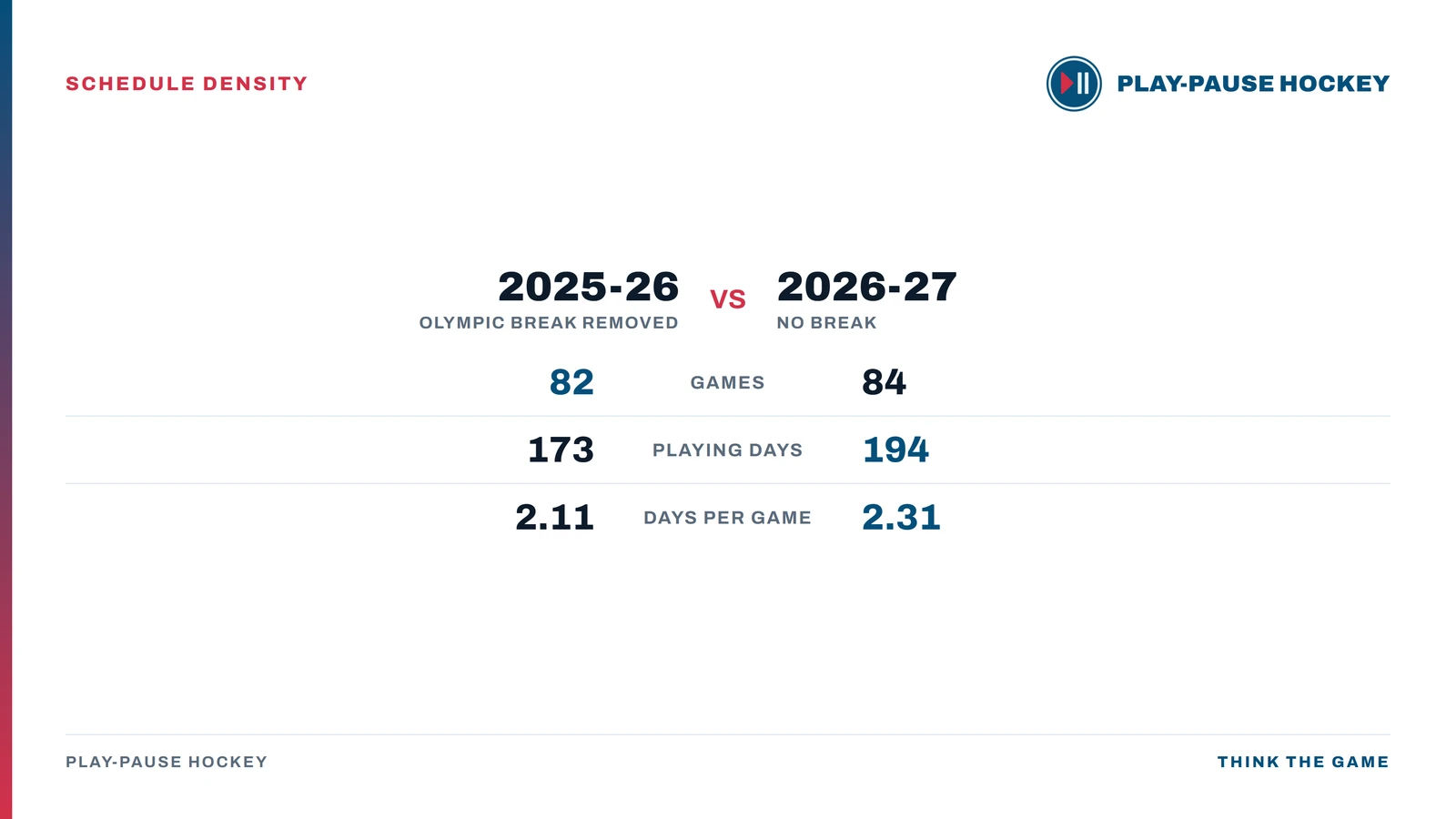
Here is the arithmetic nobody ran, because nobody could run it until Thursday. Next season opens September 29, 2026 and ends April 10, 2027. That is 194 days to play 84 games, an average of one game every 2.31 days. Last season opened October 7 and ended April 16, a nearly identical 192-day window, until you remember what sat in the middle of it. The league paused from February 6 to 24 for the Milan and Cortina Olympics. Strip those 19 days out and the 2025-26 season crammed 82 games into 173 playing days, one game every 2.11 days.
Two more games. Twenty-one more days to play them in. The expanded season is roughly 9% less dense than the one everybody just watched without complaining about compression.
The Critique That Was Written a Year Before the Schedule Existed
The dread is real and it has a source. Frank Seravalli set the tone a week before the release, and his framing was the one every feed carried into Thursday.
“Rapidly approaching” is the right verb for something you are bracing against. And the bracing has been going on for a year: the CBA that created the 84-game season was agreed on June 27, 2025, and the criticism landed almost immediately. The strongest version of it came from Daily Faceoff’s Paul Pidutti, who pointed out in July 2025 that NHL players had missed the fewest games in 23 years in 2024-25, once you normalize for schedule length and team count. Adding games to a league that had just gotten healthier looked like a self-inflicted wound.
That critique was written a year before anyone could see the schedule. It assumed the two games would be poured into the same container. They were not.
The 21 Days the League Found by Losing the Olympics
The league paid for the expansion two ways, and neither one is a secret. It moved opening night up to September 29, which matches the earliest start date in NHL history and lands a full eight days ahead of last season’s October 7. Then it got something for free: there is no Olympic tournament in 2026-27.
This is where the conversation has gone sideways. The Milan and Cortina Games ran February 6 to 22, 2026. That was last season. The next Winter Olympics is 2030 in the French Alps. Any framing that this season’s 84 games are built around an Olympic break has the calendar wrong by a full year, and the mistake matters, because the Olympic break is the single biggest reason last season was as tight as it was. Nineteen days of a 192-day window went to a tournament in Italy, and the 82 games did not shrink to accommodate it. They got shoved into what was left.
Per NHL.com, the 2025-26 regular season paused from Feb. 6-24, 2026 for the Olympics, and its 1,312-game schedule concluded April 16.
So the real comparison is not 82 versus 84. It is 82 games in 173 days versus 84 games in 194 days. Framed that way, the players did not lose anything this week. They got their February back.
Two More Games Is Still Two More Games
Here is the objection that deserves a real answer, and it is the one an informed fan will type first: days per game is an average, and averages hide the beatings. A season can be roomier on paper and still hand a team three games in four nights in March. Density across 194 days tells you nothing about any individual club’s worst week.
That is true, and it is the honest limit of this number. Nobody has published a 32-team back-to-back count yet, so the league-wide answer does not exist. What exists is one club’s tally, and it points the same direction rather than against it: Philadelphia’s 2026-27 schedule carries 12 back-to-back sets, two fewer than last season, despite the two added games.
Per Flying Fish Hockey's July 16 breakdown of the Flyers' schedule. One club is not a league, and we are not claiming otherwise.
One team proves nothing on its own. But if the expansion were genuinely compressing the calendar, the back-to-backs would be climbing, and for the one club somebody has actually counted, they are falling.
The second objection is better, and we will concede it: two more games a year is still two more games. Over a 15-year career that is 30 extra regular-season nights, and no per-game rest average erases them. Connor McDavid logged more than 230 game days in 21 months across preseason, regular season, the 4 Nations Face-Off and 53 playoff games. That bill comes due eventually, and the CBA just added to it.
The cost is measured in careers, not in calendars. That is a fair thing to be angry about. It is not the thing anybody was angry about this week.
Watch the Back-to-Backs, Not the Game Count
The number to track from here is not 84. It is how many times a club plays three games in four nights, and whether the games-missed rate that hit a 23-year low in 2024-25 holds up now that the league added inventory. Pidutti’s metric already normalizes for schedule length, which means the extra two games will not flatter it. If it climbs anyway, the critics were right and we were wrong. That is the test.
The game count will not settle anything, because the game count is the part the league already paid for. It found 21 days, and it spent them on the thing everyone is angry about.