

The Filing Was Never About the Hearing
Fifteen NHL restricted free agents elected salary arbitration by the 5 p.m. deadline on July 5. Fourteen of them drew hearing dates between July 20 and August 1. Almost none of them will use one.
That is not a prediction. It is the base rate. In 2025, eleven players filed and all eleven settled before an arbitrator heard a word, a clean sweep. Three cases actually reached a decision in 2023 (Jeremy Swayman, Ilya Samsonov, Philipp Kurashev). Before that you have to go back to Yakov Trenin in 2022, the first award since Tyler Bertuzzi in 2020. The hearing is not where this process ends. It is the thing both sides file in order to avoid.
So the question worth asking is not why the 2026 docket is dissolving. It dissolves every year. The question is what a player gives up to file at all, and the answer is sitting in the contracts they just signed. Eight of the fifteen have already settled, averaging three years apiece. The longest deal an arbitrator is allowed to award is two. Nobody was going to that hearing. They were buying a deadline, and this July, for the first time in a long time, that purchase came with a price tag.
Why Filing Cost More This July Than It Ever Has
Offer sheets came back this summer, and they came back loud. The Carlsson offer sheet, Philadelphia’s five-year, $90 million run at Anaheim’s franchise centre, carried an $18 million AAV, the richest average salary in league history. Anaheim matched it. The Hayton offer sheet, New Jersey’s $4.775 million tender, got matched by Utah too. Both were matched, which is where most takes stop. The part that matters is that both were priced, publicly, by a rival front office willing to put the money on paper. That is what the 2026 offer sheet summer actually changed.
Against a projected $104 million cap and one of the thinnest UFA classes in years, that made the offer sheet the only real leverage a restricted free agent had this month.
Electing arbitration takes a player off that board.
We made that case about one player this week, when the Zegras arbitration filing slammed shut Philadelphia’s two-day window of exposure on its own centre. What that piece could not see, because it was about one player, is what the rest of the docket did next.
An Arbitrator Can Award Two Years. Half of Them Signed for More.
Here is the mechanic that runs the whole month. Under CBA 12.10(a) and (b), an arbitrator can award a contract of one year or two years. Nothing else. And the side that did not elect arbitration chooses which of the two it is, meaning a player who files hands his own team the pen on term.
Now look at what the filers actually signed.
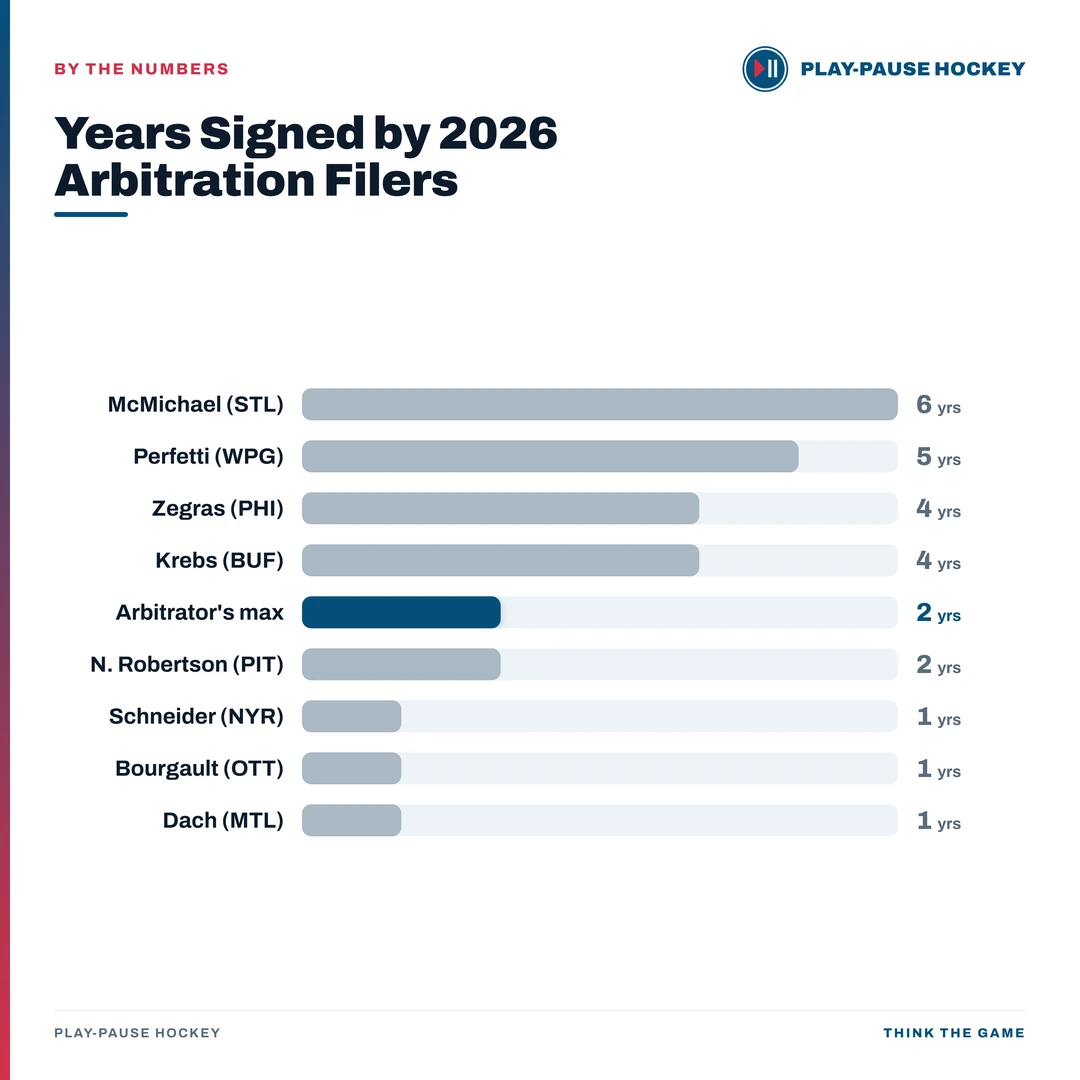
Four of them went straight past the arbitrator’s ceiling. Connor McMichael took six years from St. Louis, Cole Perfetti five from Winnipeg, Trevor Zegras four from Philadelphia at a $9.125 million AAV, Peyton Krebs four from Buffalo. Not one of those deals was a contract an arbitrator had the power to hand out.
The other four landed inside it: Nicholas Robertson at two years in Pittsburgh, Braden Schneider at one in New York, Xavier Bourgault at one in Ottawa, Kirby Dach at one in Montreal. That split is the whole story. For the top tier, the filing was a device to buy a long-term deal that the process itself cannot produce. Nobody in that group wanted a hearing. They wanted a date on the calendar, because a filing manufactures one and nothing else in the RFA summer does.
Elliotte Friedman said the quiet part on deadline day, about the best player on the list.
Jason Robertson put up 96 points last season. In a summer where a rival club just certified $18 million AAV as a real number for a young forward, he was the most obvious offer-sheet target on the board. He filed, and the board closed.
One caveat we will not paper over: the shutoff is not a single tidy clause, and some outlets describe a narrow window that survives until an arbitrator actually rules. Friedman, reporting this exact case, states it flatly. Either way no rival tendered him a sheet, which is the only test that pays.
Nobody Was Ever Going to Offer-Sheet Ronan Seeley
The obvious objection lands hard, so take it seriously: most of these fifteen were never getting an offer sheet in the first place.
That is true, and it kills the tidy version of this argument. Ronan Seeley, Alex Jefferies, Jet Greaves, Akira Schmid, Bourgault. No rival GM was burning first-round picks on that tier. For them the filing cost nothing, because the card they surrendered was worthless. Fifteen players did not disarm. Most of them were unarmed already.
Which is why the number that matters is not fifteen. It is one. The mechanism only bites the player good enough to be worth an offer sheet, and this year, in this market, that was Robertson. A rule that reads as housekeeping for a depth forward reads as the most consequential decision of the summer for a 96-point winger. He made it on July 5, with a deadline in mind rather than a bidding war, and it is fair to ask whether that trade was worth it.
Watch July 25, When Robertson’s Bluff Gets Called
Robertson’s hearing sits on July 25, and the gap behind it is not small. He is reported to be seeking around $14 million AAV, Leon Draisaitl territory. Jim Nill has not wanted to go past the $12 million AAV Dallas gave Mikko Rantanen, and Robertson turned that number down when it was offered. Saying no is not new for him this summer either: the Robertson rejection of a Seattle sign-and-trade in June froze a trade board for weeks.
No arbitrator is closing that. An arbitrator cannot even try: the most he could hand Robertson is two years, with Dallas choosing whether it is one or two, which would drag a 96-point winger toward unrestricted free agency faster than the Stars can afford. Both sides know it. That is why the room stays empty.
Kirby Dach is the honest version of what a filing is for. He turned down a two-way $4 million qualifying offer, filed, and signed a one-year deal in Montreal on July 16, exactly the kind of term an arbitrator could have handed him. He was never chasing years. He was chasing a one-way contract and a date, and the filing got him both.
The 2026 docket will empty out like every docket before it. The lesson is not that arbitration is dying. It is that filing is free right up until the summer somebody else is willing to pay you, and this was that summer.