

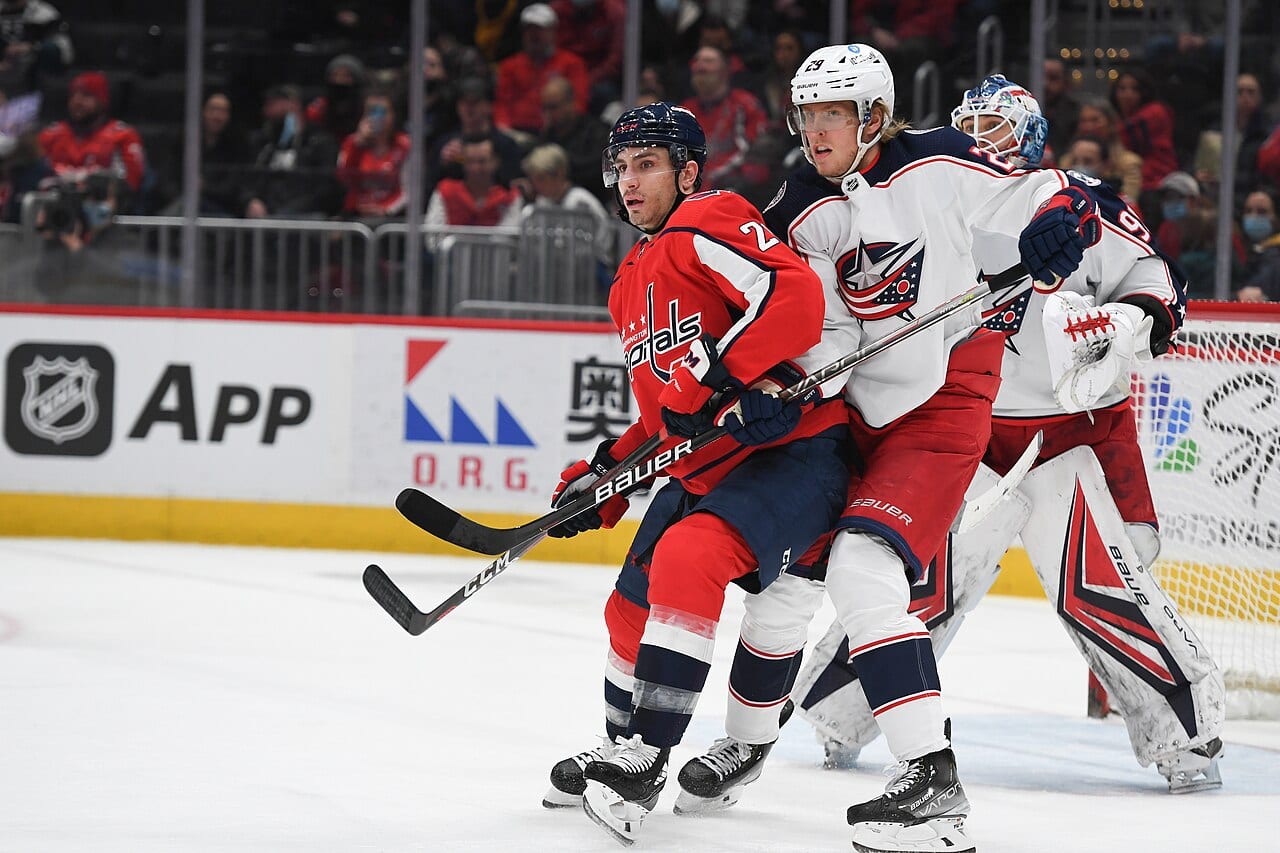
Patrik Laine was the second pick in the 2016 draft and a 44-goal scorer two years later. He has scored 224 goals in 537 NHL games, a 34-goal pace across a full season. And three-plus weeks into free agency he is still unsigned, with the interest that does exist looking nothing like a contract a player of that pedigree expects.
The easy story is bad luck. A lost season, a surgery, a market that will correct the moment someone remembers the goals. That story is comforting and it is wrong. The league has looked at the whole player, not the highlight reel, and set a price. The price is a token base salary with bonuses stapled on top.
From No. 2 Overall to a Token Base Salary
Start with what the market is actually saying, because it is more specific than “no takers.” Sportsnet’s Luke Fox has named the Islanders, Kings, Lightning, Flames and Wild as teams weighing Laine “as a project,” and wrote plainly that “a massive pay cut is coming.”
Per Sportsnet's Luke Fox (July 2026), five teams have looked at Laine as a reclamation project, with "a massive pay cut" the expected outcome.
There is a mechanism underneath that. A veteran with more than 400 NHL games who loses most of a season to injury can sign a one-year deal that layers performance bonuses on top of a very low guaranteed base, the structure normally reserved for players rebuilding value after surgery. At 537 career games and coming off the core-muscle operation that wiped out all but five games of his season, Laine fits it exactly. That is what turns “we want him” into “we will pay him almost nothing to find out.” It is the difference between a raise and an audition.
This Is a Price, Not a July Lull
It would be easy to file this under slow summer. It is not. Lesser scorers have signed. Laine is caught in the July free-agent freeze that has stranded a cluster of veteran names, and the 2026 aging-winger market has been unkind to exactly his profile: high-volume shooters whose two-way game slipped. The reporting has moved from “no rush” to a described price. David Pagnotta, on the Daily Faceoff Rundown, laid out the exact shape of it.
A million-dollar base for a former 44-goal scorer is not a snub from one front office. It is a consensus. That is the tell that this is a verdict and not a wait: independent voices are describing the same number.
One caveat worth stating out loud, because it is the sharpest single detail in the story and the thinnest sourced. The reported line that the Islanders would offer Laine “nothing more than a Professional Tryout” traces to Islanders beat writer Stefen Rosner, reading team intent, not to a wire insider confirming a rejected offer. Treat it as the vivid illustration it is. The load-bearing fact is the industry-wide price that Pagnotta and Fox both describe.
The Six-Year Trend Line Insiders Are Pricing In
Here is what a million-dollar base is really measuring. Laine’s career plus-minus is minus-75 across 537 games. Oilersnation’s tracking, over a narrower window, puts him at minus-79 across his last six seasons, with a top skating speed of 20.17 miles per hour, below the league’s median. Plus-minus is a crude number on its own. Stacked next to the speed data and six years of the same story, it stops being noise.
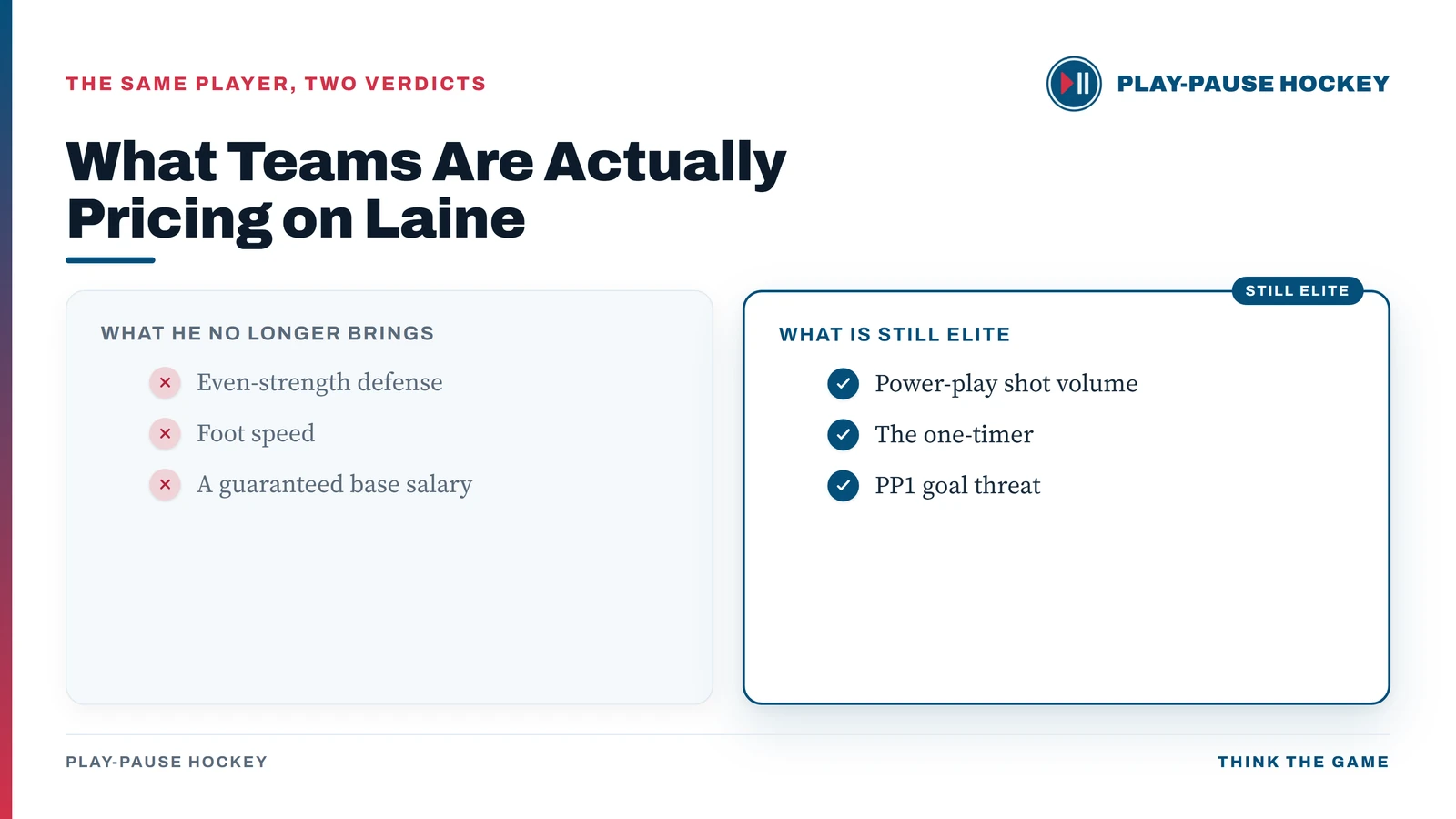
The most revealing evidence is not from a critic. It is from his biggest believer. Daily Faceoff’s Matt Larkin named Laine his top free-agent value pick, and the reason he gave was that Laine leads the NHL in power-play shots per 60 minutes over the last three years, by four more than the next-closest player. Larkin’s own framing: “he’s so good at that one thing,” and he “can’t do anything else well anymore.” The bull case and the bear case are built from the identical scouting report. They just weigh the two halves differently.
But Didn’t He Just Play Five Games?
The strongest objection cuts straight at the thesis. That lost season is the whole reason for the caution, a fan will say. Price in the health risk, get him back to seventy games, and the goals come back. Is this not just injury pricing dressed up as a character verdict?
It is partly injury pricing. But the structure gives it away. A team that believed in a healthy 30-goal two-way winger coming off surgery offers a real guaranteed base and protects the bonuses. What the market is offering Laine is the opposite: almost no guarantee, all incentive. That is not how you pay a hurt asset you value. It is how you pay a bet you are not sure is worth making. And the floor was set before the injury. The minus-79 spans six seasons, most of them healthy, and Larkin’s power-play-only verdict was written about the player at full health. The lost season shrank the sample. It did not create the read.
What a Fair Deal for Laine Actually Looks Like
None of this means Laine is finished, and the value crowd is not wrong. A contender short a right-handed one-timer, a Tampa or a Toronto, could hand him a one-year, incentive-laden deal, quarantine him to the first power-play unit the way Washington deployed a late-career specialist, and harvest 25 goals for depth-forward money. That is a genuine market inefficiency. It is also a role, not a raise, and the gap between those two words is the whole story.
Laine, for his part, sounds unbothered. “I know I’ll be playing in this league for a long time,” he told TSN in June. “That’s not a question.”
He is probably right that he plays. The question the market has already answered is at what price, and in what job. Watch which team blinks first, and watch the base salary when they do. If it starts with a one and leans on bonuses, that is not a bargain waiting to be discovered. That is the league telling you exactly what it thinks Patrik Laine is now.